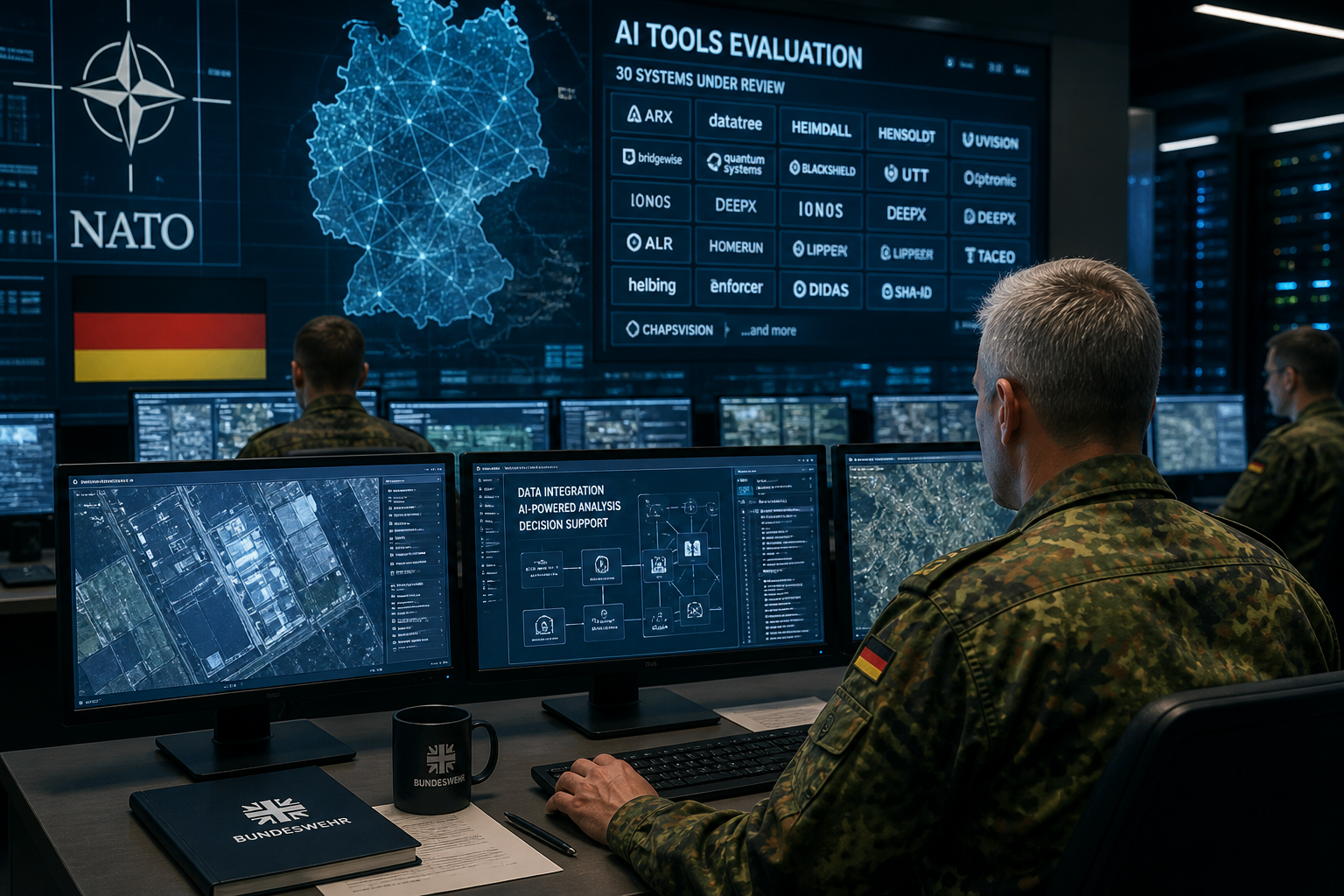
The German military, known as the Bundeswehr, is in the process of evaluating 30 artificial intelligence tools that could potentially enhance its battlefield decision-making capabilities. These tools are designed to process data from drones and satellites, thereby speeding up the decision-making process. A prototype of the selected tool is expected to be ready by the second quarter of 2027, with the aim of full deployment by 2028.
Vice Admiral Thomas Daum, who heads the military's cyber command, has expressed optimism about the outcome of the evaluation. Notably, most of the companies involved in the evaluation are German, with a few foreign candidates, including the French firm ChapsVision, still in the running. The absence of Palantir, an American company whose Maven Smart System is already used by the Pentagon and several NATO members, is particularly noteworthy. Germany had previously ruled out Palantir in April, sparking questions about what alternative the country would pursue.
The evaluation and subsequent development of a domestic AI tool reflect Germany's desire to reduce its dependence on foreign suppliers, particularly in the realm of military software. This approach, however, comes with its own set of challenges, including the time required to build, test, and integrate sovereign military software. The experience of Ukraine, where the volume of imagery from drones and satellites has exceeded the capacity of manual analysis, underscores the importance of leveraging the best available tools to process such data.
Germany's decision to evaluate a wide range of mostly German systems suggests a strategy of fostering a domestic market rather than relying on a single European champion. This approach allows for greater control over the technology but also complicates the integration process, as different systems will need to work seamlessly together. The involvement of Vice Admiral Daum's cyber command in the evaluation process indicates that Germany is treating AI as an integral part of its broader data and network infrastructure, rather than solely as a targeting system.
The success of this endeavor will hinge on the ability to narrow down the field of candidates efficiently and ensure that the selected systems can operate effectively both with each other and with NATO infrastructure. Failure to achieve this integration could lead to a situation where, despite having capable tools, Germany lacks a cohesive decision-support system by 2028, potentially reopening the case for adopting an existing system like Palantir's.
Este artículo fue escrito con la asistencia de IA.
News Factory APP - noticias agénticas para impulsar tu SEO y AEO.