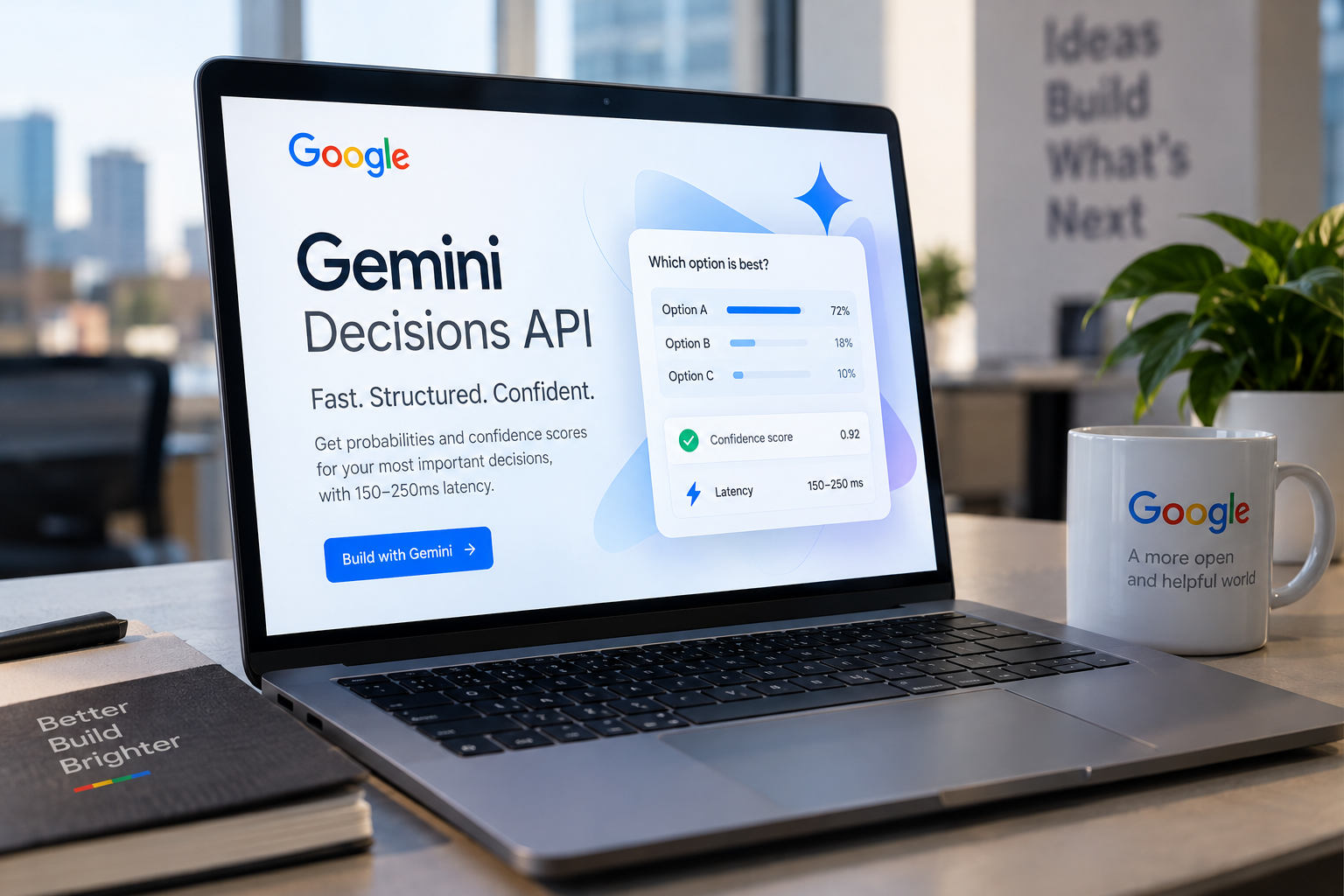
Google has launched the Gemini Decisions API, which lets developers get fast, structured answers to bounded questions using a new model, Gemini Decision 1. The model scores each option in a single pass, returning probabilities and confidence scores with 150 to 250 millisecond latency. It is available now through the Gemini API in Google AI Studio.
Google has launched the Gemini Decisions API, a new endpoint built for quick, closed-set choices. The service runs on a new model, Gemini Decision 1, and is available now through the Gemini API in Google AI Studio.
How does the Gemini Decisions API work?
The model does not write out an answer word by word. Instead, it scores each candidate option in a single forward pass and returns probabilities and confidence scores. Google says end-to-end latency runs 150 to 250 milliseconds. Input costs $0.10 per million tokens, and developers pay nothing for output.
The API is designed for the kind of bounded decisions software makes constantly. A developer can pass one multimodal input that includes text, images, audio, video and PDFs, along with up to 1,000 separate questions. The shared input can run up to 256,000 tokens.
What question types does the Gemini Decisions API support?
Three question types are available. A yes/no check estimates the probability that a condition holds. A multiple-choice question selects from 2 to 255 options and returns normalized probabilities for each one. An ordered rubric grades an input on a scale that starts at 0, returning a weighted score and probabilities for each level. Every answer carries a confidence score from 0 to 1, so code can send unclear cases to a fallback system or a human reviewer.
Developers can mix these question types against the same input in one request. Google gives an example of checking a photo of a breakroom counter, along with a short text note, to see whether it has a spill, which cleanup step fits and how severe the mess is. The company also says developers can combine modalities in a single input, such as pairing a call recording with account metadata or a scanned claim PDF with damage photos. Resolution on image and video inputs can be adjusted to control visual detail and token cost.
Google says Gemini Decision 1 leads its benchmark suite, which covers agent routing, reasoning, ranking and multimodal understanding, and that it has the lowest calibration error in that group. Median model compute is 50 to 100 milliseconds, and latency stays nearly flat whether a request contains one question or 100. Google says the Decisions API with Gemini Decision 1 is nearly five times cheaper across the shared benchmark suite than Gemini 3.5 Flash-Lite used through the Interactions API.
Where teams are already using it
Gemini Notebook uses the API as a real-time router. It classifies intent in milliseconds, sending everyday queries to the right model tier and thinking level. Google says this cuts latency by up to 40 percent for everyday queries, while deep reasoning models are reserved for complex tasks.
The rapid canvas experiment in Stitch uses the API to generate playable wireframes of a product flow in seconds and to apply edits made by voice or tap almost instantly. When a design feels right, one click moves the screens into the full Stitch experience for more polish.
CC from Google Labs uses the API to pick an emoji reaction from a palette of more than 200 options in a fraction of a second. Google Search uses the Decision API to detect adversarial behavior and content, which Google says it does with high efficacy and within the required latency.
Pricing and rollout
How much does the Gemini Decisions API cost?
Shared input is billed once per request, no matter how many questions are asked. Each question adds only the tokens for its own instructions and criteria. Google says there are no charges for output tokens, variable thinking tokens or separate audio transcription and OCR. A no-cost tier in Google AI Studio lets developers prototype.
To get started, developers can grab an API key in Google AI Studio, try the Doorstep Parcels, Speed Sketch and Find the Zoo Keeper demo apps, and follow the Python, JavaScript and REST guides in the documentation. Integrations are rolling out with OpenRouter, LangChain, Vercel, LiteLLM, Pydantic AI, Pipecat, LiveKit and OpenCode, alongside the google-genai SDKs. Support for Gemini in Google Cloud is coming soon.
Este artículo fue escrito con la asistencia de IA.
News Factory APP - noticias agénticas para impulsar tu SEO y AEO.