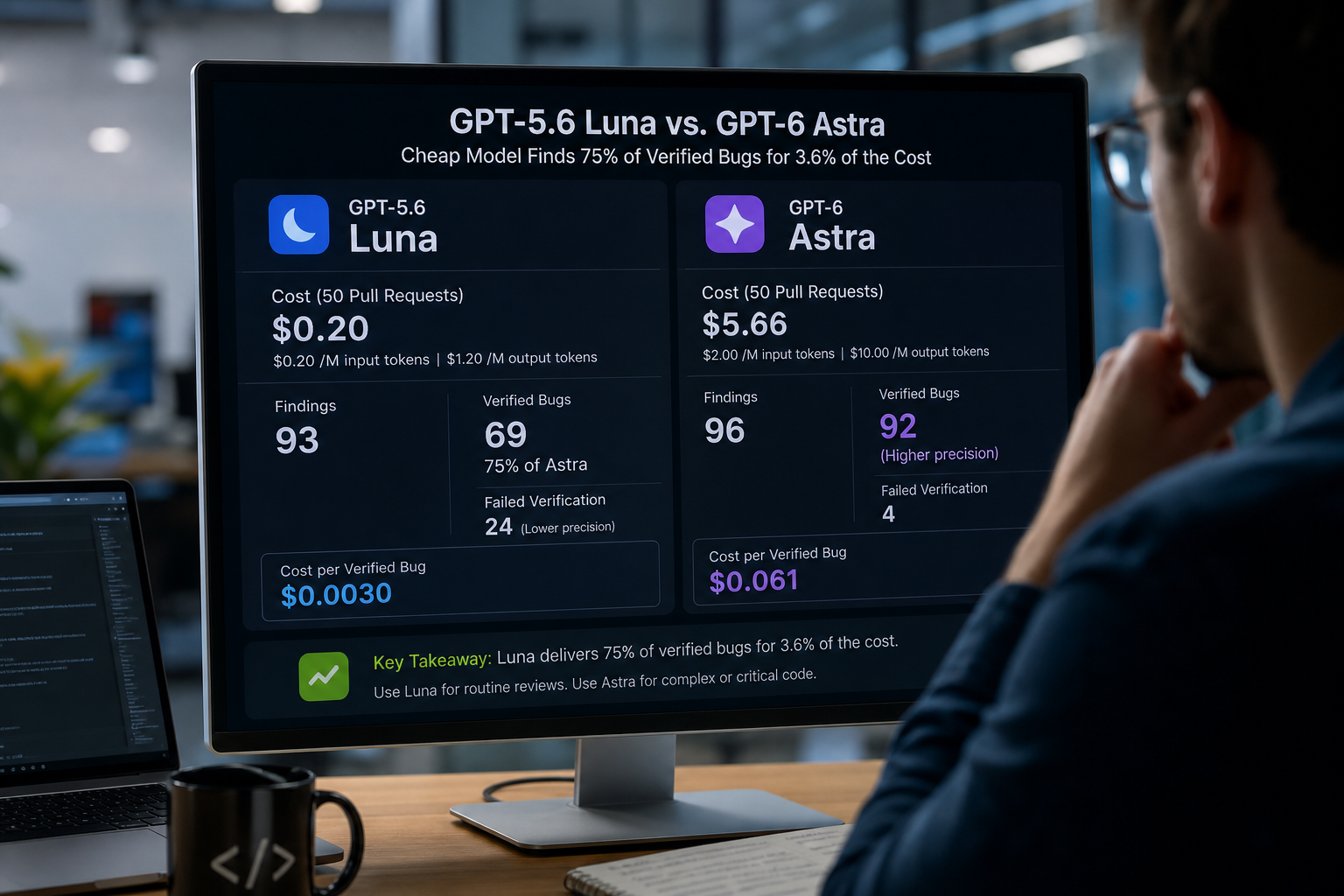
A recent comparison between GPT-5.6 Luna and GPT-6 Astra has sparked interest in the coding community, as the cheaper Luna model was able to find 75% of the verified bugs found by Astra, but at a fraction of the cost. The test, which involved reviewing 50 public pull requests, found that Luna's precision was lower than Astra's, with 24 of its 93 findings failing verification, compared to Astra's 4 out of 96.
Despite the differences in performance, the cost savings of using Luna were significant. With a cost of $0.20 per million input tokens and $1.20 per million output tokens, Luna's total cost for the 50 pull requests was just $0.20, compared to Astra's $5.66. This works out to a cost per verified bug of $0.0030 for Luna, versus $0.061 for Astra.
The test also highlighted the importance of understanding the strengths and weaknesses of different models. While Luna was able to find a significant number of verified bugs, it fell short in certain areas, such as authentication and permission code. In these cases, Astra's higher precision and ability to find more bugs made it a better choice.
The results of the test have implications for teams looking to implement AI-powered code review tools. By understanding the trade-offs between different models, teams can make informed decisions about which tools to use and how to allocate their resources. For example, a team might choose to use a cheaper model like Luna for routine code reviews, while reserving a more powerful model like Astra for more complex or critical code.
In addition to the comparison between Luna and Astra, the test also highlighted the importance of considering the context in which code is being reviewed. A diff alone does not provide enough information for a model to determine the potential impact of a change, and teams should consider using tools that provide more comprehensive context, such as repository history and production data.
Overall, the test demonstrates the potential for cheaper models like Luna to provide significant value in code review, while also highlighting the importance of understanding the strengths and weaknesses of different models. By carefully evaluating the trade-offs between different tools and considering the context in which code is being reviewed, teams can make informed decisions about how to implement AI-powered code review tools.
Este artículo fue escrito con la asistencia de IA.
News Factory APP - noticias agénticas para impulsar tu SEO y AEO.