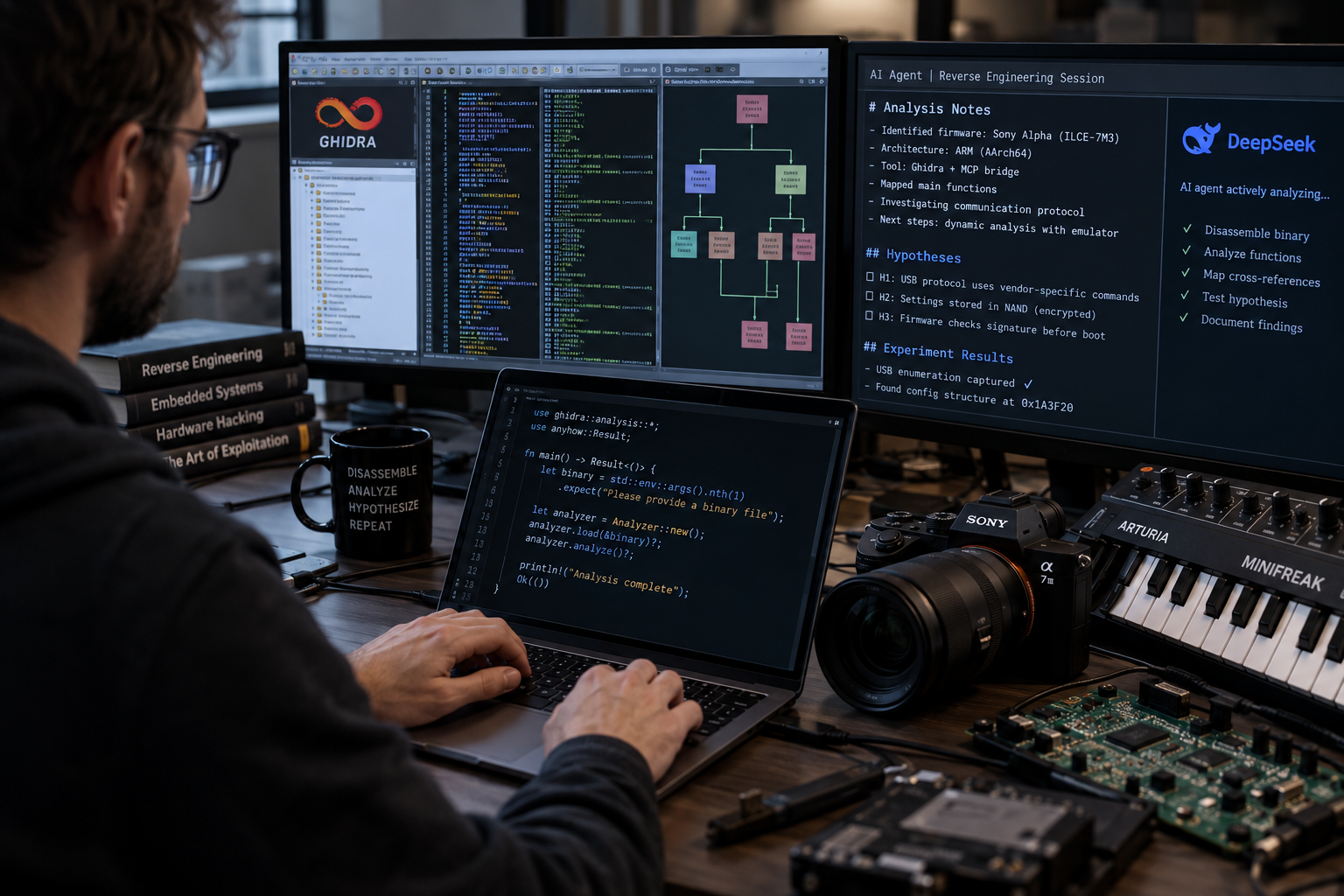
A longtime hacker says AI agents have cut his hardware and software reverse engineering from years to months. He points AI agents at compiled programs, has them log findings in Markdown, and uses Ghidra, custom skills, and a hypothesis-testing loop to guide the analysis.
A longtime hacker says AI agents have transformed how he takes apart hardware and software, cutting projects that once would have taken years by hand down to a fraction of that time. In a detailed account of his method, he says that over the past six months he has reverse engineered devices, mapped proprietary communication protocols and built custom firmware, largely by pointing AI agents at compiled programs and guiding the results.
Which tools does the hacker use for reverse engineering?
He has been hacking both hardware and software for about two decades, he writes, and he previously did all of the analysis manually. Now his setup relies on a DeepSeek harness running the DeepSeek v4.1 Flash model, which he calls fast, cheap and very capable. He occasionally uses Codex as well. For disassembly and decompilation he relies on Ghidra, which he describes as the best free tool on the market, paired with an MCP bridge that lets agents operate it directly. He also uses radare2 and kuna, command-line tools that are not as strong as Ghidra but are much faster and easier for AI agents to use.
How a typical analysis runs
How do AI agents help with reverse engineering?
His process starts with the binary itself. He has the agent identify the file type, platform and build, then chooses a decompiler to match. He notes that current AI models handle plain disassembly fairly well, meaning raw x86 or ARM instructions, so they do not always need a decompiled version to make progress.
From the start, he has the agent record every finding in Markdown files. He says the notes serve several purposes. They help him understand the work, they help the agent keep track after its context is compacted or the job is handed to a different agent, and they keep the agent from wandering in circles. Once the agent has mapped the basic structure, including main functions, branching logic and imported functions, he can move on to modifying the original program, building mods or simply learning how it works.
What happens when an AI agent gets stuck?
Some problems resist static analysis. In those cases he uses a range of methods. He has the agent debug the program and set breakpoints on key sections. He enables logging in the original software, or writes a probe that injects into the program and records what it needs to know. He sometimes gives the agent outside access, such as computer use for desktop applications or an API-controlled emulator for firmware. He also redirects the agent when it gets stuck. If it is lost following cross-references, he tells it to search for strings in the binary instead. He reads the full conversation and reasoning traces, he says, because he can often spot when an agent is heading down a dead end and suggest a better route.
Skills, languages and a hypothesis loop
Much of the workflow depends on custom agent skills. He recommends a skill from Matt Pocock that asks the user one question at a time when the agent needs input. He also uses a Ghidra skill that describes how to operate the reverse engineering tools, which he says keeps agents from giving up too early. A third skill, which he wrote himself and has published publicly, forces an agent that is stuck to follow a loop: state a hypothesis, record it in a CSV file, design an experiment that can prove or disprove it, record the result and repeat. He calls this the most important tool in his kit because it stops the agent from guessing randomly.
For writing the actual tools, he uses Python with the UV package manager for quick probes and decompilation helpers, and Rust for final implementations whenever possible. He says Rust's strict compiler gives an agent fast, precise feedback on memory and syntax errors, which helps it iterate. He has used Rust to build web tools, desktop apps, game trainers and firmware for embedded devices.
His list of results is long. He says he reverse engineered the AlphaSmart NEO typewriting device and mapped the communication protocols of the EmWave biofeedback device and his two Sony Alpha mirrorless cameras. That work, he says, let him build custom desktop and mobile apps for file transfer and wireless control, and it also enabled a wireless webcam made from his A7III camera. He has developed custom firmware for the Arturia MiniFreak, Teenage Engineering OP-Z and Akai MPC Sample synthesizers and music instruments, and for the Xteink X4 ebook reader. He also fixed a driver for an old HP printer on macOS, cracked license-locked software from his youth and built a lightweight Evernote client. In one case he deciphered the proprietary save format of a paid photo app and built his own editor for those files, which he says he finished about a year before the ArtCraft suite appeared.
He acknowledges that the line between reverse engineering and software development can blur. Sometimes the hardest part is decoding a file format, and the rest is ordinary development. Asked to summarize his view, he says the hobby has always been driven by curiosity, and that AI tools have not diminished that. He says they have given him a faster way to get results, and he encourages others to try their own hacking projects.
Este artículo fue escrito con la asistencia de IA.
News Factory APP - noticias agénticas para impulsar tu SEO y AEO.