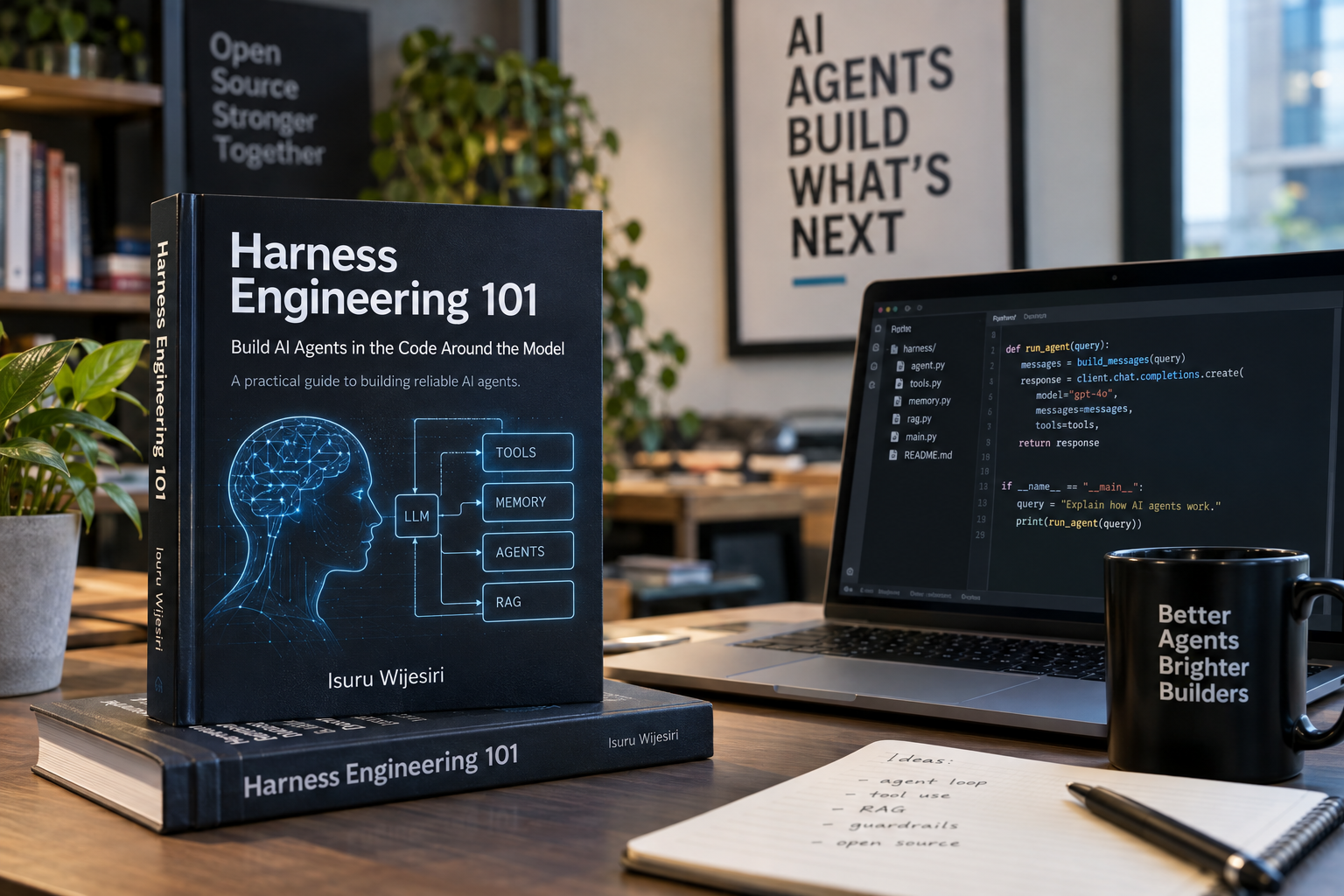
An open-source book argues that the most important part of an AI agent is not the model. It is the program wrapped around it. Harness Engineering 101 reached Version 1.0 in September 2026, and it builds its case across 16 chapters, growing a toy agent of about 300 lines of plain Python as it goes.
What Is Harness Engineering?
The author, Isuru Wijesiri, starts with a basic fact about how these systems work. An LLM API is stateless. Each turn, the caller sends the entire conversation as a JSON array and receives text back. The harness is the program that builds, maintains and protects that array. According to the series, everything the industry calls agents amounts to a set of patches on that one loop, and each patch exists because something specific broke.
The series uses a simple metaphor, and it is in the title. The LLM is the brain. The harness is the body. Wijesiri says the same ideas power One Code, an open-source coding agent built on pi.
How the chapters are organized
How Are the Chapters of Harness Engineering 101 Organized?
The chapters fall into four parts. Part I, called The Wire, covers the basics: the JSON array, the next-token black box, tools that map JSON to functions, the agent loop and caching. Part II, Running Long, deals with the array under pressure. It covers context as a budget rather than a bag, subagents, steering a loop that drifts mid-task, and background work.
Part III, The Ecosystem, takes on the crowded field of frameworks. It argues that every framework is a wrapper around the first chapter's ideas, then looks at extending the body through MCP, skills, deferred loading and hooks. It closes with debugging, including the idea that you cannot fix a prompt you cannot see. Part IV, Trust, Domains, and Data, covers reflexes and guardrails, a case study on coding agents, and retrieval-augmented generation, which the author describes as a harness pattern that existed all along.
Each chapter follows the same pattern: a named failure, a minimal patch that fixes it, and a description of what the patch costs. The chapter titles make the failures concrete. One starts with a developer asking, How do I even talk to this thing? Another begins when the window fills up. A later one opens with the problem that the loop will do something dumb.
Four standalone appendices cover advanced topics, including model routing and cost engineering, worktrees for parallel agents, plan mode for coding agents, and the plumbing of retries, rate limits and streaming. An epilogue presents a complete, annotated version of the toy harness.
Running the material and reuse terms
The book is meant to be read online, where its diagrams render properly. The GitHub repository contains the chapter source files, the table of contents, the runnable toy harness split into one file per stage, and the diagram generators. Readers who want to build the book locally can install mdBook and mdbook-mermaid. Without mdbook-mermaid, the inline mermaid diagrams display as raw code. The quantitative diagrams are regenerated with a Python script that requires Python 3.10 or later and matplotlib.
What License Applies to Harness Engineering 101?
The licensing is split. The prose, covering every chapter and appendix, is licensed under Creative Commons Attribution-NonCommercial-NoDerivatives 4.0. Readers may share it with credit. They may not use it commercially or publish modified versions. The code, including the harness files, diagram scripts and snippets reproduced in the chapters, is licensed under the MIT License. It can be used freely with attribution.
Este artículo fue escrito con la asistencia de IA.
News Factory APP - noticias agénticas para impulsar tu SEO y AEO.