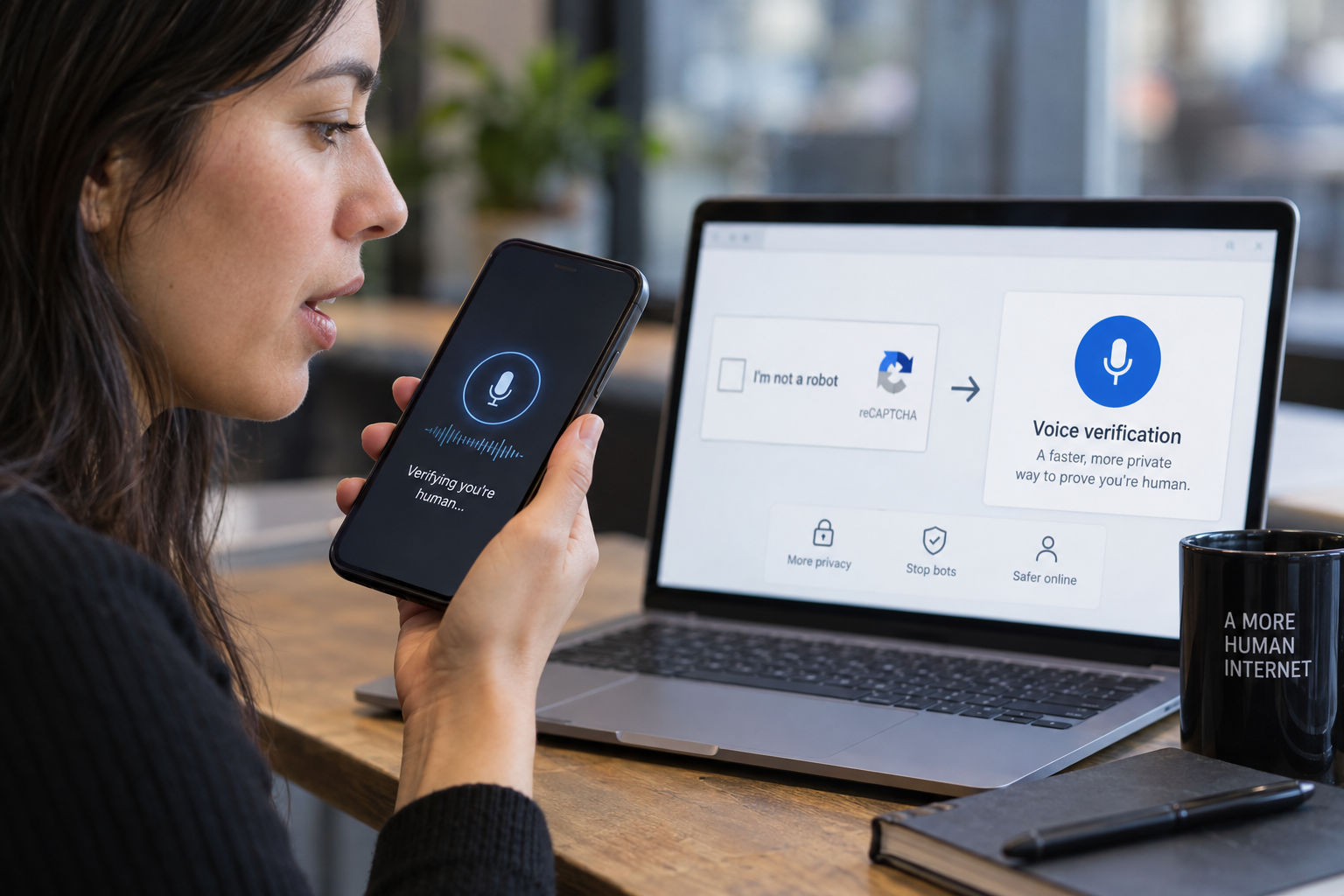
For years, websites have relied on CAPTCHA to prove that a visitor is human. Social media platforms have moved on to photos and videos. Now a startup called Helix wants voice to do the job, and it says users would not have to hand over sensitive personal information to pass the check.
How does Helix use voice to prove someone is human?
Helix’s voice technology can run directly on a user’s device. Siri co-founder Dag Kittlaus has backed the company and will also serve as an adviser. The startup raised $6.2 million in a round led by Chicago Ventures, with participation from BAM Ventures, Aglaé Ventures, Corazon Capital, Press On Ventures, Tusk Ventures, Yonder Ventures, Rule 30 and Brown Angel Group.
Helix was founded in 2025 by Alex Oberg, Anna Dorofiyenko and Mike Hall. Oberg previously worked at Ticketmaster, which acquired his earlier startup. There, he helped create Verified Fan, a product designed to keep bots off the platform. Dorofiyenko led data science teams at Live Nation and Zillow. Hall has worked at Nike and Tinder, where he helped develop the initial matching algorithm.
Oberg said the spread of AI changed how he thinks about identity. Bots were already a problem, and he saw that the problem would only get harder.
“As AI started to come up in the last two years, I was realizing that it’s going to make it increasingly difficult to determine who’s human and who’s not on the internet,” Oberg said. “Identity on the internet’s always been about proxies for identity, right? It’s your email, it’s your phone, it’s your IP address, it’s your device fingerprint, it’s your device ID.”
He argued that the industry needs to move past those proxies. With the rise of AI agents such as Instinct and Muse, he said, companies should rely on biometric signals like voice. That is where Helix fits in.
The core technology determines whether someone is human and estimates their age. Helix is also running pilots to test whether voice can serve as a biomarker for conditions such as drunkenness or distress.
Where is Helix's voice technology being used?
The company says it can deploy its technology to replace or supplement CAPTCHA and to help block bot attacks. Helix said its model runs locally, even on an iPhone 13, so the cost of deploying it is minimal. One customer is Zeel, an in-home healthcare provider that uses Helix’s technology to verify the identities of providers visiting customers’ homes.
Oberg said verifying workers, such as cabdrivers, is another use case the company is exploring. He also pointed to age-verification rules for social media platforms around the world, which he said force users to trade privacy for access. Helix’s voice technology, he argued, could offer an alternative.
“There’s like an avalanche of regulation coming down because essentially society has decided children should not be able to use the internet as adults,” he said. “That has created a bit of a strawman argument that everyone needs to trade their privacy for the sake of security and child safety. We are that company that’s saying, nope, don’t agree. It’s a four-second voice challenge.”
What are the limits of Helix's voice technology?
Oberg also laid out the limits of the technology. Helix cannot reliably detect whether someone is lying. The voice technology does not identify individual speakers, though it can verify that they are unique humans. Oberg said that even if the company stores a voiceprint, it cannot be used to reconstruct a person’s voice.
AI-powered fraud is also a growing problem on phone calls. Helix does not believe its technology can yet reliably detect AI agents during live calls.
Kittlaus said voice identification has finally reached the point where it works reliably, which he believes positions Helix to scale as AI-powered fraud increases. He also said the company’s work to compress its models gives it a cost advantage.
“What folks at Helix are doing is, instead of teaching computers how to understand speech, these guys are understanding what the speech of the speaker actually means, what’s going on with them, if they are lying, are they impaired?” Kittlaus told TechCrunch. “That side of it is fascinating to me within the larger picture that I just described.”
Este artículo fue escrito con la asistencia de IA.
News Factory APP - noticias agénticas para impulsar tu SEO y AEO.