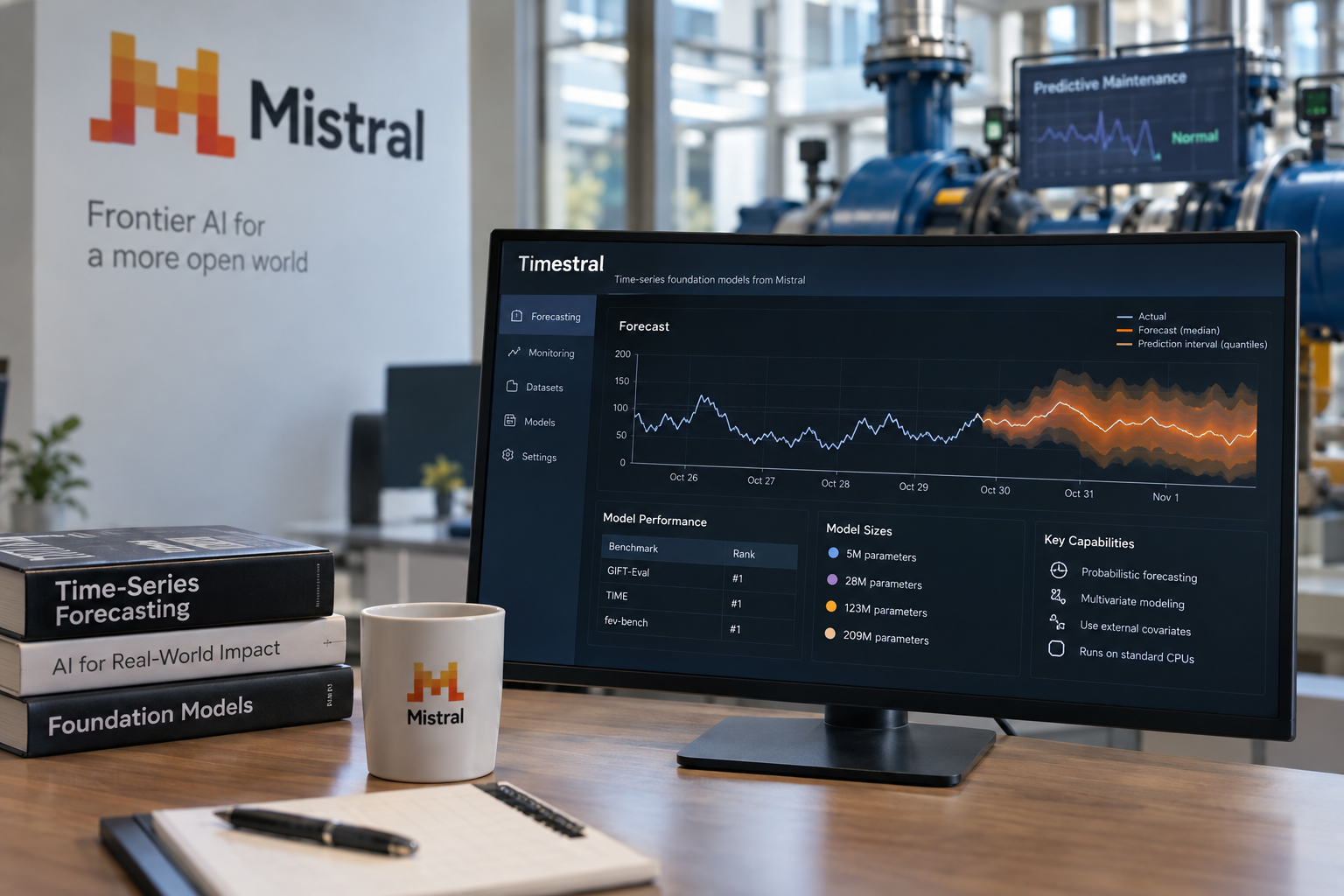
Mistral has released Timestral, its first family of time-series foundation models, and the company says its largest version outperforms the current leaders on the field's main public forecasting benchmarks while using fewer parameters. The 209-million-parameter model ranks first on GIFT-Eval, TIME and fev-bench, the three benchmarks most widely used to test forecasting systems. Mistral says it beat the previous state of the art with only two-thirds of that model's parameters.
The family includes four models with 5 million, 28 million, 123 million and 209 million parameters. Mistral says all four share the same architecture and training recipe, and each one sits at the top of the accuracy-versus-size curve, meaning no public model forecasts more accurately at that size. The larger models produce better forecasts, while the smaller ones run faster and cost less to operate.
Can Timestral forecast without specialized chips?
Timestral is built to run without specialized chips. Mistral says a standard server CPU with eight threads can forecast one day ahead from three weeks of 15-minute history in 10 milliseconds with the 5-million-parameter model. The 209-million-parameter model takes 140 milliseconds on the same setup. The company also says its 28-million-parameter model beats Chronos-2, a model about four times larger, on GIFT-Eval and TIME. The 209-million-parameter model outperforms TimesFM-3 and Falcon-2.0, Mistral said, despite having fewer parameters.
How does Timestral handle forecast uncertainty?
The models produce probabilistic forecasts rather than single predicted values. Timestral generates a set of 21 quantiles, which lets engineers see how much uncertainty surrounds a prediction and set alert thresholds accordingly. It also forecasts multiple related series together, so it can account for relationships between them, and it accepts covariates, or outside variables that influence the data. Those can be past-only inputs or known-future inputs such as a production schedule or a weather forecast.
Mistral pitches the technology most directly at industrial and financial users. In its example, a plant with thousands of sensors could use Timestral to model how a pump's vibration, temperature and pressure move together, rather than forecasting each sensor on its own. The company also describes pairing the model with its language models in agentic workflows. In that setup, Timestral would run continuously on sensor streams, flag an anomaly on a pump, and then hand the case to an agent that compares it against past failures, pulls maintenance records and operator notes, and drafts a suggested diagnosis for the plant manager.
Mistral trained the models mostly on synthetic data. The team first generated univariate processes with trends, seasonality and varied noise, then used a multivariate synthesizer to introduce nonlinear dependencies between them. The models were pre-trained on purely synthetic data before a second stage that mixed real and synthetic data with a longer context window. The company lists a context length of 32,768 time steps.
How can businesses customize Timestral?
For businesses that need more than the base model, Timestral is available through Mistral Forge, the same training pipeline Mistral uses for its language models. Customers can fine-tune the models on proprietary data, adjust the training mix and generate synthetic samples that match their own domain. Mistral says the full pipeline can be deployed on-premises, in a virtual private cloud or in air-gapped environments. The models are released under a modified MIT license.
Mistral has published a GitHub repository so developers can run Timestral on their own data. The company says a technical report with full results will follow, and it invites organizations with more specialized forecasting problems, or research collaborators, to get in touch.
Este artículo fue escrito con la asistencia de IA.
News Factory APP - noticias agénticas para impulsar tu SEO y AEO.