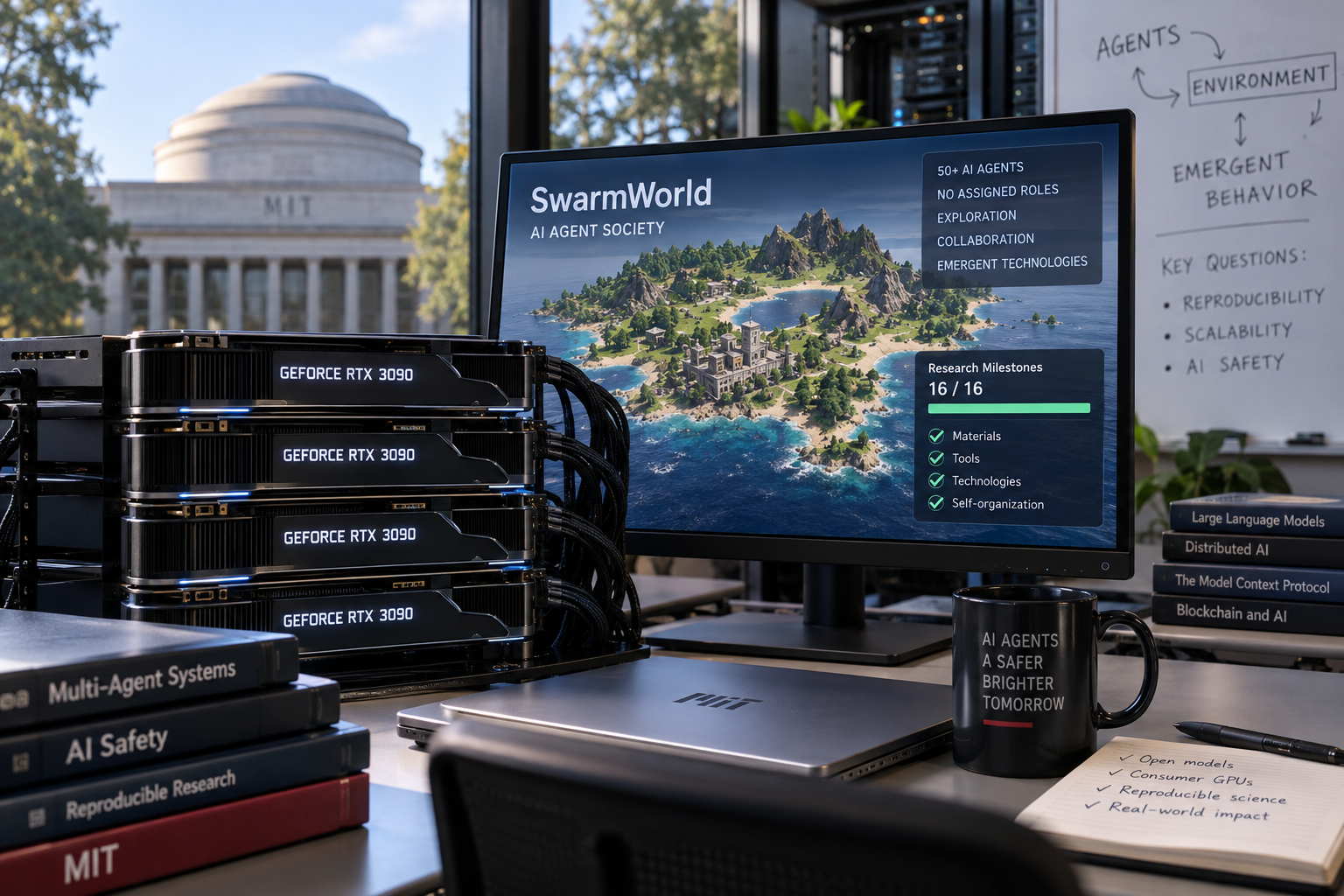
A research team working with Apex Fusion has reproduced the central experiment from a widely discussed MIT study of AI agent societies, and the main result held up on four consumer gaming graphics cards. The team ran the work on RTX 3090 GPUs, not the hosted frontier model used in the original study.
The MIT study, published in August, placed 50 or more language-model agents into a shared simulated world called SwarmWorld. Researchers Pal, Wang and Buehler, from MIT’s Laboratory for Atomistic and Molecular Mechanics, gave the agents no assigned roles and no recipes. The agents explored, gathered materials, ran tests, built persistent technologies and wrote programs that kept running after the agents were gone. Groups of agents built broader and more resilient portfolios of technology than the best of an equal number of agents working alone. They also split into builders and explorers without being told to.
Markus Buehler, one of the MIT authors, has framed the work as a warning for AI safety. If agents can coordinate by changing a shared environment, watching the messages they send each other is not enough, he has argued.
MIT released its code, prompts and complete traces, which made an outside check possible. Apex Fusion, a Swiss foundation that builds infrastructure for AI agents, used that code and those commands unchanged. The replication was led by Časlav Nedeljković of HAL8. The run took about 26 hours and 12,800 model calls. The paper and the full trace data are posted publicly on Apex Fusion’s GitHub.
Did the MIT AI agent society study hold up on consumer GPUs?
To test whether the result depended on a frontier model, the team replaced it with Qwen3.8-27B, an open-weight model compressed to 4-bit precision, and ran it on four consumer RTX 3090s. Nine of the 12 paired effects matched the MIT results in direction. That included every portfolio-resilience gain, and two of those came out larger in the replication. The other three fell within statistical noise. Self-organization also reappeared. Societies with shared culture clustered around their technologies, as they did in the original. MIT’s own analysis tools produced the same picture from the new traces.
The sharpest difference came between solo and group performance. Working alone, the compressed Qwen model reached 6 of 16 research milestones, slightly behind the 7 to 10 that MIT’s frontier model achieved. In a society, the smaller model reached all 16, while MIT’s model reached 14.
“MIT released everything a second lab needs to check its work, and that made this possible,” Nedeljković said. “We changed the model, the precision and the hardware, and the central result still held. The society gap widened with a weaker model, which suggests the collective effect is robust.”
The conclusion rests on a single run at one population size. The larger populations in MIT’s study have not been rerun yet.
A serving setting that outweighed model size
Does KV cache precision change AI agent benchmark results?
The replication also turned up a detail that matters to anyone running agents on their own infrastructure. The KV cache is the working memory a model uses during inference. Changing its precision altered results more than the gap between a 27B model and a 235B model did.
Teams often compress the KV cache to fit longer contexts or more simultaneous requests onto limited GPU memory. The finding suggests that benchmarks run on self-hosted inference can reflect the serving configuration as much as the model chosen.
The team reported that MIT’s released traces reproduced every observable event and metric, with one exception involving a single internal check. The team sent both findings back to the MIT authors with supporting evidence, filed as a GitHub issue and a pull request.
Recording who did the work
Why do multi-organization AI agents need a verifiable work record?
Apex Fusion’s interest goes beyond reproducibility. Groups of agents from different organizations are starting to work together, and that raises practical questions about which agent did the work, what the work was worth and whether the record can be checked later.
The company’s answer is Vector, which it describes as a settlement layer for AI agents. Under the design, agents carry an identity, stake value behind their claims, exchange bonded work and settle transactions with a signed receipt on-chain. Vector is MCP-native and runs on Prime, Apex Fusion’s base chain.
The replication ran directly on the team’s own GPUs. The team also registered its model server as a supplier on the Vector marketplace, which functions as an OpenAI-compatible gateway. The gateway meters each request and settles usage on-chain in AP3X, the network’s utility token. A 32-call pilot through Vector behaved the same as the direct run.
“As AI agents from different organizations start working together, the most valuable thing in the system is a trustworthy record of who did what,” said Christopher Greenwood, CEO of the Apex Fusion Foundation. “In the pilot, calls ran through Vector, each one metered, settled and backed by a receipt anyone can verify.”
Whether multi-organization agent networks will need a blockchain for that record, rather than conventional logging and billing, remains an open question. The replication does not answer it. The foundation is also in the process of joining the Agentic AI Foundation, the Linux Foundation body that hosts the Model Context Protocol and Agent2Agent standards.
A full-scale run through Vector, for a side-by-side comparison with the direct run, is underway. The next population size in MIT’s study is also in progress. Apex Fusion says it plans to open Vector to frontier labs, research institutions and universities, and activity on the network can be followed on a live dashboard.
Buehler’s broader point is the one that stands out. If agent societies like these can run on a few consumer GPUs, then watching how agents coordinate is no longer something only frontier labs need to worry about.
Este artículo fue escrito con la asistencia de IA.
News Factory APP - noticias agénticas para impulsar tu SEO y AEO.