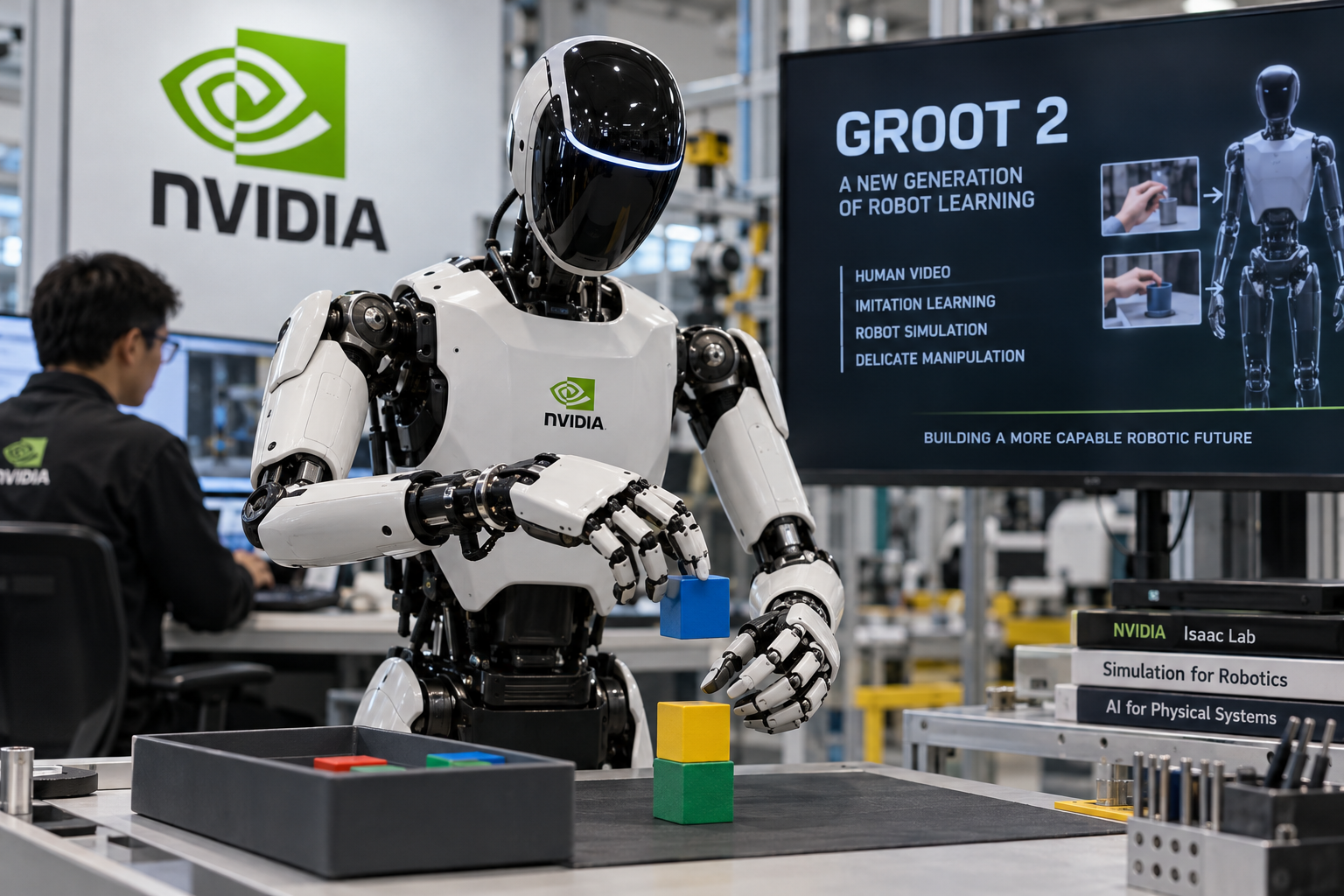
Nvidia has unveiled GR00T 2, an open AI model designed to teach robots delicate hand skills, partly by having them watch videos of people. The company calls it a world action model that predicts how its actions will change what a robot sees. Foxconn, Siemens and Nexuni are testing it so far.
Nvidia on Monday unveiled GR00T 2, an open AI model designed to teach robots delicate hand skills, partly by having them watch videos of people. The company announced the model at the Conference on Robot Learning in Austin, Texas.
What is Nvidia GR00T 2?
Nvidia calls GR00T 2 an open “world action model,” meaning it predicts how its actions will change what the robot sees before it moves. The model was trained on robot data and human video, including 100,000 hours of first-person footage that Nvidia is releasing for anyone to use. That, the company says, lets robots pick up skills from people and pass them between machines with different bodies. Some startups are already working on the data side. Maxinsights, for one, pays people to film their chores for the same purpose.
How well does GR00T 2 perform on new tasks?
In Nvidia’s own tests, GR00T 2 completed 40 of 50 tasks at least once with no training for those specific tasks. When shown a task once, it succeeded 71% of the time on average. That figure rose to 95% when the model was shown the task five times. Nvidia’s own paper, however, notes that the tasks were picked from ones the model could already learn well.
Which companies are testing GR00T 2?
Three companies are testing the model so far. Foxconn, which now earns most of its revenue from AI servers, is using GR00T 2 to help build those servers. Siemens is testing it for factory work, and Nexuni is trying it for laundry. None has said it will put the model into production yet.
Nvidia also released Isaac Lab 3.0, its open-source tool for training robots in simulation. The company says the tool trains up to 2.5 times faster on one test. Among its partners is Walden Robotics, which launched with $300 million in July.
Ken Goldberg, a robotics professor at UC Berkeley who worked with Nvidia on two of the projects, was enthusiastic about the direction. “To me, agentic robotics is the most exciting technological development since the internet in 1995,” he said.
Earlier GR00T models already underpin robots in development. LG’s humanoid is due in 2027, and Siemens has tested an Nvidia-powered humanoid on an eight-hour factory shift.
Este artículo fue escrito con la asistencia de IA.
News Factory APP - noticias agénticas para impulsar tu SEO y AEO.