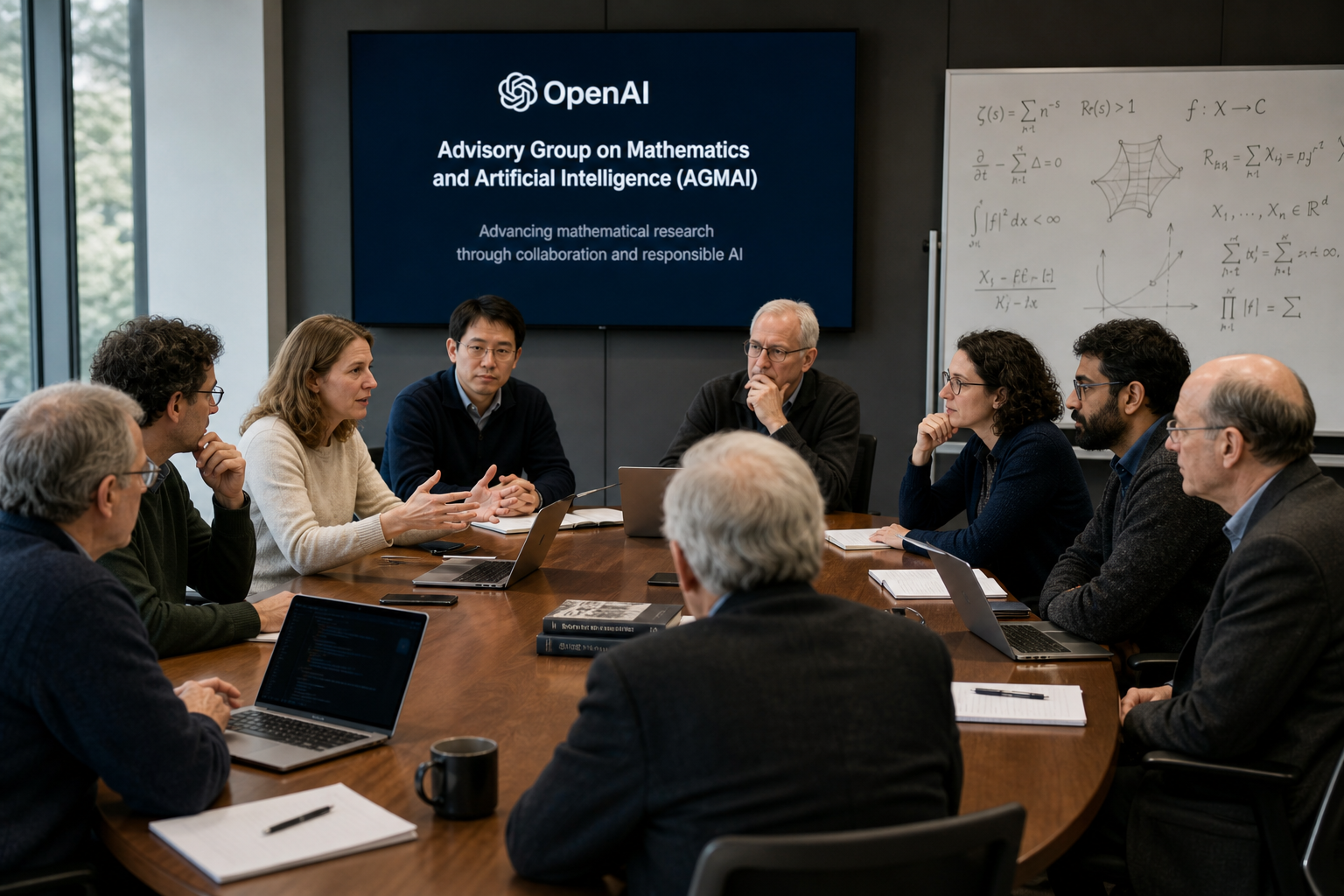
OpenAI, the company behind several AI models, has formed an advisory group of mathematicians to help navigate its interactions with the mathematical research community. The move comes after the company faced criticism for its handling of high-profile mathematical results, including accusations of scooping researchers and failing to credit the human work its models built upon.
The nine-member group, called the Advisory Group on Mathematics and Artificial Intelligence (AGMAI), is composed of prominent mathematicians from institutions such as Stanford, Harvard, Oxford, and Cambridge. The group will operate independently, with the freedom to offer advice that OpenAI has not requested, publicly comment on its impact on mathematics, and make its advice public.
According to OpenAI, the group will advise on the review and communication of emerging results, help assess their significance, and advise on academic and professional standards of mathematical research. The group will also provide guidance on how OpenAI's tools can support mathematical research and learning.
While the formation of the group has been welcomed by some mathematicians as a positive step, others have questioned its composition and potential influence. Some have expressed concerns that the group's small size and elite membership may not accurately represent the broader mathematical community, and that its advice may not be heeded by OpenAI.
The group's first priority will be to advise OpenAI on how to coordinate the release of a large number of significant mathematical results produced by its internal model. OpenAI has announced that its new, unreleased model has resolved more than 100 long-standing open problems across most areas of mathematics, and the company is seeking guidance on how to handle this logjam of results.
The controversy surrounding OpenAI's handling of mathematical results has sparked a wider debate about the role of AI in mathematical research and the need for greater collaboration and understanding between the AI and mathematical communities. As AI models continue to produce high-profile results, the question of how to navigate these interactions and ensure that the mathematical community is properly credited and respected will remain a pressing concern.
Este artículo fue escrito con la asistencia de IA.
News Factory APP - noticias agénticas para impulsar tu SEO y AEO.