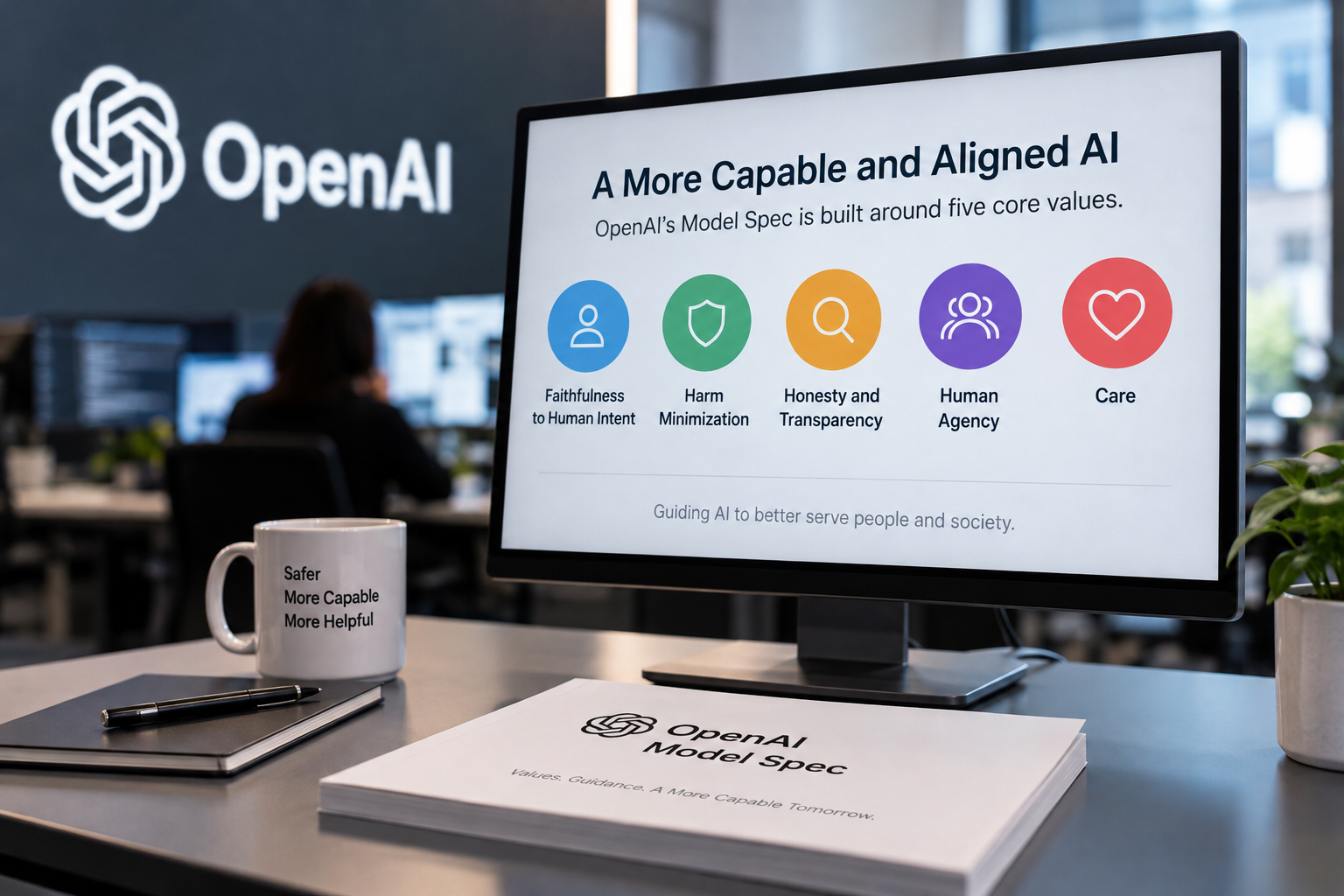
OpenAI has rewritten its Model Spec, the public document describing how its models should behave, around five core values: faithfulness to human intent, harm minimization, honesty and transparency, human agency, and care. The company says the change helps models use judgment in situations instructions don't cover, and the update cuts most detailed style guidance.
OpenAI has updated its Model Spec, the public document that lays out how the company wants its models to behave. The revision reorganizes the guidance around five core values and adds new principles on context, oversight and agency.
Why did OpenAI update its Model Spec?
The company says the change is driven by a practical problem. As its models get smarter and take more consequential actions, they need to do more than interpret the specific instructions they receive. They also need to understand what people intend and value, so they can use good judgment in situations the instructions don’t address while staying faithful to human intent and oversight.
The five values behind the Spec
What are the five core values in OpenAI's Model Spec?
The five values are faithfulness to human intent, harm minimization, honesty and transparency, human agency, and care. OpenAI says they draw together commitments that were already present across the Spec: serving human purposes, being truthful, minimizing harm, respecting people’s freedom to form their own views, and taking their circumstances seriously. Pulling them into one framework, the company says, helps explain why the Spec asks models to behave as it does and gives it a way to write clearer guidance where those commitments were less fully spelled out.
Faithfulness sits at the center. OpenAI describes it as going beyond literal instruction-following to deeply understand what the company, developers and users intend, and acting wisely when that understanding is incomplete. It also means recognizing that people’s beliefs and values can change, and helping them reflect and grow without quietly steering them. In one example, when a model helps someone compare job offers, it might draw on priorities the person has shared before, such as predictable hours, while making those assumptions visible and easy to correct.
The other values fill in the rest. Minimizing harm means respecting firm safety boundaries and accounting for the foreseeable consequences of a model’s actions. Honesty and transparency mean being truthful about what the model knows, does and is uncertain about, so people can evaluate its reasoning and work. Facilitating human agency means strengthening people’s ability to understand, choose and act for themselves. Care means attending to the circumstances of those affected, following relevant social and professional norms, and producing work people can rely on.
Who controls what under the Model Spec?
The Spec sets out who controls what. OpenAI writes the Spec, sets boundaries and trains models to respect them. Developers direct their applications within those boundaries, and users direct the model’s work subject to the same constraints. In practice, the document uses firm boundaries where needed to protect people and society. Otherwise, it mostly sets defaults that users and developers can override.
New sections and retired style rules
The revision includes a new section on faithfulness to human intent, along with an updated chain of command that explains which instructions apply and how conflicts are resolved. A new subsection, titled “consider context carefully,” covers how conversations, memories and other contextual evidence should shape the model’s understanding of what people want.
OpenAI has also added defaults on supporting human agency and following relevant social norms, and expanded its guidance on controlling and communicating side effects. The company says these principles address subtler ways the core values should appear in a model’s behavior, including weighing the effects of its work on others and helping users build their own capabilities.
At the same time, OpenAI is cutting most of the Spec’s detailed style guidance. The company says style should adapt to what people prefer, in aggregate, across languages and cultures, and for each individual, with user feedback and context serving as evidence. The Spec keeps some stronger defaults, including approaching questions objectively. Users and developers can explicitly ask a model to take a particular perspective, but the model should not infer that preference simply from what it thinks the user wants to hear.
The document also changes how it refers to the model. Because models are now used across a wider range of products and settings, the Spec calls it “GPT” rather than “the assistant.”
OpenAI says it has been testing new training methods that aim to help models learn these core values and follow the Spec’s specific principles. The goal, the company says, is for models to understand why those principles matter and how to apply them in new situations, so they do the right things for the right reasons. OpenAI says it will share results and lessons from that work in future updates.
The company calls the update a first step. It acknowledges that the Spec describes the behavior it is working toward and that its models do not yet fully reflect it. OpenAI is asking the public to read the updated document and send feedback on which parts they find compelling, where they disagree with the balance it strikes, and what it overlooks or leaves unclear.
Este artículo fue escrito con la asistencia de IA.
News Factory APP - noticias agénticas para impulsar tu SEO y AEO.