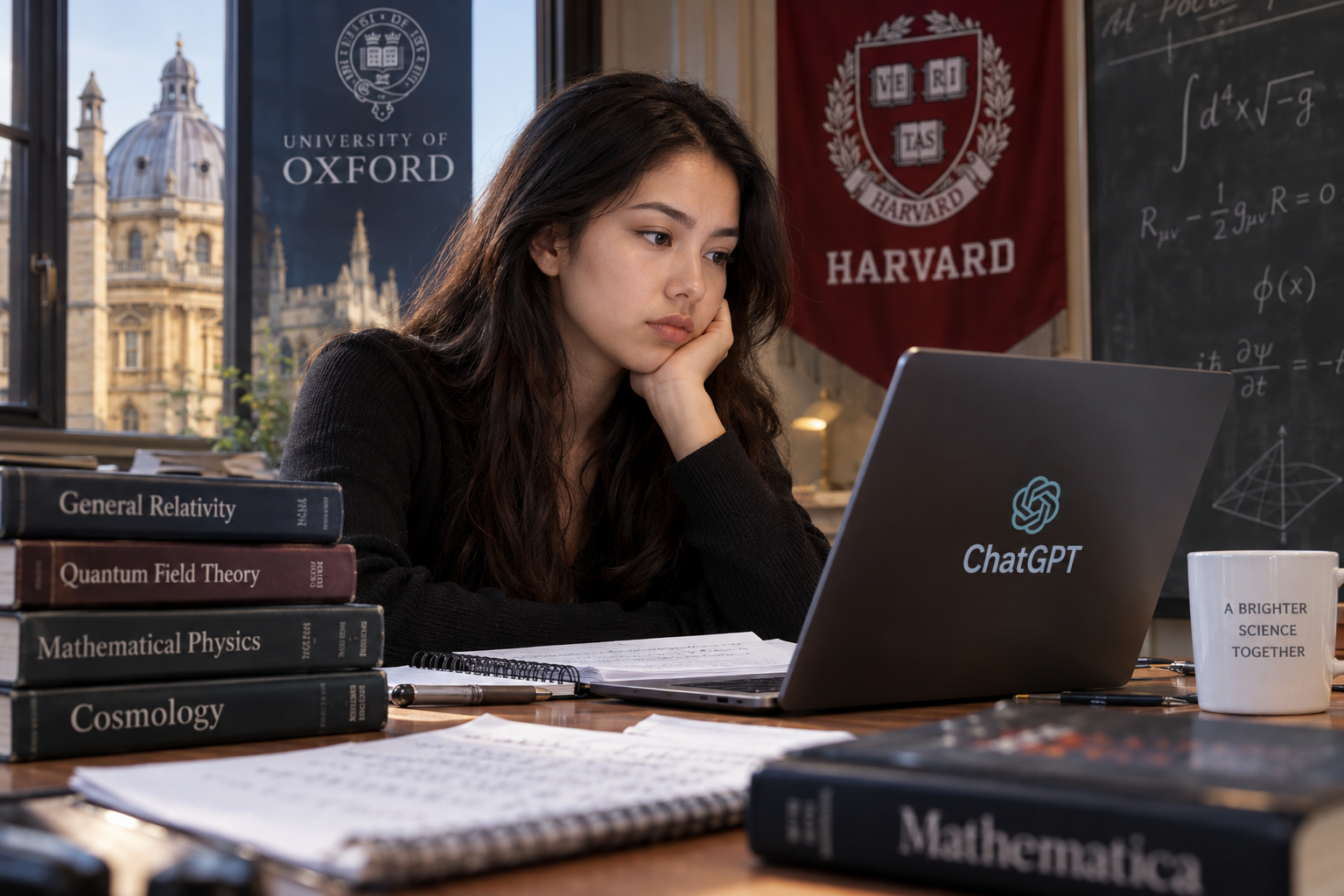
A second-year theoretical physics PhD student at Harvard says ChatGPT helped her pass a dense set of Oxford exams in record time. Now she worries the same tool is undermining the collaboration that science depends on. In a first-person essay, the student, who signs her work as Nia, describes a shift from classmates who relied on chatbots for homework to colleagues who now treat AI as the first stop for every idea.
Nia arrived at Oxford for a master’s program after an undergraduate degree in the United States. The lectures felt impersonal, the professors seemed distant and the classes were crowded. Within months of starting, she says, classmates were discussing problems by saying they had asked ChatGPT. This was in late 2024. Most problem sets in the program were not graded, and the real grades came from exams and dissertations. Still, some students treated homework as something a chatbot could simply finish.
She was skeptical at first. Her early questions to the chatbot produced answers she considered nonsense. In one exchange about scattering amplitudes, she said, the chatbot replied that she should ask a theoretical physicist. She closed the window and did not return to it for months. In January 2025, stuck on a quantum field theory problem, she tried again and got another poor answer.
What she missed most was the back-and-forth she had known as an undergraduate. In a freshman multivariable calculus course, she worked with two classmates in a group chat. They attempted problem sets on their own, then compared answers and argued over the results. She says that experience taught her more than any lecture.
That kind of collaboration did not last. In her sophomore year, she joined an honors differential equations course with a physics-major friend and asked for help after making several errors on the first homework. She says the friend accused her of trying to copy her work and began telling other people the same thing. The friendship ended. Nia finished the course with an A, but she did it alone. For most of the rest of her degree, she says, she worked by herself, explaining her answers to classmates but rarely getting the exchange she had valued before.
By spring 2025, she had a month and a half to learn four Oxford master’s courses from scratch before her exams. She had skipped many lectures, which she said she found less useful than books, and she had not kept up with some problem sets. This time she turned to ChatGPT. She copied confusing sentences from her general relativity and cosmology notes and asked the chatbot to rephrase them. She says it was most helpful when it offered concrete examples. After about three weeks, she no longer needed it as much. Her exams were closed book, she says, and she earned high passes and merits. She received her degree.
At Harvard, she says she used AI sparingly. Her first PhD project began in early November of her first year, and she relied on skills from her undergraduate mentors. She used Mathematica to write code for calculations and said she used Claude Opus only once, to fix a piece of code involving poles and residues. She used ChatGPT to find background literature and to help interpret some papers. That project was later published.
She also described the so-called “single minus” paper, which she says changed expectations about AI in physics. According to her account, an internal OpenAI model found a result that researchers had struggled with for months. She called the proof impressive and not straightforward, but she stressed that much of the conceptual work came from human researchers. The paper, she said, opened new research directions in celestial holography.
Her concerns grew in her second year. She says many colleagues now keep ChatGPT, Codex or Claude open while they work. Emails from collaborators often include notes generated by AI or based on its suggestions. She spends much of her time checking those notes, and she says many turn out to be wrong. When she raised objections to a senior colleague, she says she was told to ask ChatGPT. The chatbot agreed with her, she wrote, but offered no solutions.
Nia says she also saw posturing in the field long before AI arrived, and she believes chatbots have made it worse. She described a culture that rewards fast students, the number of papers published and citations. She asked why students are needed at all if a machine can absorb textbooks and produce results faster. A friend in the program, she wrote, asked whether many of the papers being produced with AI were worth publishing.
She is careful not to call the technology evil. “It’s not AI’s fault, it’s ours,” she wrote. Her larger concern is isolation. She said she would rather have responsive professors, teachers who understand pedagogy, clearer papers and peers she can talk with without anxiety. She fears that AI tools that validate people’s ideas will make those things harder to find.
She closed with a line from Lucretius about the value of studying how the universe works. For her, the point of physics is not awards or citations but understanding. The community of people who learn together, she wrote, is one of the few things that makes the work meaningful.
Este artículo fue escrito con la asistencia de IA.
News Factory APP - noticias agénticas para impulsar tu SEO y AEO.