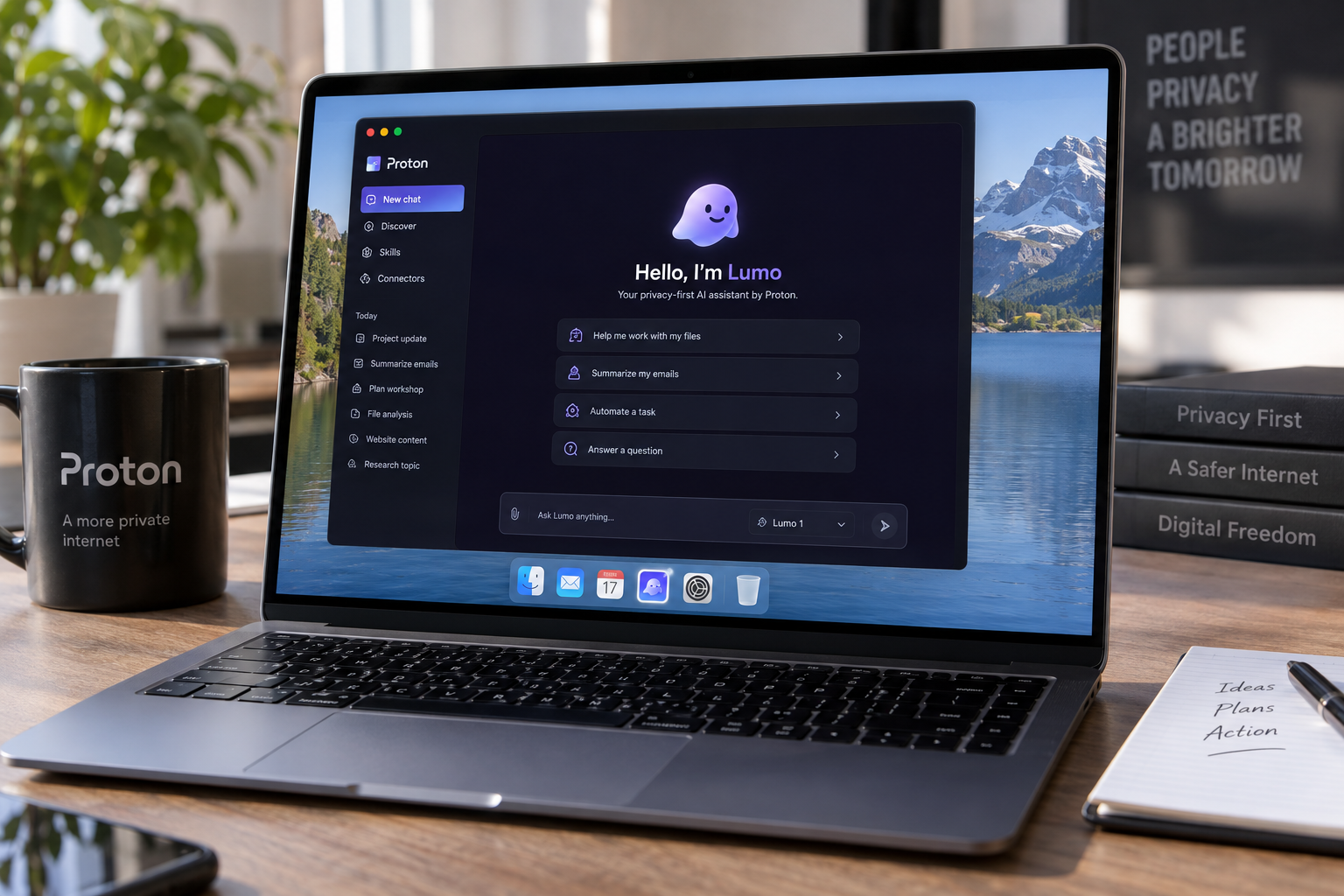
What is Proton's Lumo Desktop app?
Proton, the privacy-focused tech company that offers alternatives to Google and Microsoft tools for email, productivity, password management and cloud storage, is bringing its AI app Lumo to personal computers. On Tuesday, the company launched Lumo Desktop for Windows, macOS and Linux. The app lets users have the AI carry out local tasks that involve connected apps, personal files and other automations.
The launch reflects a shift in consumer AI. Chatbots have mostly answered questions, but companies are now building AI agents that perform tasks on a user's behalf. Those agents need access to files and apps to be useful, and that access carries risk.
Major model makers, including OpenAI, Anthropic and Meta, already offer desktop tools for their AI technologies. Those tools can put personal data at risk. Apple this week announced tighter security settings for apps that request Full Disk Access, which AI desktop apps often need.
Does Proton use Lumo conversations to train AI or serve ads?
Proton is pitching a different approach, one that gives users more control over how much access the AI has. The company says users can choose which actions the AI agent takes on its own and which require approval. Proton also says conversations and information from connected apps and files are never used to serve personalized ads or to train AI models.
The desktop app includes connectors for local tools, such as file-system access, shell execution and browser content fetching. It also connects to Proton's email app and third-party services, including Confluence, Dropbox and Jira. The connectors support local and remote MCP (Model Context Protocol) servers, which AI agents use to reach external data sources.
How does Lumo Desktop control AI access to files and apps?
Users can set permissions for each connector. For every connector, they can decide which actions Lumo performs automatically, which require approval and which are blocked entirely. Users can also switch off individual tools from the Tools menu in a conversation. Those who set up scheduled tasks can assign each one its own permissions, covering what runs automatically and what needs sign-off.
Proton says it uses encryption so that only users can read their chat history, not the company itself. It also says it keeps no server-side logs. The limited data it does store is protected under Swiss privacy law and hosted on European infrastructure, which the company says places it outside the scope of the U.S. CLOUD Act. That law governs how law enforcement agencies can access data held by cloud service providers.
Proton is also expanding its infrastructure. The company says its first Nvidia B300 cluster, built to Open Compute Project (OCP) standards, is now going live in Switzerland.
The desktop app supports Skills, a feature that lets users save instructions, templates and reference files for Lumo to reuse across conversations. Similar features exist in other AI apps. Proton says Custom Lumos, an earlier version of the feature, will be migrated to the Skills format.
Este artículo fue escrito con la asistencia de IA.
News Factory APP - noticias agénticas para impulsar tu SEO y AEO.