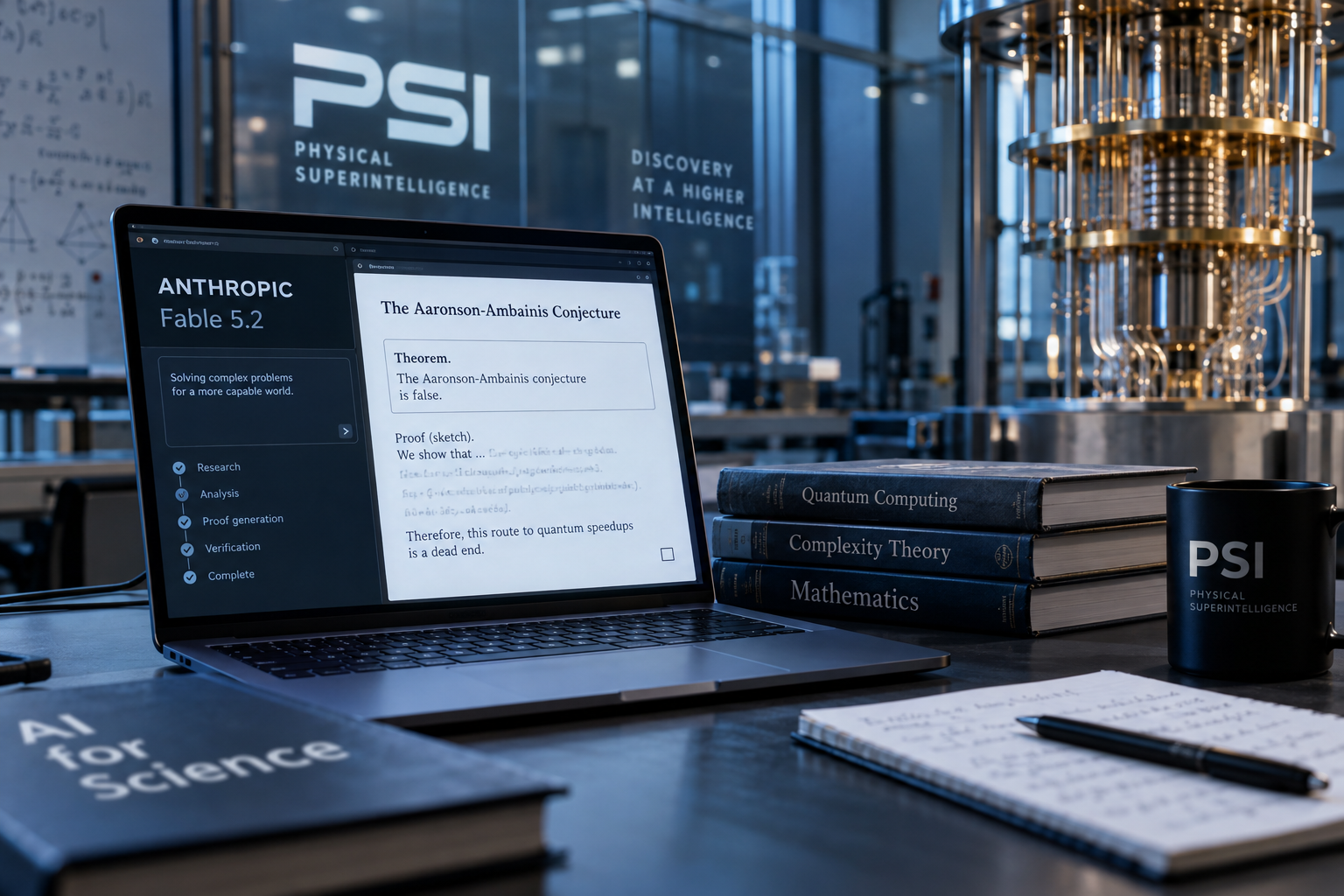
AI startup Physical Superintelligence (PSI) says researcher David Turturean used early access to Anthropic's Fable 5.2 model to solve the Aaronson-Ambainis conjecture, a question about whether quantum computers can solve certain problems faster than classical ones. The result is a negative one: it shows one route to such speedups is a dead end, though not every route.
An AI-driven startup lab says its tools have cracked an 18-year-old problem in quantum computing, and the researcher who did the work says the result may be the last paper he ever publishes in the old way.
What did PSI and Anthropic's model solve?
David Turturean, a recent MIT graduate and member of the technical staff at Physical Superintelligence (PSI), used early access to Anthropic’s Fable 5.2 model to solve the Aaronson-Ambainis conjecture. The problem concerns whether quantum computers can solve certain problems faster than classical ones. Turturean deferred plans to pursue a master’s at MIT’s computer science and AI lab to join PSI.
“I’m totally accepting the idea that this might be the last paper I ever put out,” Turturean told TechCrunch. “In a few months, like, why would you even put out a paper?”
Scott Aaronson, one of the two researchers who originally posed the problem, said he does not fully understand the proof. He believes it is correct anyway. The proof was autoformalized in Lean, a coding language for math, and a team of top researchers reviewed it after PSI shared the solution with them.
Why does the quantum computing result matter?
The result closes one door. It shows that one avenue quantum computers could follow to solve certain difficult problems at high speed is a dead end, but it does not rule out every such avenue. “It’s a negative result that allows people to know, okay, we’re no longer looking there,” Turturean said.
Aaronson said he felt a mix of emotions about the news, describing himself as satisfied, awestruck, disappointed and fatigued. In his write-up, he noted that a full proof of the conjecture was one of the last remaining open problems in quantum query complexity that researchers considered centrally important. He said he was surprised it was missing from a recent OpenAI dump of solved problems. “Surely they tried it, so was it really so much harder than all the problems that were solved?” he wrote.
The episode strengthens PSI’s pitch. The company is betting that solving scientific problems requires specialized model harnesses and scaffolding rather than a general-purpose system alone. “An effective kind of research system should have lots of things related to harnesses, lots related to tools, memory systems, simulation infrastructure,” PSI CEO Matt Pines told TechCrunch. “You want to be able to really go after a problem at breadth and depth, and be able to consider a wide range of potential alternatives.”
For now, the company makes money by using its tools to optimize data centers. Its software simulates the variables of heat, power, water and sound, where, in Pines’ words, “the performance of that site as well as its impact on the community are a direct function of its physics.” The longer goal is to turn theoretical physics breakthroughs into real technologies.
Pines said the pitch was harder to sell a short time ago. “Six to nine months ago, when I was talking to investors, like I had to sort of stretch to validate that conditional, right?” he said. “And it’s not there yet, but it’s on its way.”
AI has already produced notable solutions in mathematics and computer science, where results can be expressed and checked as code. Life sciences and physics are harder. Last week, the startup Discovered Materials released a $1 million grand challenge for researchers using AI to tackle problems such as superconductivity and heat dissipation.
How does PSI check AI-generated results against reality?
Pines said physics presents a different kind of check than math. “At the end of the day, physics is different than math because it’s the real world … nature gets a vote in your models of reality,” he said. PSI is focused on finding the most efficient way to take computational results and validate them through experiments.
Pines described that process as a feedback loop. “If it’s a true fact of nature, that’s a trick that you can exploit,” he said. “You could build a device out of it, right? The AI suggests an idea; it allows you to do something in the world you weren’t able to do before … and so each of those are kind of loops that PSI is building.”
As so-called “neolabs for science” emerge as a path to potentially groundbreaking research, the field is still working out its rules. PSI held its result until Anthropic’s model was nearly ready for release, which gave the company time to share it with relevant researchers.
Jim Halverson, a Northeastern University professor who advises PSI, said the company wanted to handle the result responsibly. “As an academic, we wanted to play our role in doing things the right way,” he said. Halverson will attend a summit at MIT next week, where leading physicists plan to discuss how to respond to the faster pace of science. “Best practices are still emerging … We figured that transparency is a good way to go, and contacting experts is a good way to go.”
Turturean said the work forced him to rethink his own process. He said he had time to review the solution before it went public, and it was the first time he printed one of his AI-assisted solutions and read it through. He said he began thinking about how to present it in a way a human could follow. “And I think it also made me realize, oh my God, the weight of what AI can do.”
Este artículo fue escrito con la asistencia de IA.
News Factory APP - noticias agénticas para impulsar tu SEO y AEO.