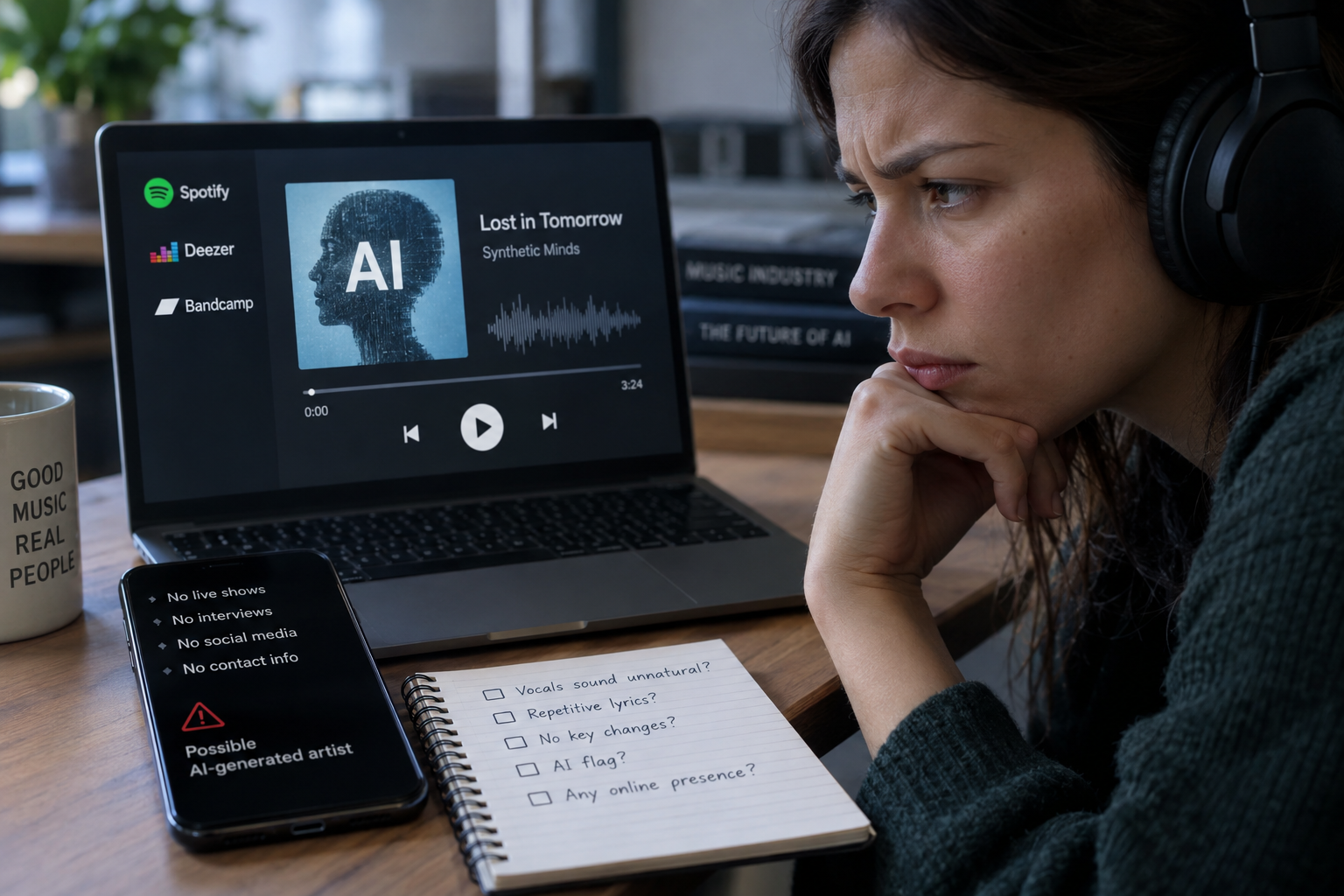
AI-generated music can often be caught by ear. Listen for flat, monotonous vocals with odd emphasis, and for a lack of dynamic shifts, key changes and interesting bridges. Lyrics that repeat ideas without metaphor are another clue. Platform AI flags help but are imperfect. Searching for the artist can also help.
If AI music is showing up in your playlists, you may be able to catch it by ear. Several traits tend to give generated songs away, and a little investigation can confirm what you hear.
The problem has grown quickly. Over the past year, songs generated with Suno have filled up streaming platforms, and some have been falsely attributed to real artists on sites like Spotify. Many listeners would rather not be fooled into hearing a track put together by a machine with nothing to say about the real world. Generative AI has also drawn criticism over concerns about data center pollution and its use in content farms.
As millions of songs are churned out, AI music is under close scrutiny, and that has made “feels like AI” a common insult. Some listeners now label songs as AI-generated based on little more than a bad feeling. Critics have panned Tyga’s $TARFACE album, and the work of Spalexma has also drawn attention, but the useful question is which specific traits point to AI and which just make a song sound off.
“AI music” can mean several things. A generator might create the instrumentals, the vocals, the lyrics or all three. It might also play a smaller role, such as a vocal filter or a single part of the instrumentation.
What are the telltale signs of AI-generated vocals?
Vocals are often the easiest place to start. AI vocals share tells with the “AI accent” found in other generated content. Listen for a slurred or warbled voice that seems to strain to fit the lyrics to the music. The singer may place emphasis in odd spots and lack the small imperfections of a human voice. Most AI vocals also stay monotonous from start to finish and rarely change their inflection.
How can song structure and lyrics reveal AI-generated music?
The same flatness often shows up in the song’s structure and instrumentation. AI tracks typically lack dynamic shifts, key changes and interesting bridges. They also rarely use non-Western instruments. That last point matters because AI music mostly borrows from U.S. pop. Much of it sounds like Imagine Dragons or Taylor Swift, as the models have remixed and regurgitated those popular sounds.
The lyrics give away a lot too. Look for a lack of metaphor and simile, awkward or ungrammatical phrasing, and no overarching theme or point. AI lyrics also tend to repeat ideas and imagery instead of building on them from verse to verse.
Can you trust platform flags and online searches to identify AI music?
If a song gets past those checks, look at what surrounds it. A track flagged as AI by a platform tool, such as Spotify’s Artist Profile Protection feature, or by an outside detector like Deezer’s AI music detector, is generally a strong sign. Still, the flags are not perfect. Bandcamp has occasionally flagged real music as AI by mistake, so it is worth digging deeper before reaching a conclusion.
A quick search for the artist or band can be revealing. Real acts usually leave a trail of live performances, social media profiles, interviews and contact information. If you can find no trace of the artist online, that is a strong warning sign. An artist with no online presence who releases a flood of sloppy songs, many with AI-generated album covers, is more likely a content farm than a musician.
The method is not foolproof. It may not work well on a band that only dabbles in AI. Used together, though, the sound, the lyrics, the platform flags and the online search can help listeners spot AI-generated music before they hit play again.
Este artículo fue escrito con la asistencia de IA.
News Factory APP - noticias agénticas para impulsar tu SEO y AEO.