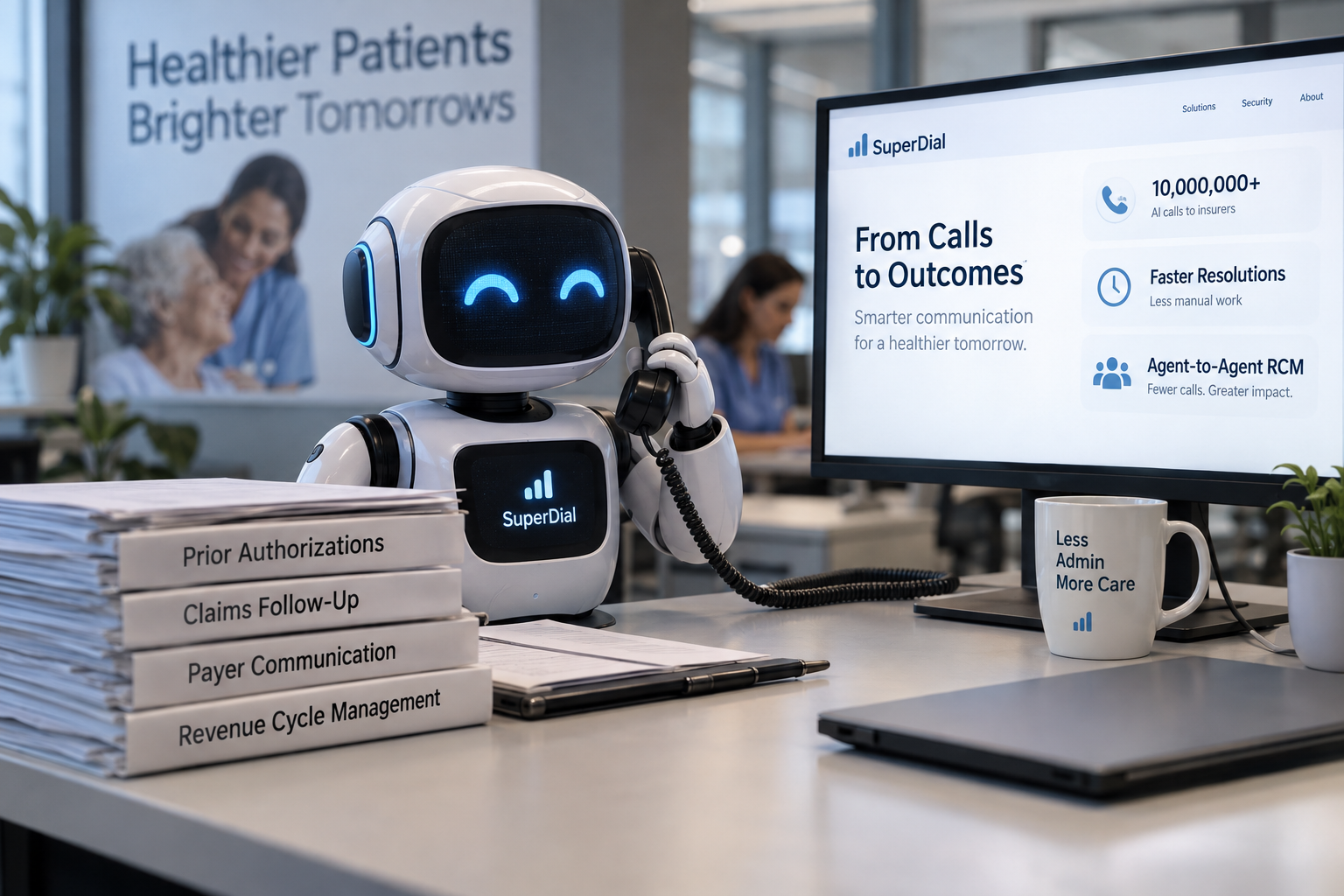
SuperDial, whose AI agents handle payer communication for revenue cycle teams, has completed more than 10 million AI-powered calls to insurers. It is now introducing Agent-to-Agent RCM, a model that measures success by whether a request is resolved, not by the number of calls made, and aims to reduce the number of calls needed.
SuperDial, whose AI agents handle payer communication for revenue cycle teams, has completed more than 10 million AI-powered calls to insurers. The company now says its next goal is to make most of those calls unnecessary.
That is an unusual message for a business built on automating phone calls. SuperDial argues that healthcare is heading toward a odd arrangement in which software on the provider side calls software on the payer side, each asking for information that already sits on a screen somewhere.
AI has reached both sides of the transaction. Providers are deploying agents to chase claim and benefit information. Payers are deploying automation to answer those requests. Each side is getting better at keeping the exchange going, and SuperDial says neither is getting better at ending it.
“The future of healthcare administration cannot be two bots arguing with each other faster,” said Sam Schwager, co-founder and CEO of SuperDial. “If an agent already has the information, that context should travel with the request. If a digital channel can answer it, there should be no call. The goal is fewer exchanges, not faster ones.”
What Is Agent-to-Agent RCM?
SuperDial is introducing what it calls Agent-to-Agent RCM, an approach that measures success by whether a request is resolved, not by how many calls an agent completes. The company’s co-founders are Schwager and Harrison Caruthers.
From calls to outcomes
How Does SuperDial Resolve a Request Across Channels?
Under this model, SuperDial takes responsibility for resolving a customer’s request across every available channel, so the customer does not have to manage each one. If an electronic transaction can supply the answer, SuperDial uses it. If the information is available through a payer portal or by faxback, its agents retrieve it there. When a phone call cannot be avoided, the agent carries forward what is already known and asks only for what is missing.
How Much Faster Are AI Payer Calls Than Human Ones?
The company says the approach is already helping teams get payer information faster and with less manual work. Among successful requests where the required information was retrieved, SuperDial’s agents average about four minutes per call attempt using payer voice automation. The company compares that with 17 minutes or more when a human representative is reached.
The McKinsey figure SuperDial cites comes from 2021, when the consulting firm estimated that simplifying healthcare administration could save up to $265 billion annually. SuperDial says that as AI spreads, the industry risks spending that potential on faster versions of the same back-and-forth.
SuperDial’s longer-term ambition is an AI-native network for payer-provider communication. In that model, agents would exchange trusted information directly instead of repeatedly requesting it across disconnected systems. The company says that would mean fewer repetitive inquiries reaching payer staff, fewer hours for providers spent chasing information, and fewer administrative delays for patients trying to get care.
The company also wants to change how the industry measures AI’s value. Rather than counting how many calls an agent can complete, SuperDial says the better measure is how much work it removes. “Ten million calls have proven that AI can take on healthcare’s phone burden,” the company said in its announcement. Its next target, it says, is powering the next billion payer requests through Agent-to-Agent resolution.
SuperDial describes its platform as covering eligibility and benefits verification, prior authorization, claims follow-up, credentialing, enrollment, and provider data management. The platform works across phone, payer portals, EDI, APIs, fax, and documents, and it can return structured results to integrated systems and work queues. The company says it maintains controls designed to support HIPAA compliance and has completed a SOC 2 Type II examination.
Este artículo fue escrito con la asistencia de IA.
News Factory APP - noticias agénticas para impulsar tu SEO y AEO.