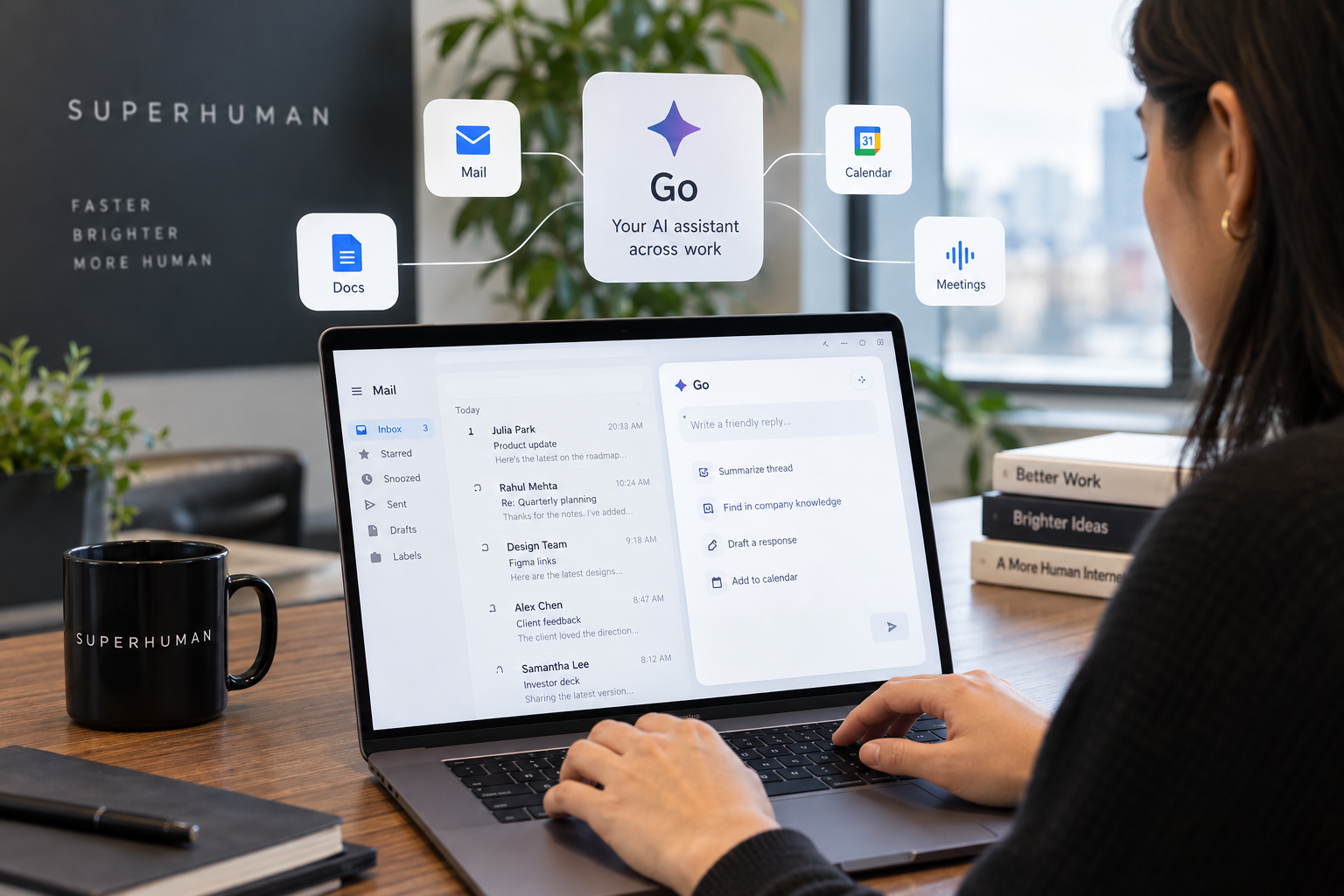
What is Superhuman's Go assistant?
Superhuman, the productivity company formerly known as Grammarly, is rolling out a broader set of AI features centered on its Go assistant. The update lets Go draw context from across a user's apps, makes it act on its own more often, and places AI agents throughout the company's products.
The push reflects a wider trend. Productivity apps are trying to feed more information to their AI tools while making those assistants available almost everywhere inside the software. Superhuman has taken heat over some of its AI features, but it began promoting Go after rebranding last year, and this rollout builds on that effort.
Go now learns context across different apps and offers more personalized prompt suggestions. Superhuman is also reworking its onboarding so users can connect the tools they already use and load information about their work at the start, rather than piecing it together over time.
Like Grammarly, Go works inline with the cursor. It also manages other agents. The company is making the assistant proactive, meaning it can check a user's schedule, keep watch over email and draft responses without being asked. Go also learns a user's writing style and adjusts its replies in email and Docs to match.
Superhuman is adding 20 new connected agents through its Go software development kit. The list includes DeepL, Legora, Amplitude, Databricks and Blackboard.
What can Go do in Superhuman Mail and Docs?
Inside Docs, all Go agents now work natively, and users can send them off to handle tasks in the background. Users can also set up routines that trigger workflows when specific events occur. The company says it is considering adding AI to other products as well, including Docs and Superhuman Mail.
In Mail, Go is replacing the AI tool that had served as the product's central feature. Users can run enterprise searches using data from the company's knowledge base and connected tools. Go uses that same context to write drafts and organize the inbox across both Google and Outlook accounts.
The company acquired notetaking app Fathom in September to add more context to its suite. Superhuman is now rolling out live collaborative notetaking that can be shared across a team. Go can also take action after a meeting ends, such as writing an initial draft of a proposal.
Mehrotra said Go has built good momentum, with more than 1 million active users. He acknowledged that many assistants are competing for attention in both personal and professional settings. Go is oriented toward work, he said, but that does not mean it stays out of personal life.
Can Go handle personal tasks as well as work?
“One of the reasons why these assistants have been popular is that they treat you as a whole person and recognize that we need to cover both extremes,” Mehrotra told TechCrunch over a call. “Go is definitely more work-focused than some of the tools coming out of the pure consumer ecosystem. It doesn’t mean we draw the boundary at helping you with your personal tasks or helping you with your calendar or all of your email.”
Go may not compete directly with assistants such as Instinct, Muse and Fo. Superhuman's larger goal is to get users to pick its assistant over offerings like OpenAI’s Dots or Claude Duet.
Este artículo fue escrito con la asistencia de IA.
News Factory APP - noticias agénticas para impulsar tu SEO y AEO.