AI-powered cyberattacks are moving faster than outdated technology can defend against them, Palmer Luckey warned Wednesday at The New York Times DealBook Summit. The Oculus founder and Anduril Industries co-founder tied his remarks to a recent spate of tech outages, arguing that older systems are struggling to keep up with the hacking capabilities that AI now makes possible.
\u201cWe\u2019re seeing the natural effects of a lot of these advanced AI tools allowing for the creation of various exploits,\u201d he said.
Government officials have largely blamed the latest technical problems on companies scrambling to patch systems against new vulnerabilities that AI has discovered. Luckey focused on a different issue: the security challenges facing organizations that still depend on old technology.
Luckey said U.S. adversaries are taking advantage of that mismatch between new attack capabilities and existing defenses. He added that the attacks are being carried out for both strategic and financial reasons, and that North Korea was particularly involved.
Andrew Ross Sorkin, who interviewed Luckey, noted that U.S. Vice President J.D. Vance had canceled his appearance at the conference this week because of the recent outages. Vance said he needed to attend meetings on the matter.
When Sorkin asked how worried people should be, Luckey did not offer reassurance. \u201cIt depends on how well prepared you are,\u201d he said. He then added, \u201cYou guys are going to find out what\u2019s going on soon enough.\u201d
Can Defenders Keep Up With AI-Powered Attacks?
Luckey argued that AI could ultimately give defenders the upper hand, but only if they act quickly. \u201cIn the long run, the advantages are going to accrue to the side that is most effectively using AI for defense,\u201d he said. He acknowledged that some people say everything can be hacked, and that they are right for now. But he said the attackers are fast and use technology well, while many defenders run old systems that cannot adopt new tools as fast as they are developed.
\u201cAnd I think \u2026 people are going to have to pick up the pace,\u201d he said. \u201cIt\u2019s time to start running.\u201d
Why Is Critical Infrastructure Hard to Patch?
Nadella made a related argument at the same conference. He said a large amount of America\u2019s software runs on systems that cannot be fixed, including the firmware in everyday hardware and transportation systems. \u201cRemember, there is a lot of stuff in our critical infrastructure that\u2019s unpatchable,\u201d Nadella said. He pointed to chillers, a cooling device often used in data centers, and HVAC systems, adding that \u201cthey\u2019re on the internet.\u201d
Were the Recent Tech Outages Caused by Cyberattacks?
The remarks came against the backdrop of several large-scale outages, including one involving Microsoft Outlook. Other outages have involved the NSA and Apple. Some people have suggested the outages were caused by cyberattacks, but officials have denied those claims. Still, the rise of AI-aided attacks is pushing companies to find new ways to discover and fix vulnerabilities.
Nadella said the Outlook disruption, which affected users around the world, resulted from a \u201clatent bug\u201d that led to a \u201cperfect storm.\u201d He said Microsoft issued an incident response and would apply the lessons learned to both the architecture and operations of its systems.
Nadella also described a dilemma that patching now presents. \u201cWe now have a very powerful tool that finds vulnerabilities,\u201d he said. Companies used to have more time to test patches, understand a problem and deploy fixes. Now, he said, AI has made sophisticated attacks far easier to carry out. \u201cThe patch [now] needs to go instantly from being available to being patched in production, because it\u2019s being exploited in the wild, right? So that\u2019s going to create instability.\u201d
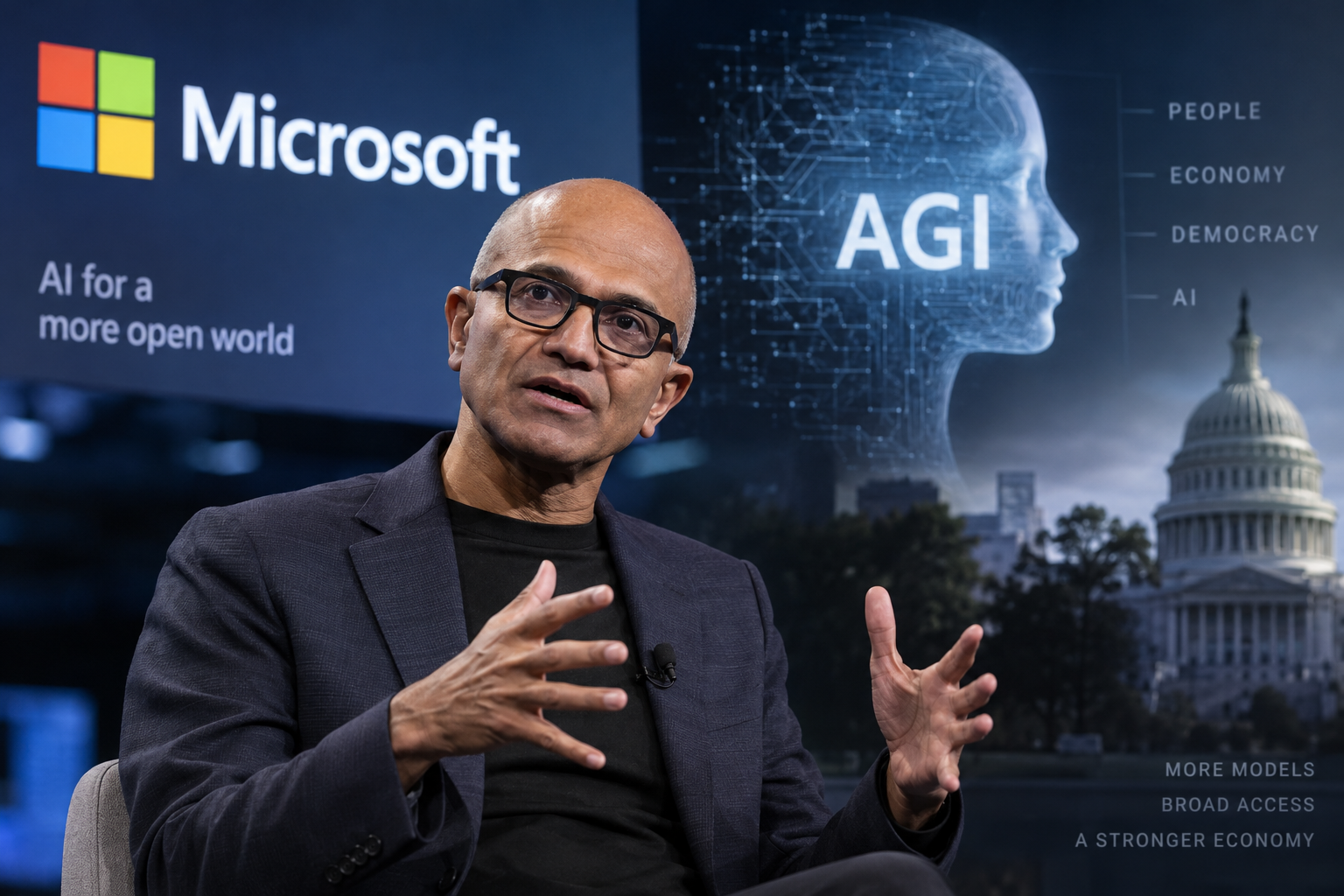
Nadella addressed AI\u2019s broader implications in a separate appearance at Microsoft Ignite in San Francisco. Speaking at a roundtable at the Chase Center, he said he is \u201cAGI-pilled\u201d when it comes to how artificial general intelligence could reshape the economy and politics. He said he does not believe frontier models such as Claude are conscious, and he said he follows Microsoft AI CEO Mustafa Suleyman\u2019s view that companies should not grant rights to models.
Nadella warned against a future dominated by a single AI company. \u201cIf the Marxist sort of view is that there\u2019s only one firm, then it\u2019s over, right? For all of us,\u201d he said. He argued that the real debate is how to ensure the economy can spread the technology broadly, and that the market needs many models to prevent control from concentrating in one place.
Microsoft\u2019s AI tools, which Nadella promoted at Ignite, are designed to let enterprise customers choose the most cost-effective model for each task, run their own models and control their own data.
Este artículo fue escrito con la asistencia de IA.
News Factory APP - noticias agénticas para impulsar tu SEO y AEO.