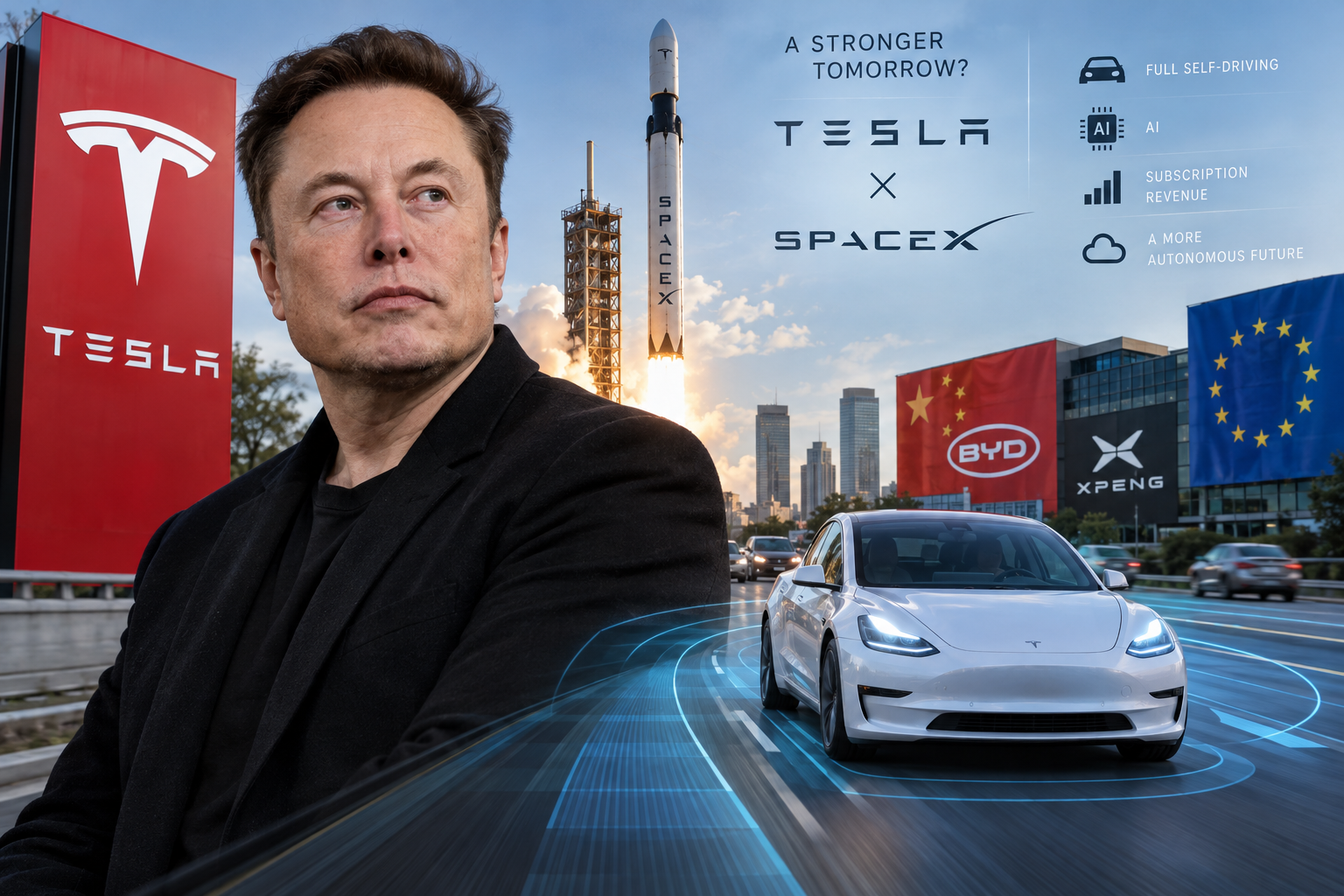
Elon Musk's “flying” Roadster jumped and flipped through the air this month in a stunt that spread across the internet. The spectacle was made possible by compressed-gas thrusters developed by SpaceX. Five days later, Musk revealed that Tesla and SpaceX were exploring a merger that could accelerate his push into autonomous driving.
The bigger story is about how Tesla makes its money. Car companies already face growing competition from China, and many are trying to move away from a model built mainly on vehicle sales. They want recurring revenue from software and AI-powered services instead.
“Automakers are starting to look in the mirror and the software piece is what they are all looking at as the golden goose, because the margins are so high,” said Dan Ives, a tech analyst and partner at merchant bank Yorkville Ives.
Tesla's car business still matters a great deal. It generates 75 percent of the company's total revenue, and that money will help pay for the heavy AI spending Tesla needs to compete with Big Tech rivals.
Musk is operating in a very different market than the one he faced in 2008, when Tesla launched its first battery-powered Roadster. Chinese rivals now lead the electric vehicle race, and they are also investing heavily in software and AI to challenge Tesla in autonomous driving. Tesla ceded its position as the world's largest electric vehicle maker to BYD last year. Musk has said the company still leads Chinese competitors in autonomous technology.
Musk's earlier goal of selling 20 million vehicles a year by 2030 has been scaled back to 5 million. Even that target looks steep. Tesla delivered 1.6 million vehicles last year.
Analysts say the near-term key to growth is Full Self-Driving, or FSD. Despite its name, the software still requires a human to sit in the driver's seat and pay full attention.
“The biggest driver for demand is Full Self-Driving,” Musk said at an earnings briefing on Wednesday. “And today, there's really no competitor for FSD in any car that you can buy.” The company reported its largest car order backlog in four years during that briefing.
How Many Full Self-Driving Subscriptions Does Tesla Have?
The share of new Teslas sold in North America that include the supervised version of FSD has topped 75 percent. Tesla now has 1.7 million active FSD subscriptions globally, up 67 percent from a year ago. The company has not said how much recurring revenue FSD generates. The price varies by market, and in the United States it costs $99 a month.
Ives said FSD is already the highest-margin part of Tesla's business. He argued that if the software reached about 50 percent of Tesla's global customer base, up from roughly 10 to 15 percent today, it could “transform the whole financial model.” He said that expansion would add more value than selling an extra 50,000 to 100,000 cars a year. “For every dollar of FSD revenue, the market rewards it 50-70 percent more than that dollar they would generate from selling an actual car,” he said.
When Will Tesla's Full Self-Driving Get EU Approval?
Realizing that potential depends on regulators. Tesla has not won approval for its fully autonomous version of FSD. Its supervised version has been approved in the Netherlands and several other European countries. Tesla is seeking wider EU backing that would let it roll the software out across the bloc, but a vote of member states has been delayed until December.
Tesla is not alone in that race. Xpeng, the Chinese automaker backed by Volkswagen, is also seeking European approval for its advanced driver assistance and autonomous driving systems. Xpeng is working with German authorities and is targeting EU approval for its FSD rival, XNGP, after the bloc adopts new rules expected early next year. “We aim to be one of the first,” said Xpeng general counsel Zheng Yeqing.
Why Is Tesla Exploring a Merger With SpaceX?
A merger with SpaceX could give Tesla more financial firepower to take on Chinese rivals and Big Tech groups with far larger AI budgets. Analysts said a combined company could speed up research into materials, AI and manufacturing. It could also cut costs and improve access to critical parts such as chips.
“You're going to see the results of what happens when you have a collaboration with the world's best car company and the world's best rocket company,” Musk said at the Roadster event.
Lei Xing, founder of Chinese consultancy AutoXing, said “the future of mobility and vehicles will be autonomous, and autonomy will likely benefit from SpaceX tech.” Evan Horetsky, a former Tesla executive who now founds industrial project developer Atlas Partners, said Chinese EV growth was “phenomenal,” but warned against underestimating Tesla's engineers, who he said keep pushing technical boundaries in autonomy and robotics.
One of Tesla's top 15 shareholders said he supports the merger and expects the company to benefit from “all the AI-related innovations now happening at SpaceX.”
The deal could also expand Musk's control. William Blair analyst Jed Dorsheimer said the tie-up, if approved by shareholders and regulators, could give Musk control of 50 percent or more of the merged company.
Not everyone is convinced. Max Willson, an industry observer and Tesla enthusiast, put it bluntly. “I think Elon Musk is playing a dangerous game,” he said. “SpaceX and Tesla have achieved extraordinary things, but combining his businesses risks tying their futures to his most speculative bets.”
Este artículo fue escrito con la asistencia de IA.
News Factory APP - noticias agénticas para impulsar tu SEO y AEO.