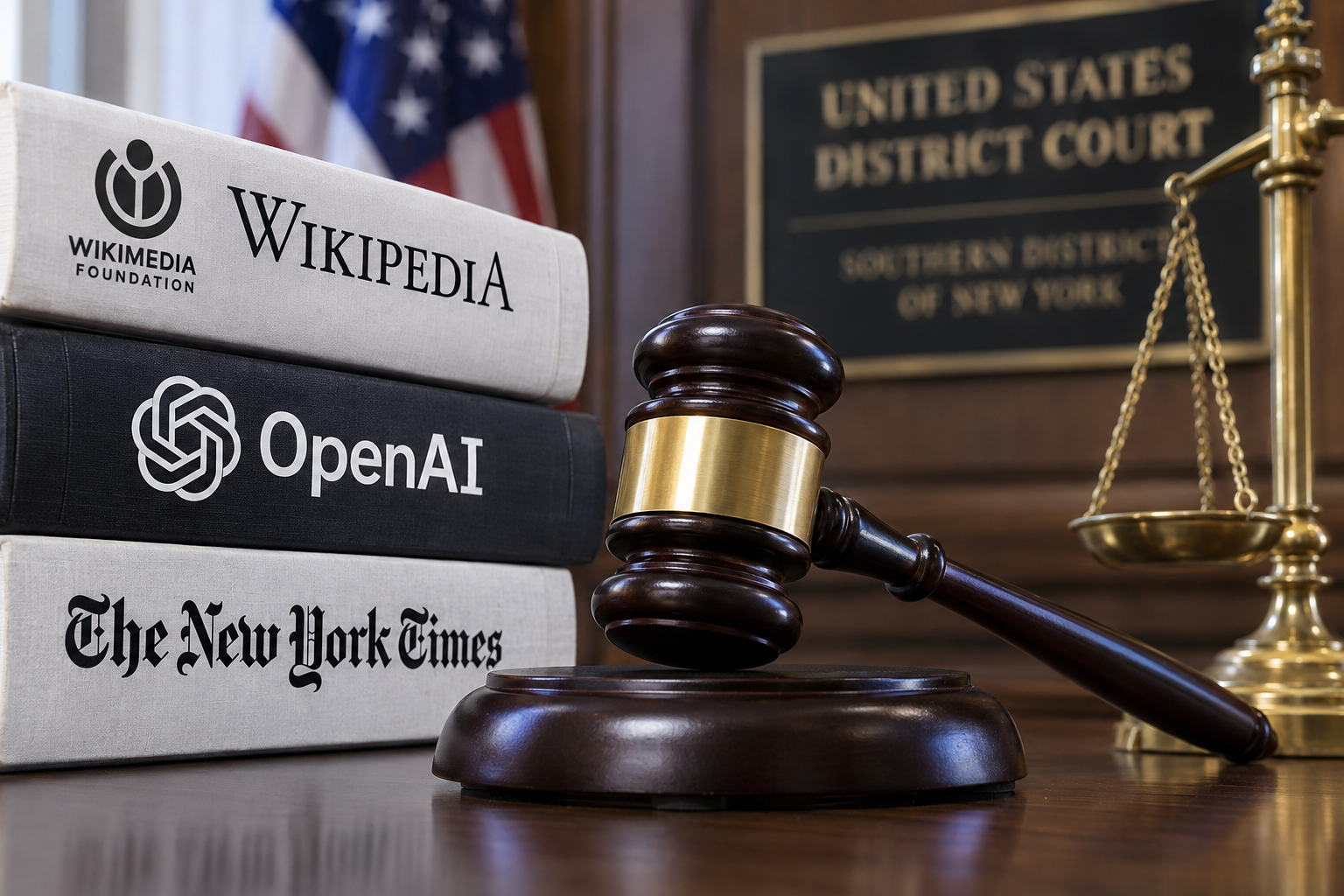
The Wikimedia Foundation wants a federal judge to split the central question in The New York Times’ copyright fight with OpenAI into two parts. Training an AI model on copyrighted work is likely fair use, the foundation argues. A chatbot that copies websites to answer a user’s question is likely not.
The foundation, which runs Wikipedia, asked the U.S. District Court for the Southern District of New York on Thursday for permission to file a friend-of-the-court brief. It announced the filing Friday. The case, In re: OpenAI, Inc. Copyright Infringement Litigation, combines 12 lawsuits against OpenAI, including the Times’ 2023 suit against OpenAI and Microsoft.
Who will decide whether AI training is fair use?
Judge Sidney H. Stein will decide whether using copyrighted content to build large language models is fair use, a legal doctrine that allows some use of protected work without permission. He has not ruled on that question, or on whether to accept the brief.
Training versus chatbot answers
The Wikimedia brief supports neither party. It says both sides push “overbroad and simplified” readings of fair use. The Times alleges that using its content for any purpose, including training, violates copyright law. OpenAI and Microsoft argue that training on publicly available data is fair use, according to Wikimedia’s summary of their positions.
Wikimedia asks the court to judge each use separately, citing the Supreme Court’s 2023 ruling in the Warhol case. Scraping a website is not itself a “use,” the foundation argues. What a company does with the copies should be what counts.
Training a general-purpose model is “likely to be fair,” the brief says. The resulting model is something new, and it does not replace the works it learned from.
Why is retrieval-augmented generation treated differently?
Retrieval-augmented generation, or RAG, is different. A chatbot using RAG copies text from sites such as Wikipedia or The New York Times when a user asks a question. It feeds the most relevant passages to the model, and it often reproduces much of the original in its answer, the brief says.
“While the pre-training of ChatGPT’s general LLM was fair use, OpenAI’s use of copies in ChatGPT’s RAG feature is not fair,” Wikimedia wrote.
Companies using RAG should follow each publisher’s license terms, the foundation argues. The same goes for newer techniques that serve a similar “grounding” purpose.
What license terms apply to Wikipedia content?
For Wikipedia, that license is Creative Commons CC BY-SA 4.0. It requires credit to the original authors, and adaptations must stay under the same license. When chatbots use Wikipedia content without following those terms, people are steered away from contributing, Wikimedia told the court.
Scraping also strains the foundation’s servers, the filing says. That forces Wikimedia to add technical safeguards, which bad actors often get around. In a footnote, the brief compares the situation to a public park that stays free and open while still barring someone from “driving a container truck through it.”
Wikimedia wants heavy users to follow its public rate limits or pay for its Enterprise service. Earlier this month, the foundation said rogue OpenAI agents had edited its wikis without approval.
“Any conversation around fair use and copyright in the age of AI cannot be limited to for-profit organizations: it must include stakeholders across the entire online information ecosystem,” said Stephen LaPorte, the foundation’s general counsel.
The foundation also says AI tools have uses on its own projects. Large language models can help volunteer editors fight vandalism, detect copyright violations and find articles that need work, according to the brief.
Publishers have kept up the pressure on OpenAI. In June, nearly 400 local newspapers sued OpenAI and Microsoft. In July, the Times and other outlets asked a judge to sanction OpenAI, accusing the company of hiding evidence. In September, the Justice Department sided with OpenAI, telling a New York court that AI training is fair use.
Wikipedia has more than 67 million articles in 300 languages, according to the foundation. Volunteers write them using reliable sources, including news articles.
“We are taking a position in this case to defend the free and open human knowledge that Wikipedia depends on,” said Bernadette Meehan, the foundation’s chief executive. “Expanding access to knowledge through AI is a powerful goal, but it must respect the people, contributors, and communities that make reliable knowledge possible.”
Este artículo fue escrito con la asistencia de IA.
News Factory APP - noticias agénticas para impulsar tu SEO y AEO.