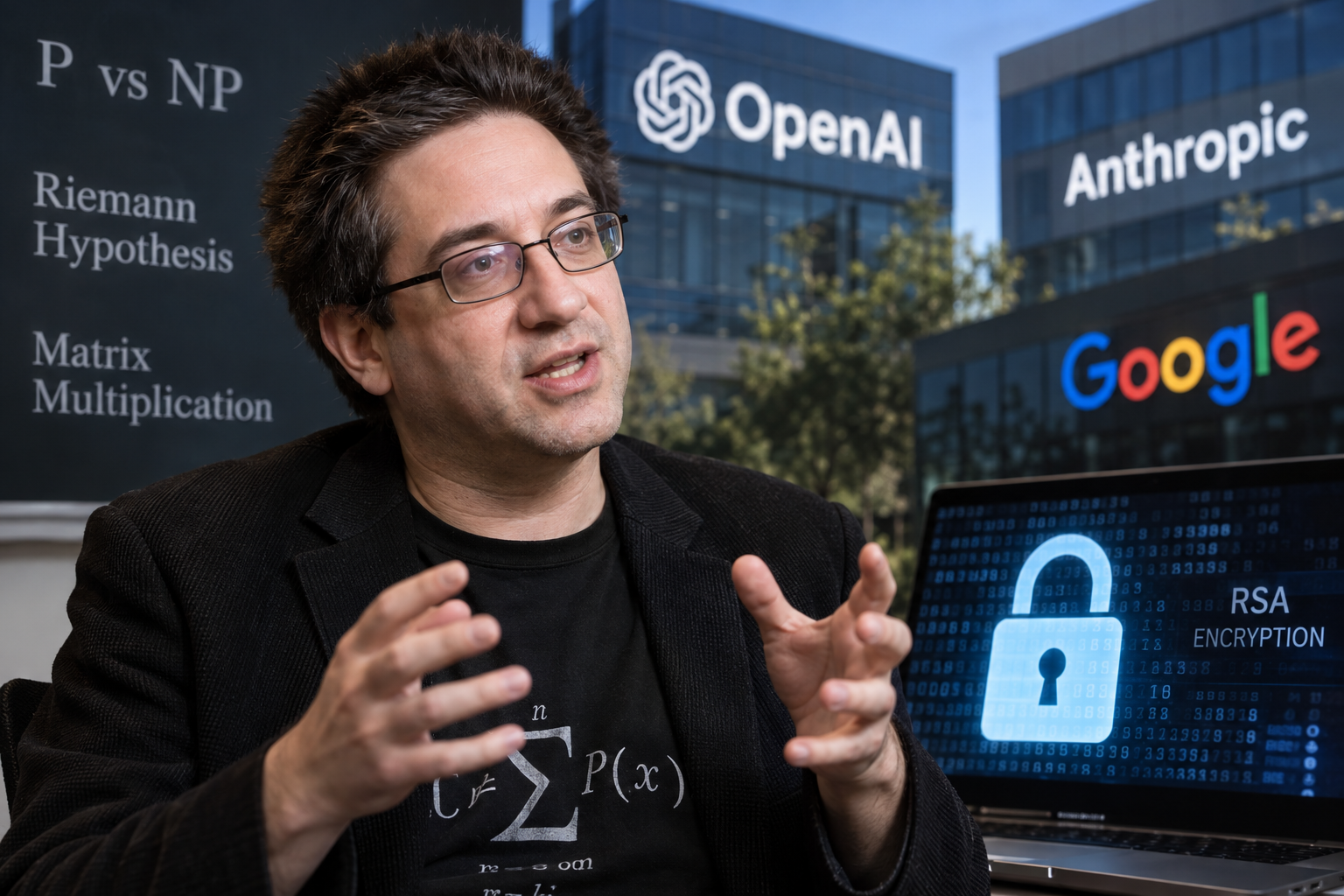
Does Scott Aaronson say AI labs have cryptography breakthroughs?
Computer scientist Scott Aaronson says he is “virtually certain” that leading AI labs are holding back results that would break some of today’s cryptography. He made the claim in a post on his blog, Shtetl-Optimized, on Wednesday. He also said he does not know what those results actually are.
“Because people have been hounding me about it: yes, I’m virtually certain, from multiple reliable sources, that the AI labs are now sitting on one or more bombshells in that area,” Aaronson wrote.
Until he sees details or hears from someone inside a lab, he says he feels “much, much less confident” about what exactly those results are. TNW has not independently verified the claims.
Has Scott Aaronson confirmed that AI labs can factor large numbers?
The post followed a comment Aaronson left on his blog on Tuesday. In it, he said he had heard “many, many rumors” that one or both labs had a fast way to factor large numbers. That would break RSA, the encryption behind much of the web’s security. The comment spread widely on X, and he later added a note to it, pushing back on the idea.
“A rumor is a rumor is a rumor, and the parts that I’m ‘virtually certain’ about fall well short of Factoring in P,” he wrote.
What did Google publish about factoring algorithms?
The rumors also arrived as Google published a paper on Wednesday describing a new factoring algorithm. Aaronson said the work held significant theoretical results but nothing of practical use for breaking encryption.
A week of AI math
The cryptography talk comes during a run of mathematical results from OpenAI and Anthropic. On Tuesday, both labs published proofs of VP ≠ VNP. That problem has long been seen as a step toward P ≠ NP, the most famous open question in computer science.
OpenAI also posted a paper claiming that the exponent of matrix multiplication is exactly 9/4. The 111-page paper says that multiplying two n×n matrices takes at least n^(9/4)/2 multiplication or division steps. The question dates back to Volker Strassen’s work in the late 1960s.
Last week, Anthropic mathematician Levent Alpöge said he and Claude had proved the Riemann hypothesis. The Lean proof assistant has since certified that proof. In October, OpenAI said its model had disproved a famous hypothesis.
Aaronson said the pace of these results has changed his outlook. “I now feel in my bones, for the first time ever, that a proof of P ≠ NP is not far,” he wrote.
He asked readers not to let the cryptography rumors overshadow the math. If their main worry was a Bitcoin wallet, he wrote, they should look for rumors elsewhere. He also urged people to accept that the AI proofs are real, now that the labs back them with Lean certificates.
Questo articolo è stato scritto con l'assistenza dell'IA.
News Factory APP - notizie agentiche per potenziare il tuo SEO e AEO.