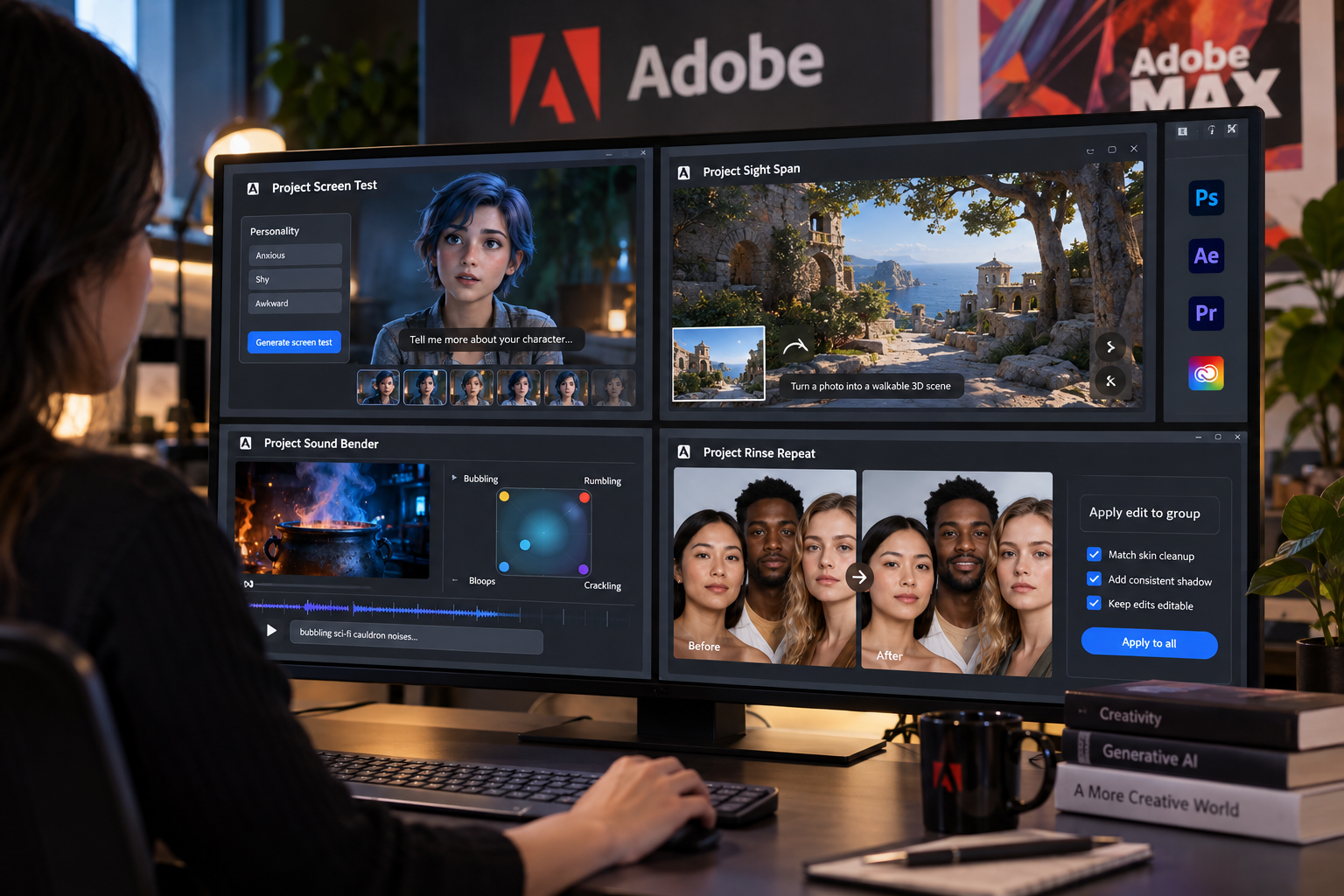
Adobe is previewing a set of experimental AI tools that could change how designers, filmmakers and audio editors work, though none of them has a guaranteed path to market. The features were unveiled at Adobe Max, the company’s annual conference, as part of its closely watched “sneaks” program, where engineers show off projects still in development.
How does Project Screen Test work?
The most unusual is Project Screen Test. Instead of writing a text prompt that describes how an AI-generated character should sound and act, users talk to the character directly in an audition-style setting. You begin by picking base personality traits, such as “anxious, shy, awkward,” and then give the character a voice. You can choose a preset, describe the voice in a prompt or upload sample audio for the tool to reference.
From there, the conversation gets more detailed. Users can talk with the character as if they were on a FaceTime call, working through its backstory, temperament, goals, flaws, fears and movement quirks. When the personality feels right, the tool generates animated screen tests by placing the character in a scenario or environment the user describes. A separate Personality tab lets users manually adjust any trait the character picked up during those conversations.
Adobe has not said how, or whether, Screen Test would fit into its existing AI video tools. It is currently a standalone experiment. The results were more distinct and consistent than many AI-generated animated characters, but the appeal is also the limitation. AI video generation gives creators far less control than traditional animation, where every detail of a character is chosen deliberately.
What is Adobe's Project Sight Span?
Project Sight Span takes a different approach to images. It converts a photograph into a 3D environment that users can move through and reposition. The software generates objects and background details outside the original frame, and those additions look like they belong in the picture, even when the viewer turns to see what is behind them. The 3D view is rough and pixelated, but the image sharpens back to full resolution once a user settles on an angle.
Sight Span works with any flat image, including photos, paintings and illustrations, and it can preserve and reproduce an artist’s style. Tattoos and facial features that were moved within a photo still looked recognizable and faithful to the source. Apple’s Spatial Reframing feature offers a milder version of the idea. Sight Span goes further, allowing more aggressive repositioning and a completely different shooting point. The result, however, feels less like a photograph afterward.
Project Sound Bender is an AI audio mixing tool. A user uploads a video clip and types a description of the sound they want, such as “bubbling sci-fi cauldron noises.” The tool generates effects and syncs them to the footage. It also presents a square canvas that lets users adjust the sounds in real time. Each corner is assigned a sound automatically, including dense gurgling with popping bubbles, rumbling boiling rocks, pitched bloops and crackling electric fire. Dragging the cursor across the canvas changes how those sounds blend, and users can replace any corner with a different effect.
Adobe also showed Project Rinse Repeat, which applies an edit made to one subject across other people or objects in the same photo. If a retoucher removes acne or blemishes from one person, the tool adapts that change to others in a group who need similar work. It can also add shadows to products in marketing images, even when the items differ in shape and size. Rinse Repeat is built on Photoshop, and the edits it spreads remain fully editable because they are recreated with native Photoshop tools.
Will Adobe's Sneaks tools become products?
None of the projects is a finished product. Adobe describes them as tech previews that might eventually become features in Creative Cloud or Firefly. Still, most are built on the company’s generative AI work, and AI now sits at the center of Adobe’s growth strategy, so at least some are likely to reach users. That prospect raises a larger question for creative professionals. If these tools prove useful, they could eventually take over parts of the workflows, software and stock libraries that artists rely on now.
A common thread across the sneaks is turning complicated editing, filmmaking and audio work into something more interactive and easier to pick up. Some demos look more like toys than production tools, but Adobe argues the underlying capabilities could produce practical results.
Gautham Mysore, a senior research scientist at Adobe, said the goal is not to replace expertise. “Making these interactions more intuitive is also about giving experienced creatives more precise control,” Mysore told The Verge. “Sound Bender’s sonic exploration capability and Sight Span’s camera positioning are examples of how professionals could apply their judgment and refine a result more directly. That connection between creative intent and control is a big part of what we’re exploring.”
Adobe plans to show video demonstrations of Sight Span at its Sneaks keynote during the conference.
Questo articolo è stato scritto con l'assistenza dell'IA.
News Factory APP - notizie agentiche per potenziare il tuo SEO e AEO.