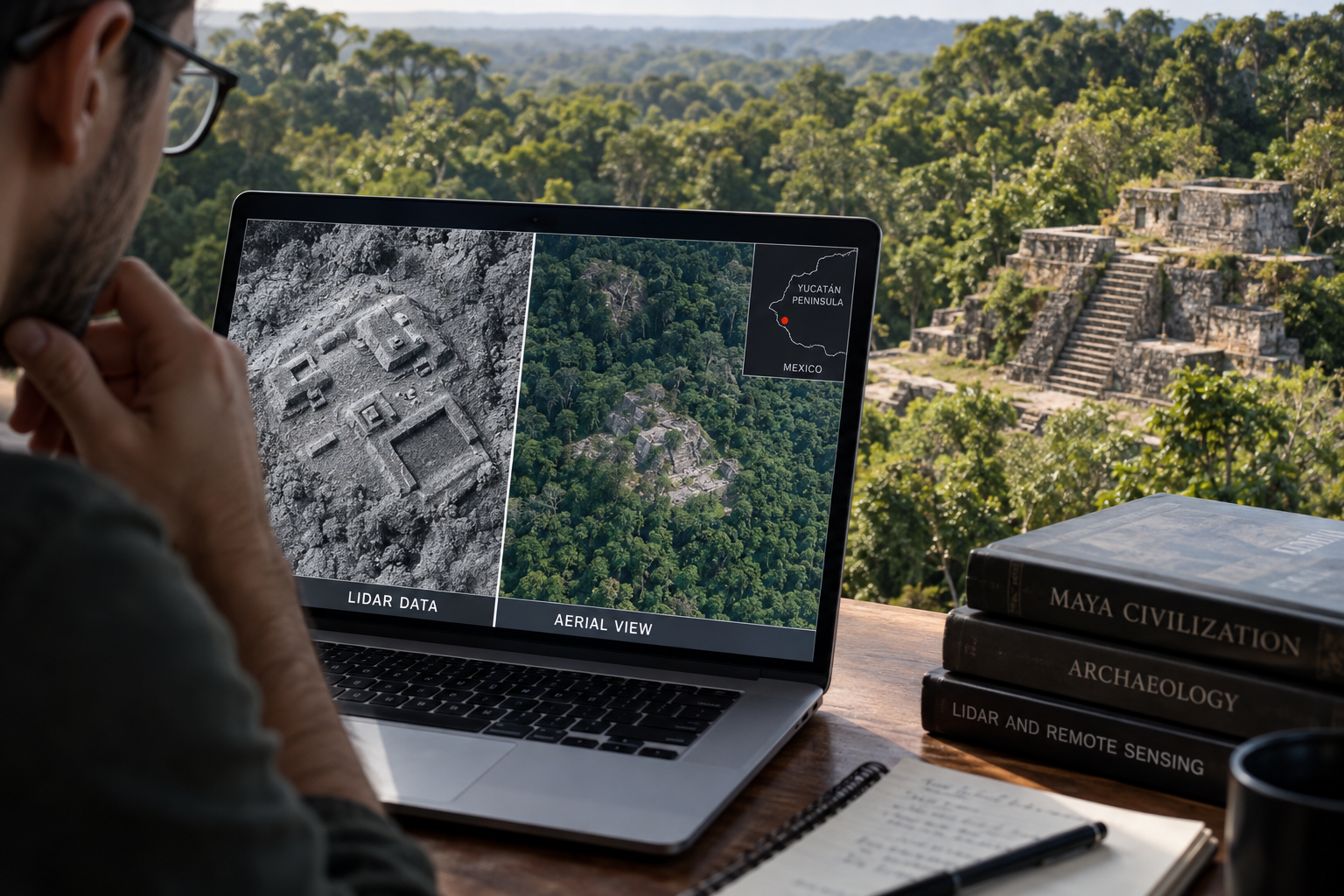
A writer who calls themselves a non-archaeologist says a group of AI agents identified a Maya site in Mexico that was missing from the country's official register. The catch arrived later: archaeologists had already mapped the place. The author says the site was rediscovered, not discovered, but the sequence of events from idea to official reply took less than 72 hours.
The experiment began in Peru, where the author was traveling in October and reading about Hiram Bingham, the American explorer who is credited with 'discovering' Machu Picchu in 1911. Bingham had been searching for a different city when a local farmer guided him to the ruins. The author asked several AI assistants, including Gemini, ChatGPT, Claude and Grok, how a modern explorer might do better. They all pointed to lidar.
Satellite photos are of limited use in dense jungle, the agents explained, because from above a ruin looks like trees. Lidar fires laser pulses through gaps in the canopy and maps the ground underneath. Peru has little public lidar coverage, and commissioning a private survey would mean permits, costs and paperwork. The Maya lowlands, by contrast, are much better covered by public data, so the author switched regions.
The author asked the agents to analyze the data overnight. The lidar strips, about 1,200 square kilometers of jungle, were converted into images. Forty-eight agents reviewed them one by one, looking for pyramids, platforms and plazas while filtering out natural hills, sinkholes and roads. The author says there was no specialized model or classifier involved. The agents examined the pictures and followed a set of instructions. By morning, the reports described many villages and regular shapes that looked like structures.
One site stood out. It sits on the edge of a cliff under the jungle canopy and has straight edges and sharp corners. Zoomed in, the agents described a levelled plaza, an oval pyramid at least 8 to 12 meters tall, a raised courtyard attached to it and a flat-bottomed hollow that could have been a water reservoir. The agents also checked the raw point cloud to confirm that the shapes sat on the ground and were not artifacts of the trees. Under 10 to 17 meters of forest, the ground returns traced the plaza, pyramid and courtyard.
On the agents' advice, the author wrote a report and sent it to the National Institute of Anthropology and History, known as INAH. The author translated the report into Spanish, a language the author does not speak, and relied on the agents to get it right. The report went out on October 20.
INAH replied the next day. Its staff checked their records and found no registered archaeological site at the location. At that point, the author believed no one had mapped the site before. A later update, posted on November 11, corrected that. The site had been documented in a 2025 study by Estrada-Belli and colleagues that mapped settlements across the Maya lowlands. The agents had read the literature but did not find the study.
The author also offered a speculative account of what the site might have been. Based on a long conversation with the agents, the author suggested a small Maya civic center from the Classic period, roughly AD 250 to 900, serving as the local elite's downtown. In that reading, the plaza was a gathering place for ceremonies and possibly a market, the pyramid a temple, and the courtyard the residence of a local ruler. The hollow could have been an aguada, a rainwater reservoir that Maya towns relied on through the dry season, or simply a depression. The author cautioned that this interpretation is speculation.
The author noted other recent work in the same vein. Auld-Thomas and colleagues used lidar in 2024 to find an entire Maya city in Mexico, and a separate study by Sprajc in 2026 reported what may have been ancient Maya marketplaces. The author says the site is now with INAH and the archaeologists who mapped it first, and promises an update if anything further emerges.
The author draws a broader point from the episode. Most reporting on agentic AI has focused on coding, mathematics and physics, the author argues, but the same approach can be applied to other fields. The author also acknowledges that the outcome was less an original discovery than a demonstration that a careful amateur with AI tools can land near the work of professionals. Whether that holds beyond a single case is an open question that this experiment does not answer.
Questo articolo è stato scritto con l'assistenza dell'IA.
News Factory APP - notizie agentiche per potenziare il tuo SEO e AEO.