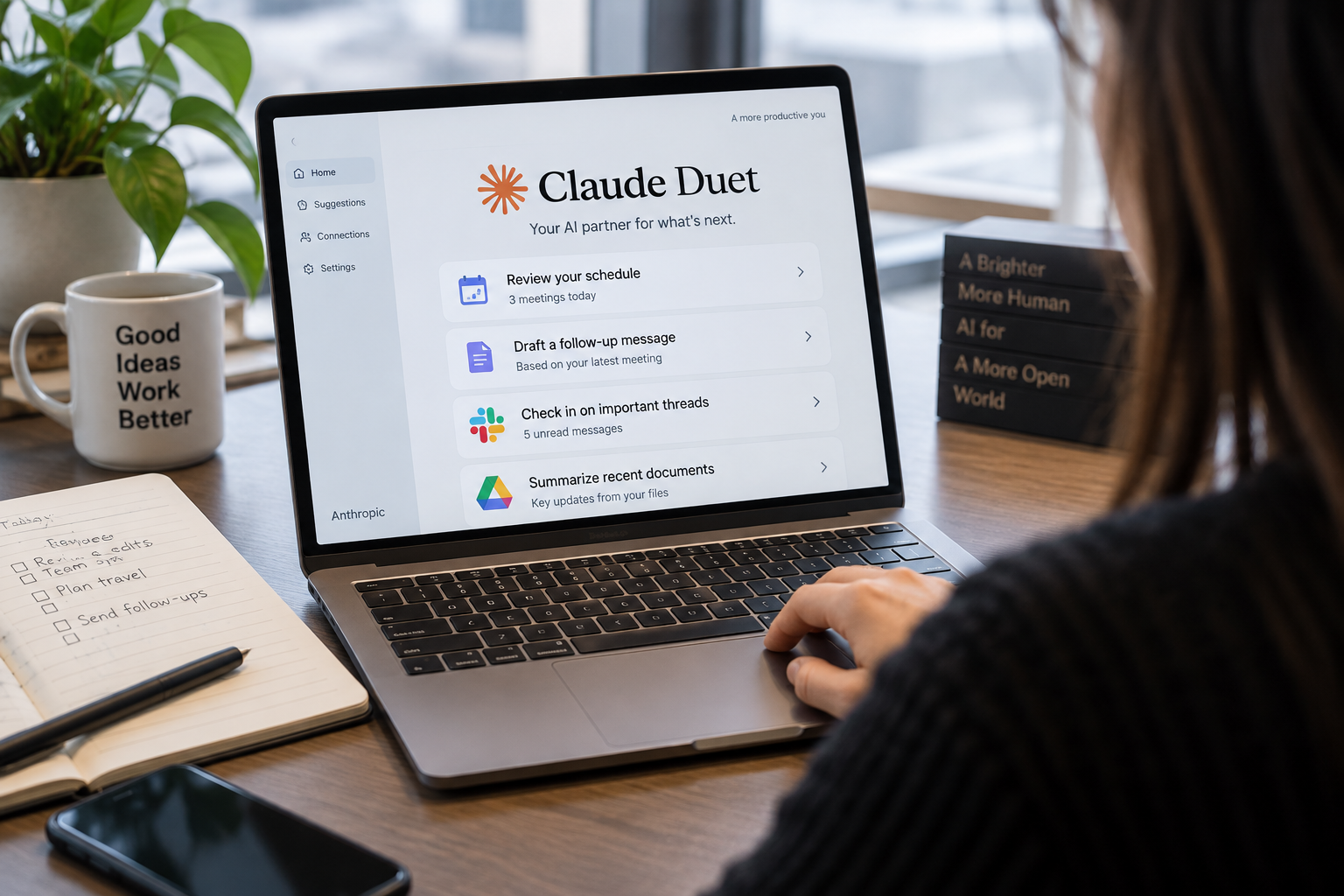
Anthropic’s new consumer AI agent, Claude Duet, can be genuinely useful at managing a busy workload. It can also come across as a little anxious. That was the takeaway after a reporter spent a week testing the tool while juggling a heavy travel and work schedule, giving it access to a work email account, a calendar, Google Docs and Slack.
Duet is still a “research preview,” according to Anthropic. Access is limited to Pro, Max and Ultra subscribers in the United States, and everyone else has to join a waitlist. The company describes the product as built for “professionals and small business owners,” and says it is meant to use its own judgment about which items need a user’s attention first. It will not order lunch or run errands for you.
Like Meta’s Muse, Duet comes with its own app. The design follows Claude’s cheerful, minimalist look. Once users connect the productivity and chat services they want, Duet looks for ways to help and presents its suggestions as cards. Users swipe left to hide a card or right to accept it, which the reporter likened to a to-do list version of Tinder.
Duet arrives after a busy few months for AI agents. Instinct released a text-based assistant, Meta introduced Muse to help with shopping, and OpenAI launched Dots, which focuses on work. Duet is more work-oriented still, and the reporter described it as more approachable than Claude Cowork, which was itself more approachable than Claude Code, the coding agent that set off a wave of hype earlier this year.
Is Claude Duet useful for a busy workload?
The tool’s strength became clear once it had access to the reporter’s accounts. Their biweekly staff meeting is summarized automatically in an email from Gemini. Because Duet could read that email, it linked something said in the meeting to a direct message in Slack. It also worked out who the reporter’s boss was from a shared Google Doc used for weekly one-on-one meetings. Each morning, Duet greeted the reporter with a short message and highlights for the day, such as a reminder to pack equipment needed for a video shoot before a flight. Its suggestions typically ended with an offer to draft a message or add an item to an agenda.
Not every nudge landed. In one case, the reporter had told a source that a story would likely publish on Tuesday and that a link would follow. The draft went to editors late Monday night. Tuesday morning, before 9 a.m., Duet flagged that the story still needed an edit and warned that the reporter might not be able to send the link as promised. The reporter said the alert was misplaced. The tool missed the nuance in the earlier message, which made clear the deadline was not firm, and it did not account for the fact that it was only 7 a.m. where the editor was.
Does Claude Duet write messages or articles for you?
Duet also proved helpful with planning. The reporter had overlooked that upcoming time off would leave only a couple of working days before a major draft was due. Duet suggested a fix, offered to update a Google Doc with weekly notes for the editor, and drafted a Slack message to announce the change. The message was a bit too polished. It mimicked the reporter’s habit of writing in all lowercase, and pointed out its own cleverness in an aside. It also shortened “signature” to “sig,” a choice the reporter said they would never make. Anyone who saw the message would have known it came from an AI, since it carried a “sent with Claude” label.
The tool also repeatedly offered to draft the reporter’s articles. The reporter declined, saying writing is the part of the job they want to keep. When Duet offered to review its own work, the reporter said the moment felt awkward.
Duet also raised a broader question about privacy and control. The reporter opted in to sharing their data and knew exactly what they were doing. Seeing an agent read every email, draft and Slack message in practice still felt unusual. The reporter also wondered whether handing off calendar entries, to-do lists and attention during meetings would change how they felt about their job, possibly making them feel more detached from their workplace.
Can Claude Duet replace a personal assistant?
The reporter concluded that Duet is not yet ready to act as a true personal assistant. The name, the reporter noted, rests on the word “personal.” A human assistant reads tone, knows what matters and what does not, follows office norms and handles people tactfully. Anthropic says it is still testing how Duet decides when to message users, so the tool may improve. The reporter was not convinced that AI will ever fully master nuance.
Still, the test clarified what the reporter wants from AI. Work communication is scattered across email, direct messages, meetings and shared documents. An agent that spots overlooked discrepancies across those sources and raises them is useful. The reporter sees that kind of tool as a backup for personal organization, not a replacement for it. Creative work is another matter. The reporter said they want to find their own way into a topic and stumble on unexpected material along the way, which an agent doing the legwork would skip.
Questo articolo è stato scritto con l'assistenza dell'IA.
News Factory APP - notizie agentiche per potenziare il tuo SEO e AEO.