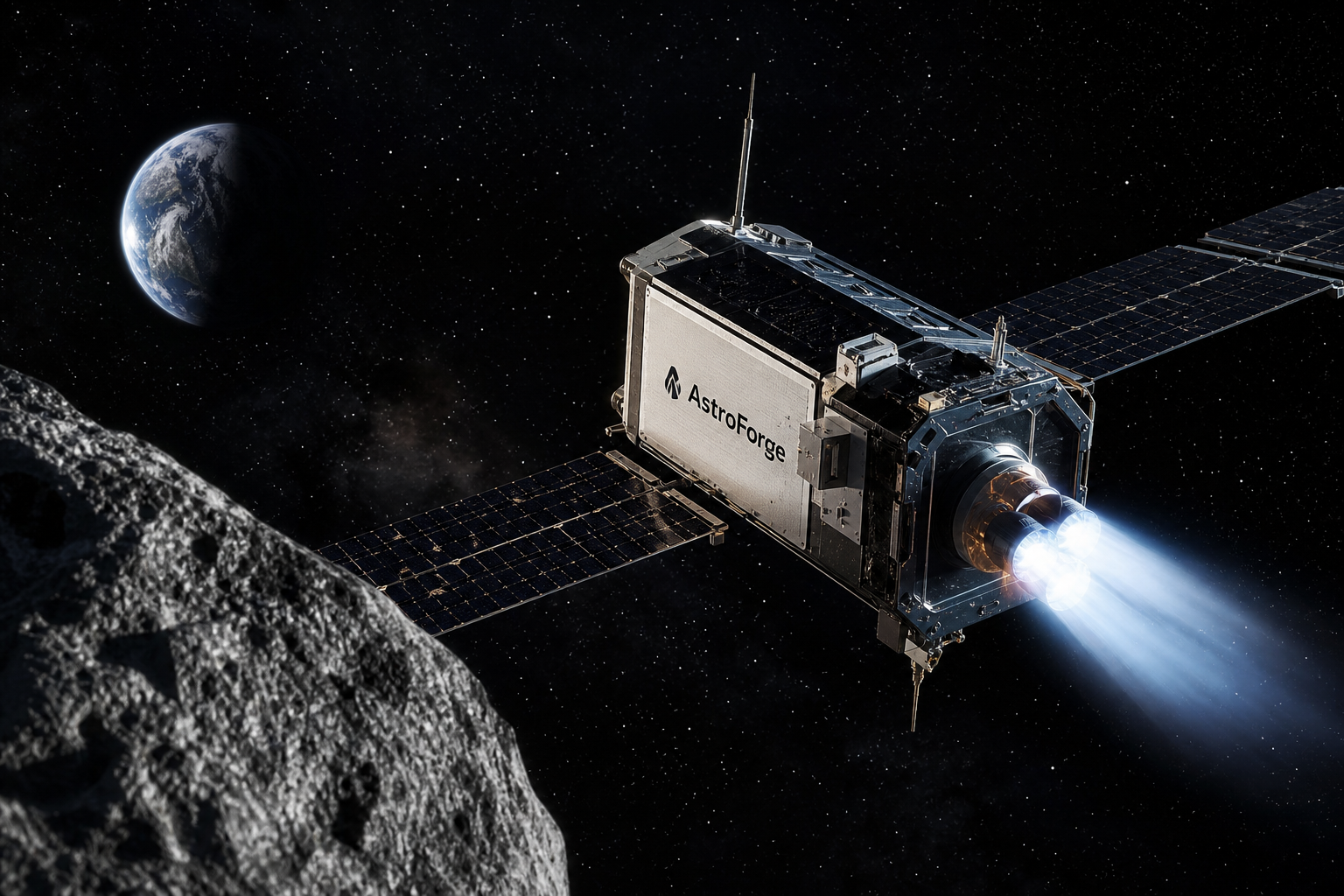
AstroForge, a startup developing asteroid mining technology, is taking a bold step in spacecraft autonomy by launching its first AI-controlled spacecraft in 2027. The company's autonomous control stack, called 'Solo,' is a transformer-based model made in-house, which will be launched on the first rocket by Stoke Space, backed by NASA. This mission aims to gather scientific data about the sun, marking a significant step in spacecraft autonomy.
Traditional spacecraft autonomy relies on redundancy and automation, with teams of flight controllers communicating with the vehicle from Earth. However, this approach is not feasible for startups like AstroForge, which lack the resources to maintain such a system. Instead, the company is leveraging advances in transformer models to create an autonomous control stack that can solve problems onboard.
AstroForge's co-founder and CEO, Matthew Gialich, explained that the company's experience with its Odin spacecraft, which suffered anomalies and communication issues, spurred the development of Solo. 'Would that have been recoverable with all the data on the spacecraft? I don’t know, but I can tell you nothing onboard tried it, and I would love something onboard to try if the spacecraft is unrecoverable at launch,' Gialich said.
The Solo system includes traditional control algorithms, models trained on test data for specific subsystems, and an overall intelligence layer trained on about 2,500 sensors in the spacecraft. Armand Awad, AstroForge's head of flight software, said the company aims to create a constrained autonomy that can perform tasks like anomaly resolution. In theory, the agent in control of the spacecraft will be able to realize and fix issues, such as losing track of its position in space or correlating a power anomaly to issues in its star tracker.
AstroForge's third vehicle, DeepSpace-2, is set to launch alongside Intuitive Machines' third moon mission by the end of 2026, with Solo onboard in 'shadow mode.' This will allow the company's engineers to test the system before the Autonomy-1 mission. While there are concerns about the reliability of neural networks, AstroForge is pushing forward with its autonomous control stack, which could potentially revolutionize spacecraft operations.
Questo articolo è stato scritto con l'assistenza dell'IA.
News Factory APP - notizie agentiche per potenziare il tuo SEO e AEO.