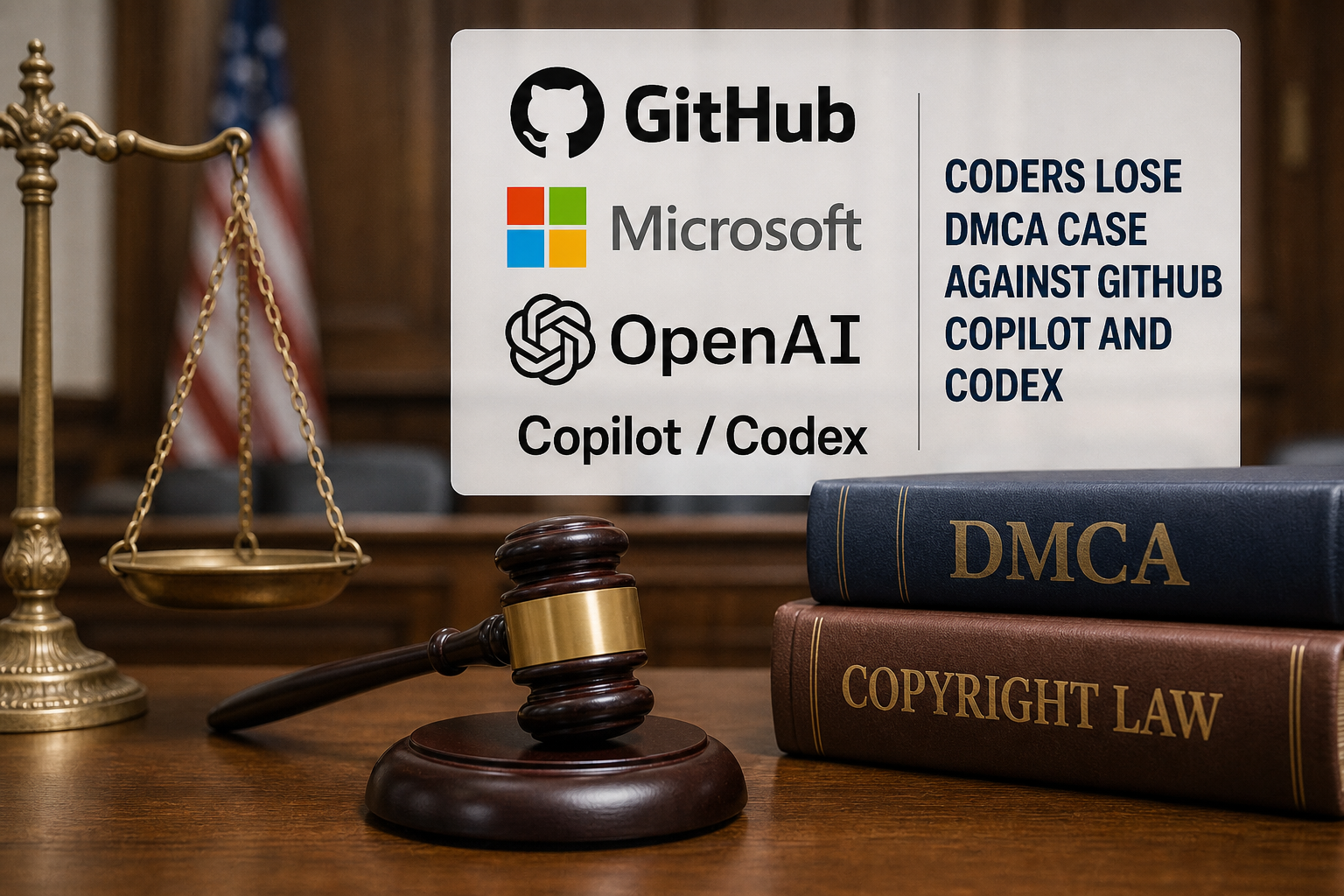
A unanimous Ninth Circuit panel has ruled against anonymous programmers who sued GitHub, Microsoft, and OpenAI over copyright infringement claims related to the AI-powered coding tools Copilot and Codex. The court found that the tools do not violate the Digital Millennium Copyright Act by reproducing open-source code without attribution.
The case, known as Doe v GitHub, centered on the claim that Copilot and Codex breach section 1202(b) of the DMCA, which bars intentionally removing or altering copyright management information. However, the court held that removal requires an existing work to remove it from, and since Copilot generates new code based on statistical patterns, it does not remove or alter existing copyright information.
The court's comparison to a search engine was key in its decision. While a search engine retrieves and displays stored information, Copilot predicts a likely completion based on the input it receives. The court took this as a description of generation rather than retrieval, which meant that the DMCA claim did not apply.
The ruling leaves two breach-of-contract claims running, which turn on the open-source licenses themselves rather than federal copyright law. Open-source lawyer Heather Meeker notes that license notice requirements generally attach to redistribution rather than training, and licenses that grant use for any purpose may offer less protection than developers assumed.
The case has significant implications for the use of AI-powered tools in coding and software development. The Authors Guild, the Association of American Publishers, and other groups had filed amicus briefs in support of the programmers, while the Electronic Frontier Foundation and Public Knowledge argued that a broad reading of the DMCA would have negative consequences for artists, teachers, and engineers who use AI tools.
The ruling is a victory for GitHub, Microsoft, and OpenAI, but the issue of AI-generated content and copyright infringement is far from settled. As AI tools become increasingly prevalent, courts will continue to grapple with the complex questions surrounding their use and the rights of creators.
Questo articolo è stato scritto con l'assistenza dell'IA.
News Factory APP - notizie agentiche per potenziare il tuo SEO e AEO.