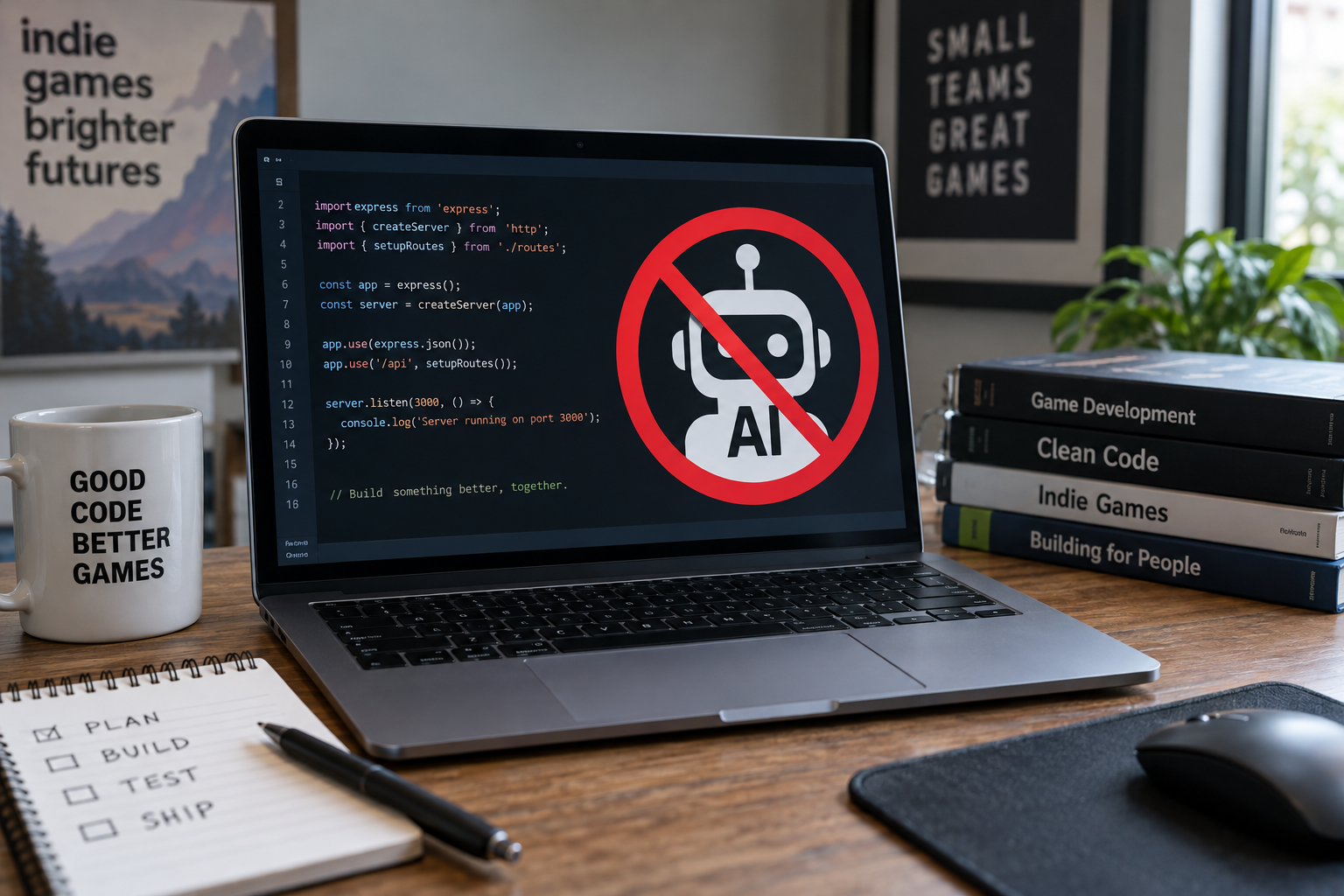
A columnist argues that no amount of AI-generated code is safe, so the least you can use is zero. The argument follows the Independent Games Festival jury's refusal to vote for games using generative AI, a dispute over Big Walk from House House. The writer cites deskilling, degrading codebases, unreliable bug-finding agents, and GPL licensing risks as reasons.
The Independent Games Festival jury said it would not vote for any game that uses generative AI “in any capacity.” The statement landed on Big Walk, a game from House House, the studio behind Untitled Goose Game. Panic publishes the game, and it had been a favorite for this year’s IGF awards. Now a columnist is using the dispute to ask a bigger question: how much AI belongs in the software people build?
The jurors did not draw a line between AI-generated art and sound on one side and AI-assisted code on the other. They wrote that programming is a creative discipline that deserves the same respect as any other part of making a game, and they said that extended to the past work used to train these models without the creators’ consent.
House House responded that it had “sparingly” used LLMs to “help work through difficult technical challenges and bugs.” The studio said less than a percent of a percent of the code in Big Walk had been touched by LLMs in any way. It also said that “this is not an endorsement of, or argument for, the use of AI tools, however minimal,” and it apologized that the game’s LLM usage may not meet the standards of those trying to limit the harm generative AI is doing to video games and the wider world.
The columnist said the episode first looked like a tempest in a teapot. That changed after reading a blog post by Bruno Dias, who wrote that using LLMs means “willingly participat[ing] in a noxious political project” and using products made through exploitative processes. Dias argued that either an ethical boundary exists or it does not, and that a set of heavily subsidized software products that did not exist two years ago falls on the side of faults people should never commit without sanction.
Why do developers worry about AI coding tools?
The columnist says the concern goes beyond ethics. Citing what they describe as growing evidence, the writer points to deskilling among developers and to codebases that get worse the more leeway coding agents are given. The column describes anecdotes of Claude writing four versions of the same function in different places, large sections of code that never get called, and bug-finding agents that imagine bugs or even create them. The writer adds that LLMs do not understand code. They work with statistical relationships between words and phrases.
The column also takes aim at the idea that AI coding tools have made quality easier to achieve. It quotes Lex Friedman’s recent observation that AI has “dramatically reduced the cost of producing an app, but it hasn’t reduced the work required to produce a great app.” The columnist agrees, arguing that the real value lies in apps that show refinement, testing, and care.
Marco Arment, developer of the podcast app Overcast, is a central figure in the column. The author recently moved back to Overcast from Castro, and notes that Arment has become an enthusiastic “agentic coder.” That means Overcast contains Claude-generated code, as does Arment’s new app, Fineliner. The columnist says they do not expect either app to erase data, overheat a device, or leak credit card information. Still, the writer says it is hard to square Arment’s well-known reluctance to use libraries he did not write with his enthusiasm for having robots write code for him.
Does AI-generated code create licensing risks?
Licensing presents another problem. Language models are mostly trained on open-source code, but the column points out that open-source does not automatically mean legal to train on. If an AI tool incorporates GPL-licensed code into software that is not GPL-licensed, the developer has a legal problem, and the writer suspects that problem already exists in thousands of codebases.
The column ends on a personal note. The writer says they can no longer make a living doing technical writing because of AI, and argues that AI does technical writing badly in the same way it does everything else: well enough to slide by if no one cares about the result. The author cites a worried post from the head of Iconfactory, the design and coding studio, about the difficulty of making a living designing for clients and selling apps amid a glut of vibe-coded AI apps.
How much AI-generated code is safe to ship?
The columnist does not reject AI outright. Big Walk, they note, seems to qualify as a terrific app made with generative AI. Still, the writer argues that LLMs cannot make anything thoughtfully because they have no thoughts. Good software, the column argues, requires a human developer with both taste and understanding. “The more you delegate to your robot coding assistant, the less you understand,” the writer says. “And the least amount of LLM-generated code you can use is always zero.”
Questo articolo è stato scritto con l'assistenza dell'IA.
News Factory APP - notizie agentiche per potenziare il tuo SEO e AEO.