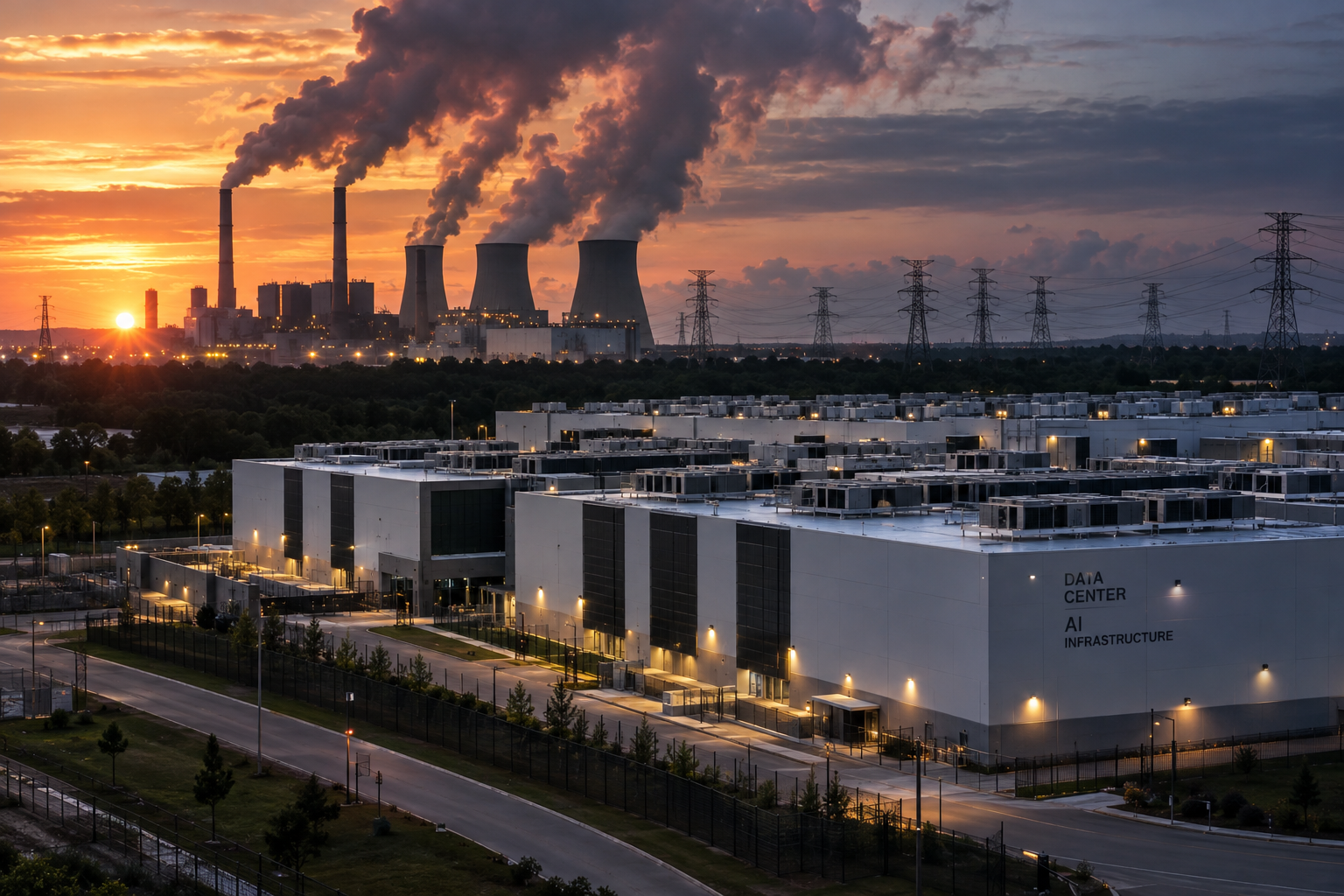
A new Nature Sustainability study estimates that 403 large US hyperscale data centers likely consumed about 82 terawatt-hours of electricity from May 2024 to April 2025, about 1.8 percent of national use. Roughly 54 percent of that power likely came from gas and coal, producing an estimated 25.7 million metric tons of carbon dioxide.
Fossil fuels remain the biggest source of electricity for the largest data centers in the United States, and the facilities together burn through more power than many countries do, according to a new paper in the journal Nature Sustainability.
The study focuses on hyperscale facilities, the sprawling complexes spanning millions of square feet that developers are racing to build, largely to support generative AI. The researchers say the findings show there is a lot of work left to do to cut pollution tied to AI’s reliance on fossil fuels.
“We tend to discuss AI’s environmental footprint as though it were some fixed property of the technology, when in reality the same computing infrastructure can have dramatically different consequences depending on the electricity system supporting it,” said Gianluca Guidi, the lead author and a postdoctoral fellow in the Department of Biostatistics at Harvard T.H. Chan School of Public Health. “I actually find that encouraging, because it means these impacts aren’t inevitable. We have choices about where we build and how we power this infrastructure.”
Guidi and his team used satellite imagery to identify 403 hyperscale data centers across the country. They estimated each facility’s power consumption based on its electrical capacity, then used Environmental Protection Agency data to approximate how much carbon pollution each one would have produced if connected to its local power grid between May 2024 and April 2025.
How much electricity do US data centers use?
The totals are large. The 403 facilities likely consumed around 82 terawatt-hours of electricity that year, about 1.8 percent of all US electricity consumption. That exceeds the annual electricity use of about 148 nations, most of the countries in the world, including Austria, Israel and Venezuela. It does not include the largest economies, such as the US and China, according to John Sterman, director of the MIT System Dynamics Group and the MIT Sloan Sustainability Initiative.
Which power sources do US data centers rely on?
Electricity demand from these data centers produced 25.7 million metric tons of carbon dioxide emissions, comparable to the annual carbon footprint of Denmark, according to the paper. Sterman said that exceeds the total carbon emissions of about 113 nations. The reason is that roughly 54 percent of the electricity the facilities consumed likely came from gas and coal.
Sterman, who was not involved in the research, said he used Claude, an AI model, to help compare the paper’s findings with the electricity use and emissions of individual countries. He said he sees real value in the technology. “I think AI can be extraordinarily helpful,” Sterman said. “But we’ve got to figure out a way to limit the harms. Especially because those impacts are irreversible. Once you allow these data centers to emit the CO2, you can never undo that.”
Sterman said policymakers should require data center operators to bring new clean energy online.
The study has limits. It does not account for local air pollution from new gas infrastructure being built to meet data center demand. It also leaves out gas turbines that some AI companies have installed at their facilities to power themselves without connecting to the grid. And while hyperscale data centers include more than AI computing, they make up only a fraction of the thousands of data centers in the US, with more appearing each year.
Why does data center location affect emissions?
The location of a facility matters a great deal. The study found that generating electricity in coal-heavy Wyoming produced roughly seven times more carbon emissions per kilowatt-hour than in hydropower-rich Oregon. “Two data centers consuming exactly the same amount of electricity can have dramatically different carbon footprints simply because of where they’re located,” Guidi wrote.
Fengqi You, a professor of energy systems engineering at Cornell University who was also not involved in the study, pointed to what he called “long-term carbon lock-in.” “Power plants and supporting infrastructure built to meet rapidly growing data center demand may operate for decades. Decisions made today could therefore shape emissions well into the future,” You said in an email.
Both You and Guidi noted how difficult it is for researchers to estimate energy use at all, because data center operators do not disclose that information. Guidi and his colleagues are building a website to track the environmental impact of individual data centers. A bipartisan bill moving through Congress could also require broader national disclosure of data centers’ electricity use.
Gina McCarthy, a former White House national climate advisor and EPA administrator, said in a statement shared by the study’s authors that communities and policymakers need reliable, independent data on what these facilities mean for air quality, health and the climate. “This study is an important step.”
Questo articolo è stato scritto con l'assistenza dell'IA.
News Factory APP - notizie agentiche per potenziare il tuo SEO e AEO.