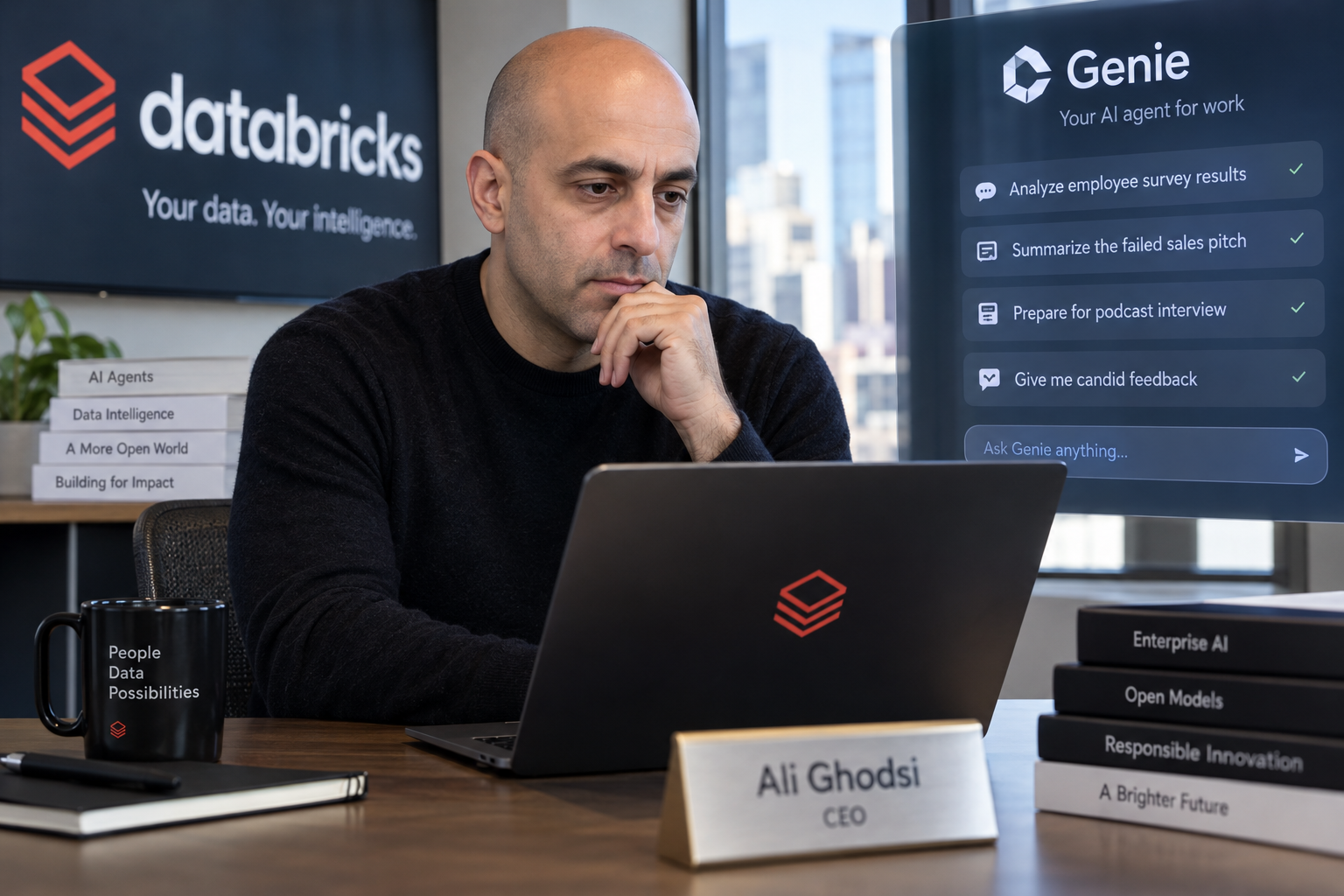
Databricks has released an updated version of Genie, its AI agent that can perform multistep jobs and complete assigned tasks unsupervised. CEO Ali Ghodsi demonstrated it on his own work, including an employee survey, a failed sales pitch and podcast prep, and said it gives him the blunt feedback he no longer gets from staff.
What is Databricks’ Genie AI agent?
Databricks on Wednesday released an updated version of Genie, its AI agent that can now perform multistep jobs that take extended work to finish. The company says corporate leaders can assign it a wide range of tasks, and the agent will complete them unsupervised. To make the case, CEO Ali Ghodsi skipped the usual product demo and fired up his actual agent, then walked a reporter through his most recent chats and charts.
The agent works through an ontology that Databricks built to give Genie the context it needs from the information customers store on the Databricks platform. Ghodsi used it to dig into an employee satisfaction survey. He showed how it picked out the areas where the company scored poorly, then helped him rate, and discard, fixes that some executives had proposed for those low scores.
Genie also tackled a sales problem. Ghodsi had it summarize a large pitch to a prospect that went badly. The summary included the features the prospect said it needed before it would buy. Ghodsi has also used the agent to prepare for a podcast interview, having it review his previous appearances and develop likely questions. During the conversation with the reporter, he even asked it what he should say. The advice, the reporter noted, was not bad.
Can AI agents give executives candid feedback?
The most telling use, according to the account, was the one Ghodsi described least directly. He was using Genie to find out what he is now unlikely to hear as the head of a company of about 12,000 people. The agent became a source of blunt information about what was not working, and he said it gave him things he needed to address.
When the reporter pointed this out, Ghodsi brought up a well-known idea. “Have you heard of Dunbar’s number? The magic number is 150,” he said. Named for British anthropologist Robin Dunbar, the figure is theoretically the maximum number of people with whom humans can maintain stable relationships. In a small startup, a CEO knows everyone and has direct relationships with them, so employees feel safe delivering bad news. At 12,000 employees, Ghodsi acknowledged he cannot know everyone. A salesperson is unlikely to confess a disastrous sales call to the CEO, and an HR manager is unlikely to admit that a plan to raise employee satisfaction will probably fail.
“Anyone who has more than 150 employees, which is a lot of companies, a lot of people can get value out of this,” he said of AI agents generally and of Genie specifically.
Databricks is now pitching Genie as an always-on agent for business leaders, and Ghodsi’s own daily use is central to that message. Inside the company, the practice is often called dogfooding, from the phrase “eating your own dogfood.” Ghodsi said he also uses Genie in his personal life, instead of alternatives such as OpenClaw, Instinct or Muse, which he described as raising security concerns.
He argues that Genie can do for the business side what AI agents and harnesses are doing for programmers. A harness is the software that wraps around an AI model and lets it use tools.
How does Databricks manage AI agent costs?
Cost is the obvious objection. Agents could push corporate AI spending higher, and Ghodsi said that risk can be managed. He pointed to Databricks’ Unity Gateway product, which lets companies set usage limits and swap in less expensive open-weight models.
Questo articolo è stato scritto con l'assistenza dell'IA.
News Factory APP - notizie agentiche per potenziare il tuo SEO e AEO.