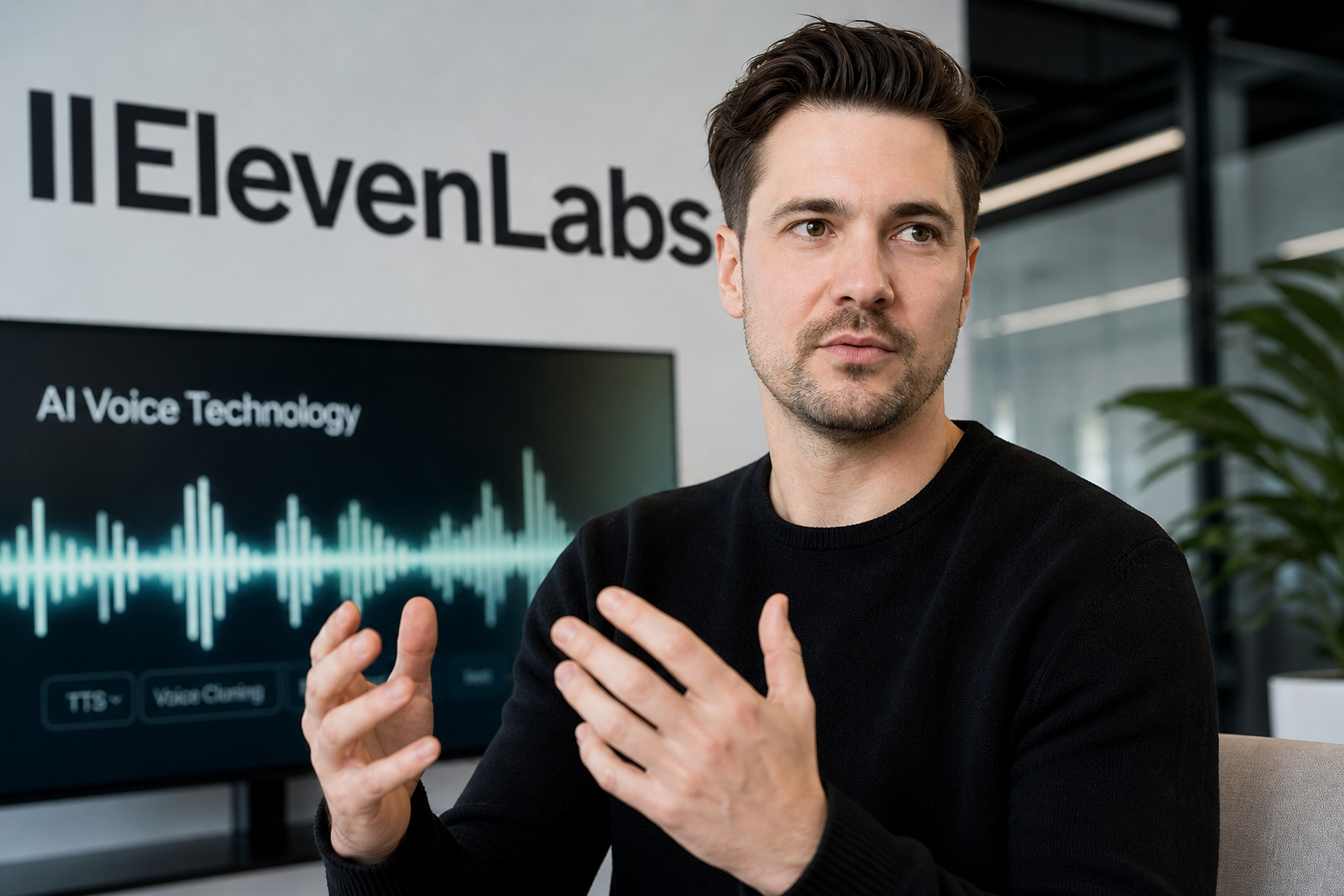
ElevenLabs, a company that specializes in building the voice layer of AI, has seen significant growth in recent years. With a reported valuation of $22 billion, the company is making waves in the industry. CEO Mati Staniszewski sat down to discuss the company's progress, the increasing competition in the market, and the importance of transparency when using AI in customer service.
ElevenLabs' technology is designed to turn text into speech that sounds human, and is used by a range of companies, including Klarna, Deutsche Telekom, and Adobe. The company also sells its platform to creators, who use it for audiobooks, dubbing, and music. However, with the rise of competing companies, such as Decagon, which trained its voice product on ElevenLabs' technology, the market is becoming increasingly crowded.
Staniszewski believes that businesses should disclose when a customer is talking to an AI agent, rather than a human. He thinks that this transparency is important, especially as the use of AI in customer service becomes more prevalent. However, he also acknowledges that this may not always be possible, and that the company is working to improve the quality of its AI models to make them more indistinguishable from human customer service representatives.
The company is also working to expand its market share, and is willing to sacrifice some of its gross margins in order to do so. Staniszewski notes that the company's ability to fine-tune and constrain its models in smart ways allows it to keep costs down, and that it is able to pass on any savings to its customers.
As the company looks to the future, it is preparing for a potential IPO in 2028. However, Staniszewski is cautious about the timing, and notes that the company will only go public when the time is right. With its valuation and growth, ElevenLabs is certainly a company to watch in the AI industry.
Staniszewski also discussed the company's approach to training its AI models, which involves annotating data and using thousands of people to help with this process. He notes that the company is able to detect accents accurately, and that its models are designed to be highly customizable.
In terms of the use of frontier lab models versus open-weight models, Staniszewski notes that it's less of a binary choice. He believes that open-source models can be used for informational purposes, but that frontier models are still necessary for more complex tasks, such as financial services.
The company's technology is being used by a range of customers, including governments, and Staniszewski notes that each deployment requires a different approach. He believes that the company's ability to adapt to different use cases is one of its key strengths.
Finally, Staniszewski discussed the potential risks associated with the use of AI, including the risk of cybersecurity breaches. He notes that the company takes precautions to prevent these types of breaches, and that its technology is designed to be secure.
Questo articolo è stato scritto con l'assistenza dell'IA.
News Factory APP - notizie agentiche per potenziare il tuo SEO e AEO.