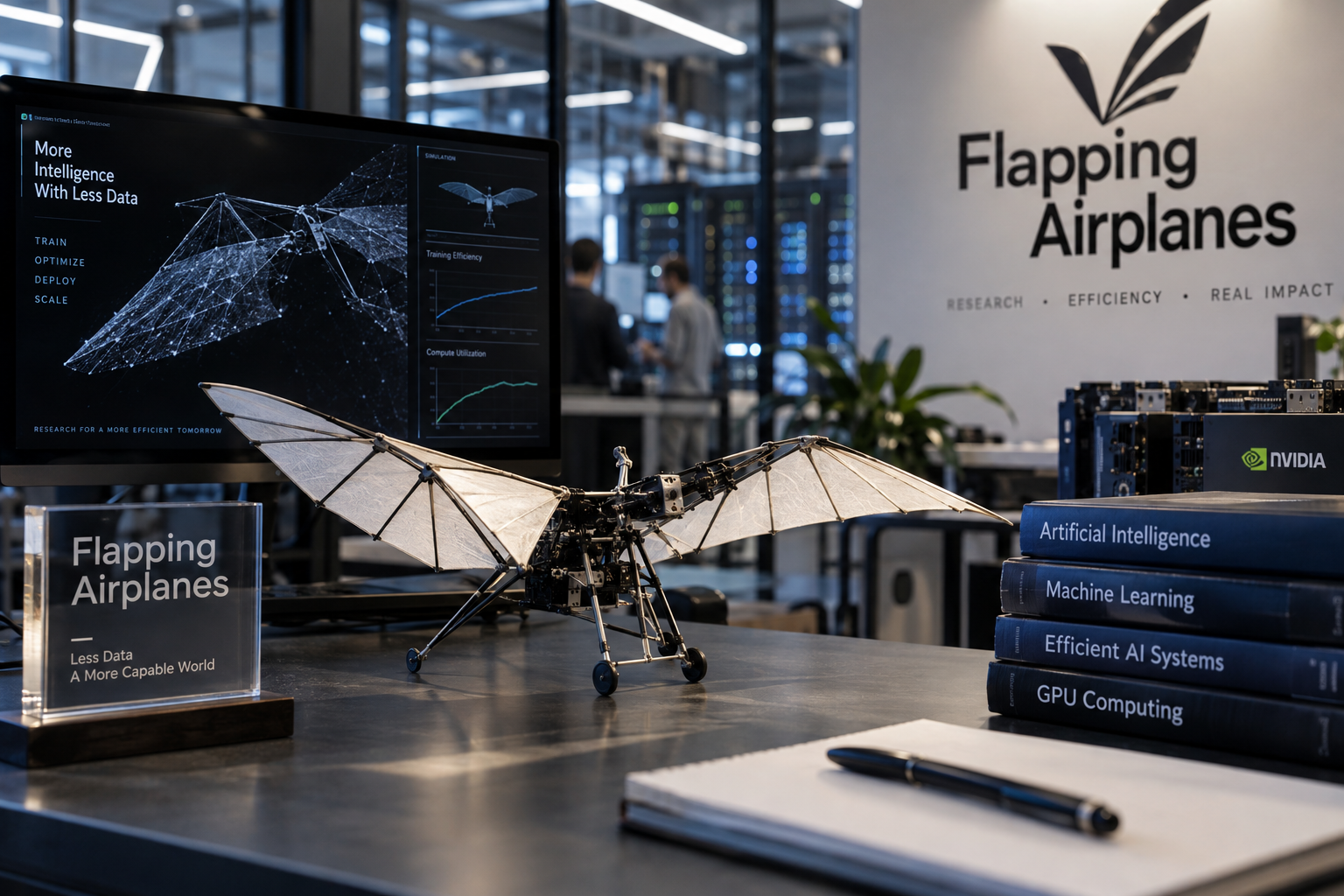
Flapping Airplanes, a year-old AI research lab, raised $1 billion in a Series A round at a reported $6 billion valuation, co-led by Index Ventures and Lux Capital. The company is building AI systems that cost less to train and run, and it does not yet have a product on sale.
Flapping Airplanes, a year-old AI research lab, has raised $1 billion in a Series A round at a reported $6 billion valuation. The company announced the round Wednesday. Index Ventures and Lux Capital co-led it.
The valuation has quadrupled in roughly nine months. Flapping Airplanes launched in January with a $180 million seed round from GV, Sequoia Capital and Index, which valued the company at $1.5 billion. Earlier backers Sequoia, GV and Kleiner Perkins also took part in the new round. Valor, Atreides, Kleiner Perkins, A* and Nvidia are also investors.
The company was founded by Aidan Smith and brothers Asher and Ben Spector. Smith is a former founder and Thiel fellow who worked at the brain implant company Neuralink while in college. Asher Spector earned a statistics PhD at Stanford. Ben Spector was a computer science PhD student at Stanford and founded Prod while he was at MIT. Prod is a student-run startup accelerator, five years old, that David Cahn, a partner at Sequoia and an investor in Flapping Airplanes, has described as one of the most powerful talent incubators in Silicon Valley.
What is Flapping Airplanes building?
The startup's central goal is to build AI systems that cost less to train and run. The founders say they want to create intelligent systems without ingesting half the internet. To get there, they have built what they call the world's most complete megakernel framework. A kernel is a program that runs on a graphics processing unit, and a megakernel bundles many tasks into a single program. According to the founders, the framework can overlap memory-bound inference with compute-bound training. In practice, that means one task that spends most of its time waiting for data can run alongside another that spends most of its time doing math, so the chip is rarely idle.
Asher Spector told Bloomberg that the startup is working on ways to train models with less data and computing power. It also wants to get more out of the chips that run them. “The basic thesis is demand for AI is going to outpace chip and data supply,” he said. He added that getting 10 percent more performance out of each chip would be “tremendously economically valuable.”
To pursue that, the company has been writing its own version of the software that runs Nvidia's graphics chips, co-founder Aidan Smith said. Nvidia is one of the company's investors.
Does Flapping Airplanes have a product on sale?
In an earlier interview with TechCrunch, Asher Spector put the goal in simple terms. “A model that’s a million times more data efficient is probably a million times easier to put into the economy,” he said. The company does not have a product on sale. Spector told Bloomberg that Flapping Airplanes plans to sell its technology eventually, to make AI cheaper for other companies to use.
The company belongs to a growing group of AI startups that focus on research before building products. Bloomberg describes these firms as “neolabs.” Yann LeCun's AMI Labs raised about $1 billion in March. Mirendil raised $200 million in June. Flourish, run by Internet Explorer co-creator Thomas Reardon, was reported in May to be raising about $500 million for brain-inspired AI that uses less energy. Other startups are chasing the same idea of making AI cheaper to run.
The bets come as AI companies spend heavily on chips and data centers. Flapping Airplanes is using its new funding to hire and try to turn its research into working systems. The name refers to the ornithopter, an old aircraft design with flapping wings. Spector said it stands for combining the strengths of natural and artificial intelligence.
Questo articolo è stato scritto con l'assistenza dell'IA.
News Factory APP - notizie agentiche per potenziare il tuo SEO e AEO.