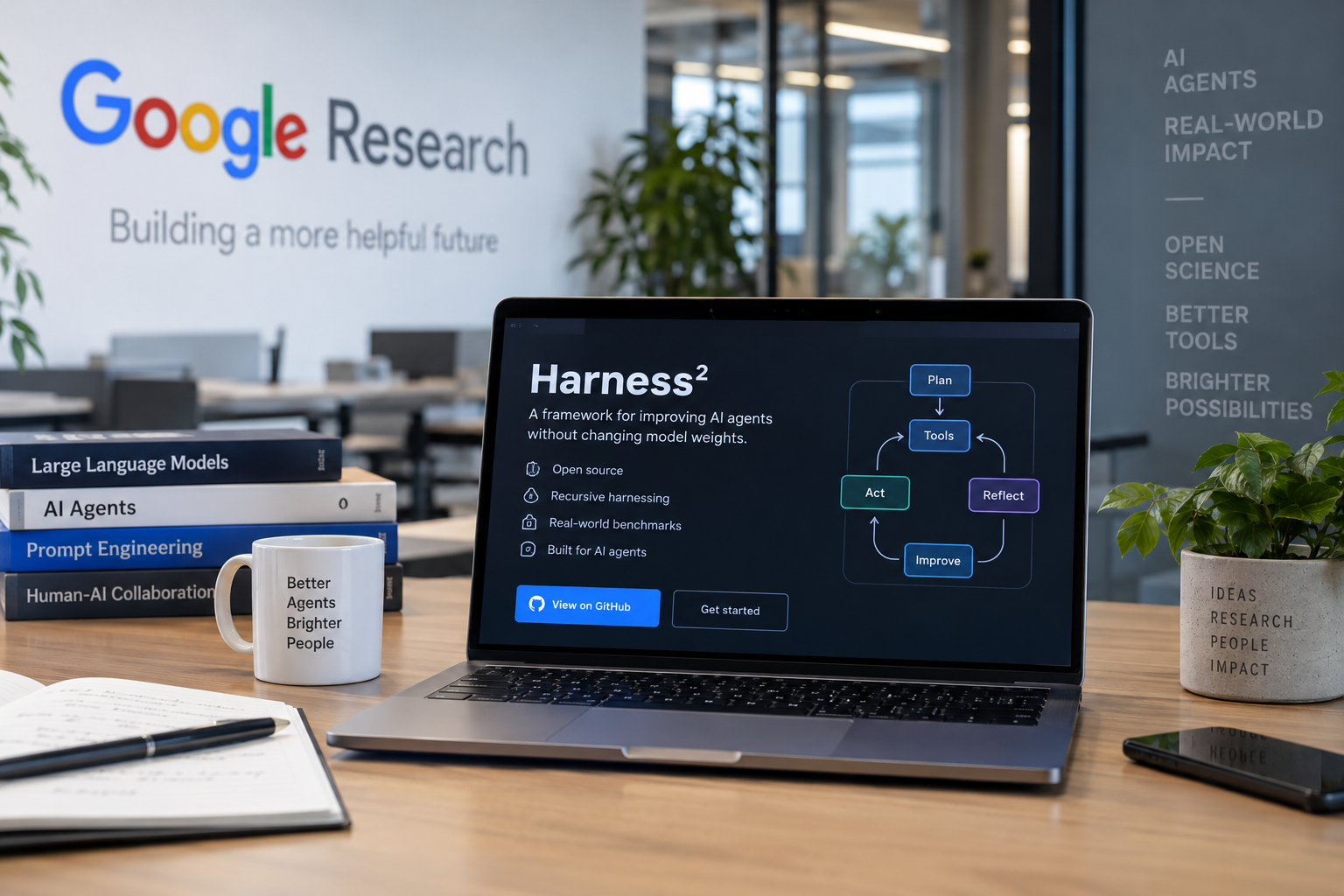
What is Harness² and what does it do?
Google Research has released Harness², an open framework designed to help AI agents handle tasks they were never built for. The project, published in a public code repository, aims to improve the system wrapped around a model rather than the model itself.
That system is known as a harness. It includes the prompts, tools, memory, skills and orchestration logic that let a model act as an agent. Harnessing, in the project's terms, is the process of optimizing that system. Harness² is built to do this in what its developers call an open world, where agents regularly run into tasks the harness was not designed to handle.
How does Harness² improve AI agents without changing model weights?
The framework operates on two levels of recursion. The first, task-level recursion, refines the harness for the task at hand. It works through a step the developers call Propose–Probe–Compose. The system proposes edits, tests how those edits change behavior on the same task, and then builds a refined harness from the differences between executions. It does this without ground-truth feedback, meaning it does not need a correct answer to learn from.
The second level, harnessing-level recursion, maintains a persistent improvement harness. After each task, the system keeps the adopted harness and any lessons the evidence supports, then uses them to guide later refinement.
The team reports results across three professional benchmarks and four model-harness configurations. A single Harness² step improved GLM-5 and Gemini 3.5 Flash over their base harnesses. The largest gains were 11.5 points on WorkBuddy-Bench, 4.5 points on JobBench and 11.8 percentage points on the partial pass rate for LAB. Increasing the task-level recursion budget produced further gains, according to the documentation.
Developers can edit eight components around the model: the system prompt, guardrails, memory, tool guidance, subagents, skills, scripts and plugins. Together, those components control how context is built, how the model interacts with tools, how work is delegated and how the model behaves inside the tool loop.
Harness² supports two ways of scaling refinement. Parallel recursion probes several candidate harnesses at once, with a mix of general and domain-specific candidates, and composes refinements from the results. Sequential recursion carries the improved harness and its accumulated evidence through successive steps. The project summarizes the difference simply: parallel recursion explores wider, while sequential recursion refines deeper. The release also supports OpenCode and Codex executors, with OpenCode as the default.
The framework ships with three benchmarks. JobBench covers professional work, LAB covers legal work and WorkBuddy-Bench covers office, web and code tasks. WorkBuddy also offers office, web and code subsets. Setup requires Linux, Python 3.12 and the uv package manager. A local demo runs both recursion modes with deterministic editors and real Python executions, and it needs no model credentials.
What do you need to run Harness² with model-backed benchmarks?
Running model-backed benchmarks requires more. Users need Node.js 20 or newer, the Google Cloud CLI and the dependencies for each benchmark. LAB needs Pandoc and Poppler, and WorkBuddy-Bench needs Docker. Models run through Vertex AI, and the documentation warns that these runs incur API costs, recommending small task selections to start. A dry-run flag previews which tasks would be selected without making any model calls.
The project also flags a security concern. Executor network access is unrestricted, and Codex runs with its sandbox disabled. Public benchmark rubrics may be available online, so the documentation tells users to configure network restrictions before evaluation to keep benchmark answers and grading criteria out of reach.
Results are saved under a runs directory, organized by benchmark and subset. Each run includes task summaries, deliverables, adopted harnesses, reflection notes and evaluation results. Users can repeat a command to resume an interrupted run, and they should use a new runs directory when changing models or task selection.
Harness² is licensed under Apache 2.0. Third-party code, benchmarks and datasets keep their upstream licenses. The project carries a disclaimer stating that it is not an officially supported Google product and is not eligible for the Google Open Source Software Vulnerability Rewards Program. The accompanying paper, listed on arXiv as 2610.14224, is credited to a team of researchers, with Ruiyao Xu named first.
Questo articolo è stato scritto con l'assistenza dell'IA.
News Factory APP - notizie agentiche per potenziare il tuo SEO e AEO.