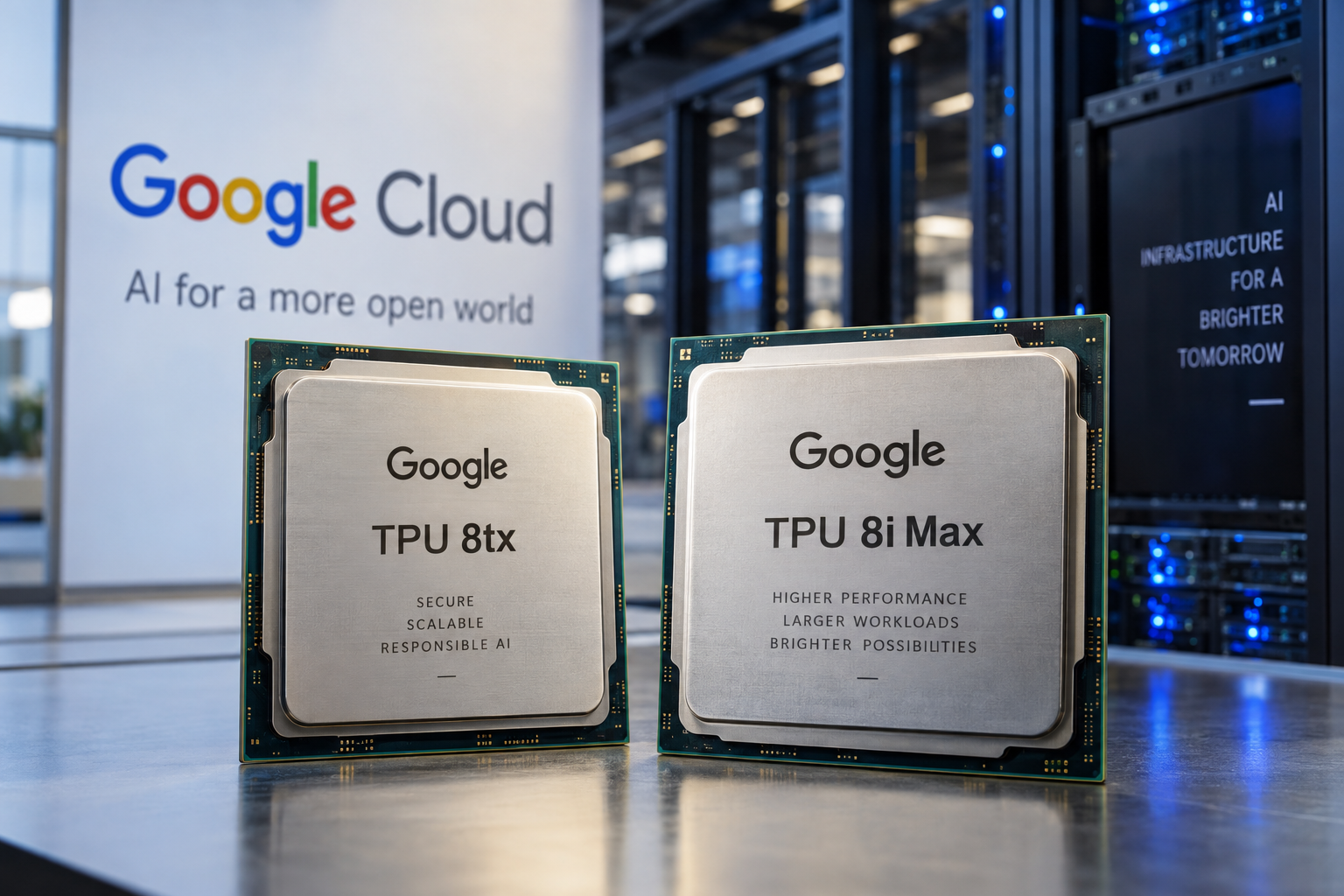
Google has added two chips to its TPU lineup: the TPU 8tx, built for running AI models and agents on private data in governments and regulated businesses, and the TPU 8i Max, which combines two TPU 8i chips to double computing power, on-chip memory and memory bandwidth for large workloads. Pricing and release dates have not been disclosed.
Google has added two chips to its line of in-house AI processors, aimed at two very different jobs: running AI on private data and handling large-scale workloads that need serious memory and computing muscle.
What is the Google TPU 8tx?
The first, the TPU 8tx, is designed for governments and regulated businesses that need to run AI models and agents on private data. It uses the same silicon as Google’s TPU 8t training chip and works alongside AMD’s fifth-generation EPYC processors. Google says its security features are built directly into the hardware, keeping data and model weights isolated and protected while the chip is running.
The 8tx can also handle smaller training jobs. That lets teams fine-tune models on private data and run other workloads without moving the data between clusters. Google describes the chip as offering “hardware-level confidential compute for private fine-tuning and secure agent execution.” The company said its faster network design cuts latency by up to 50% compared with the TPU 8t.
What does the TPU 8i Max do differently?
The TPU 8i Max takes a different approach. It combines two TPU 8i chips in a single package, and compared with the standard 8i, it doubles computing power, on-chip memory and memory bandwidth.
Google is pointing the 8i Max at workloads where memory access can become a bottleneck. Those include AI agents working across entire codebases and systems analyzing hours of video. The design also fits twice as much silicon into the same rack space, which increases the computing capacity data centers can run per square meter and per watt.
The launch expands Google’s eighth-generation TPU lineup to four systems. The company unveiled the first two, the TPU 8t and TPU 8i, at its Cloud Next event in April. Google said it is the first time it has introduced four TPU systems in a single year.
When will Google's new TPU chips be available?
Google has not disclosed pricing or exact release dates for either chip. The company’s chief technologist for AI and infrastructure, Amin Vahdat, wrote in a blog post that Google’s TPU business now has nearly 100 customers. They include frontier AI labs, trading firms, retailers and universities.
TPUs are among the main alternatives to Nvidia’s chips for AI workloads. Google makes them available through its cloud business and works with four design partners to develop them.
Questo articolo è stato scritto con l'assistenza dell'IA.
News Factory APP - notizie agentiche per potenziare il tuo SEO e AEO.