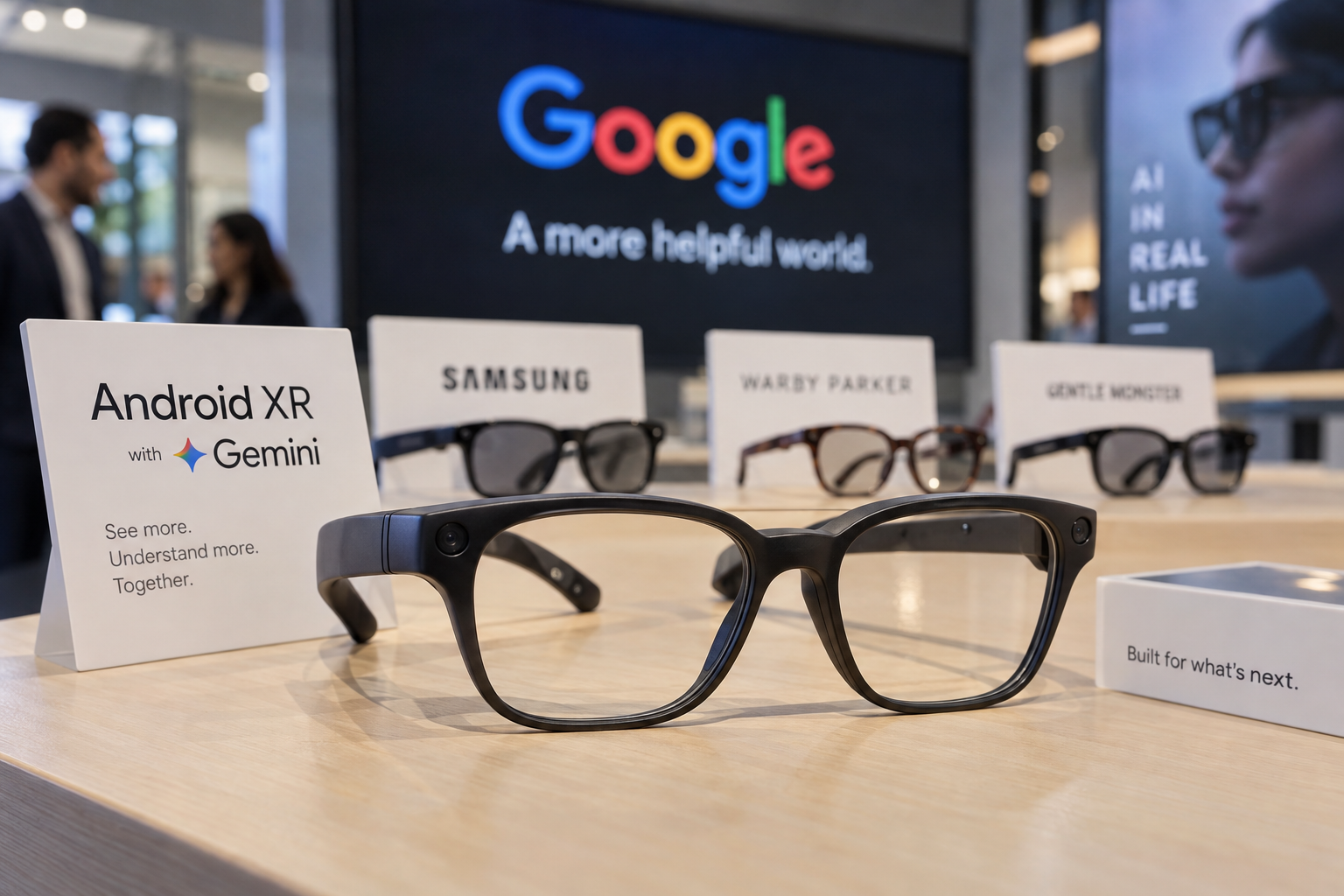
Samsung, Warby Parker and Gentle Monster are launching smart glasses that run Google's Gemini assistant through Android XR. The glasses automatically redact faces in photos and videos, process audio only from the wearer, and offer real-time translation after a tap. Preorders open now, with shipping expected to begin December 10.
Samsung, Warby Parker and Gentle Monster are bringing a new wave of smart glasses to market, and they arrive at a rough moment for the category. Meta has driven the smart glasses comeback for the past several years, but its privacy record earned its glasses the “pervert glasses” nickname and has made the product line a tough sell in some circles. Google is betting that a stronger privacy stance and a more capable AI assistant can change the conversation.
How well does live translation work on Google's smart glasses?
All of the new glasses were made by Samsung and run Google’s Gemini assistant through Android XR, the company’s platform for smart glasses and mixed-reality headsets. In hands-on testing, the live translation features stood out. Speech in French, Spanish, Korean and German was translated in real time after a tap, and users don’t have to pick the languages or download a specific language pair ahead of time. Meta’s Ray-Ban Display struggled with a similar setup during a recent trip, according to the reviewer. In a test with an English speaker and a Thai speaker, the Google glasses translated both into Japanese correctly.
How do Google's Android XR glasses handle privacy?
Privacy is where Google made its boldest move. The glasses automatically redact faces from photos and videos to protect bystanders. When the reviewer asked Gemini to identify a colleague on camera, and later an editor, the assistant said it could see a person but could not identify them because of privacy protections. Meta’s glasses don’t offer that kind of facial redaction, and Google’s decision to rule out facial recognition entirely stands out.
The privacy LED that signals when a camera is recording is standard on these glasses, and they will disable if someone tampers with it. Juston Payne, Google’s senior director of product management for extended reality, said the company wants to go further than the light. “Somebody might come up with some solution that our algorithms can’t detect, so then the question becomes: So what can we do?” Payne said. “We’re not going to target ads on it. We’re not going to train Gemini on it. Humans aren’t going to be able to use it to improve the models. We’re also redacting faces before they actually go to the server in the first place.”
Bystander audio gets scrubbed too, according to Payne. The glasses process sound only from the wearer through beamforming microphones, and camera and microphone access require users to opt in.
Google is also extending its rules across its own services. YouTube will crack down on videos featuring harassment or unwanted sexualization, regardless of how they were captured. Google Shopping and Google Ads won’t allow sales or ads for accessories such as lens covers for privacy LEDs. Google Play policies will bar third-party apps from enabling social livestreaming, real-time facial identification, or changing how the LED works. Apps that request camera or microphone access will undergo further review to confirm they are used responsibly. That review matters less today, but it applies to future Android XR devices and products like Xreal’s Aura glasses.
The reviewer said it is too early to judge how the public will respond to the policy. Still, the approach is far broader than Meta’s more reactive stance so far, though Meta does not operate an app store or a computing platform like Android. Locally blurring faces and ambient audio also means giving up a source of training data, which makes the choice a notable one.
Style remains Meta’s strongest suit. Its partnership with EssilorLuxottica offers more than 100 combinations of frames and lenses. Warby Parker’s collection includes three designs in green, brown and black, starting at $395. Gentle Monster offers six frames, including two with a distinctly Y2K look, with bolder colors and tinted lens options. Those models start at $449. The reviewer found the Warby Parker line more everyday, while the Gentle Monster frames felt more editorial and runway-ready.
The glasses weigh 41 grams, which is light for the category. Battery life is estimated at about nine hours, and the case provides up to seven additional charges. The 12MP ultrawide camera takes decent photos and video, and image stabilization straightens tilted shots.
Accessibility features include Guided Vision, which gives conversational audio descriptions of a user’s surroundings. Android XR is also working with Aira, a service that streams what the camera sees to a live human interpreter. At launch, the Aira feature will work only with Android phones. The glasses themselves work with either type of phone.
Gemini also appeared more capable than Meta AI on the Ray-Bans in the reviewer’s tests. It added event details from a concert flyer to Google Calendar, pulled up flight options, gave walking directions and listed museum hours. It also corrected its own mistakes in real time and asked for a better view of an object when it couldn’t identify it.
When do Google's Android XR smart glasses ship?
Preorders open today, and the glasses are expected to ship starting December 10. The reviewer’s conclusion was that technology is not the main obstacle for smart glasses. Adoption will depend on culture, privacy and usefulness, and a single dominant player has shaped the discussion so far. Serious competition from Google, the reviewer argued, is good news for consumers.
Questo articolo è stato scritto con l'assistenza dell'IA.
News Factory APP - notizie agentiche per potenziare il tuo SEO e AEO.