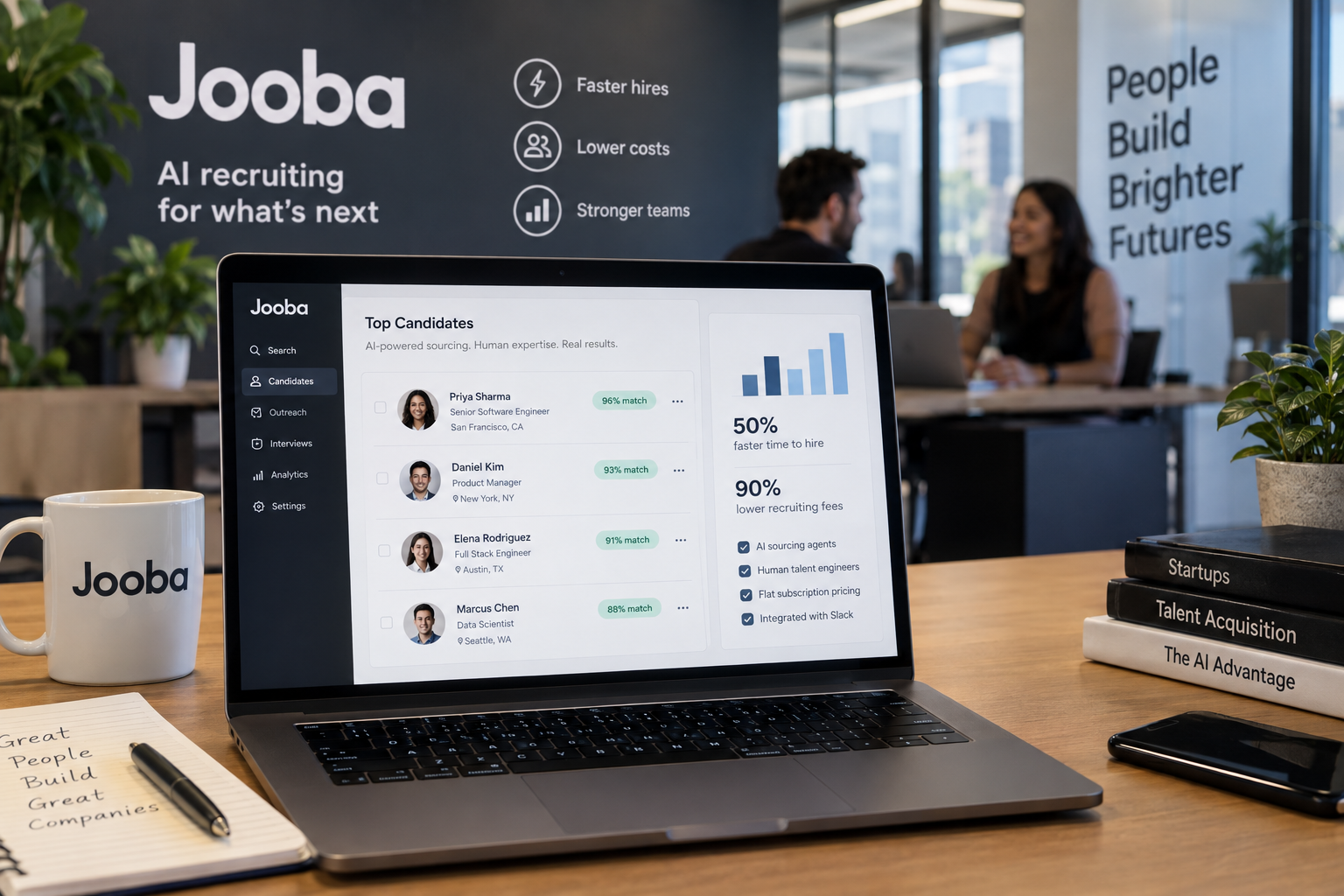
Jooba, a company that uses artificial intelligence to source job candidates, has launched generally and raised $4 million in seed funding from a16z Speedrun, Scribble Ventures and Genius Ventures. Its pitch is a managed recruiting service that pairs custom AI agents with human recruiters, sold through a flat subscription rather than large fees for each hire.
For a fast-growing startup, recruiting can quickly become a job of its own. Founders have to define roles, find candidates, write outreach and keep a pipeline moving, often while also managing the team those new hires will join. An outside agency can take on some of that work, but the fees can make every hire an expensive decision.
Jooba says AI now makes a different business model possible. The company builds a dedicated AI sourcing agent for each open position and sells the service on a subscription basis. According to Jooba, that approach can reduce total time to hire by 50% and recruiting fees by 90%. Those are significant claims, and they explain the business the company is trying to build. Jooba wants to offer the hands-on help companies expect from a recruiting agency while passing along savings it says automation makes possible.
The bet rests on the idea that startups want recruiting results more than they want another piece of software. Self-serve tools can search for candidates or automate parts of outreach, but someone still has to run them, judge whether the results are useful and turn a list of names into real conversations. At a small company without a recruiting team, that work usually falls to a founder or hiring manager.
How much does AI recruiting cost compared with traditional agencies?
Jooba argues that traditional agencies have not kept pace with what technology can do. In its announcement, the company points to placement fees that can exceed $30,000 per hire, a heavy cost for a startup filling several roles at once.
“Traditional recruiting agencies are using AI to do less work while still charging startups $30,000 to $50,000 a hire,” said Troy Kirwin, partner at a16z Speedrun. “As an AI-native firm, Jooba is fixing that misalignment by building a structurally better business model that serves the needs of fast growing companies much better.”
How does Jooba's AI recruiting service work?
Customers start by meeting with a human “talent engineer” to describe their hiring needs. Jooba then builds a sourcing agent for each role, calibrated to its technical and cultural requirements. The company says those agents continuously search through millions of potential candidates to find people who could be a fit.
Does Jooba keep humans involved in the hiring process?
Human staff stay involved before any outreach begins. Talent engineers review, refine and approve the candidate pipeline, creating a checkpoint between the automated search and the message sent to a prospective hire. That division of labor is central to the product. The software handles the volume of searching, and people decide what the system produces is worth pursuing.
Jooba also tries to make the service feel like part of the customer’s own hiring team. It sends personalized outreach under the hiring manager’s or founder’s name, so candidates do not encounter a separate recruiter at every step. Qualified, interested candidates are routed into a dedicated Slack channel, where the team can review them and schedule interviews. For companies already coordinating work in Slack, that places the recruiting pipeline inside a tool they already use.
Speed is another main selling point. “Founders don’t have months to wait for an agency to slowly build a pipeline, which is why we optimized Jooba for sheer speed to value,” said Mark Benliyan, co-founder and CEO of Jooba. “Within 22 hours of our onboarding call, our customers are talking to their first highly qualified candidate. By letting our AI agents do the heavy lifting of sourcing, we are cutting the total time to hire by 50%, allowing lean teams to stay focused on building their product.”
A first candidate conversation is not the same as a completed hire, however. Interviews, decisions and whether a candidate accepts an offer all still come after the sourcing stage. Jooba’s broader claim is that a faster sourcing process leads to a shorter overall hiring timeline.
Customers have offered their own praise. “We’ve tried nearly every other recruiting platform and agency out there, and can confidently say Jooba has been by far the best recruiting experience we’ve ever had,” said Keyan Kazemian, co-founder and CEO of 222.
Pricing is the other major part of Jooba’s effort to stand out. A flat fee lets companies budget for recruiting differently than they would for a large charge tied to each placement. Jooba says its flexible subscriptions let startups scale their hiring capacity up or down as needs change.
With the seed round and general availability, Jooba is entering the market with a simple proposition: startups should be able to buy a managed recruiting service at a price that reflects the work AI can automate.
The company will have to prove it can keep delivering candidates quickly, preserve the human judgment customers are paying for and make the subscription model work as hiring needs shift. If it does, Jooba could give growing companies a reason to rethink both the traditional recruiting agency and the software they use to hire.
Questo articolo è stato scritto con l'assistenza dell'IA.
News Factory APP - notizie agentiche per potenziare il tuo SEO e AEO.