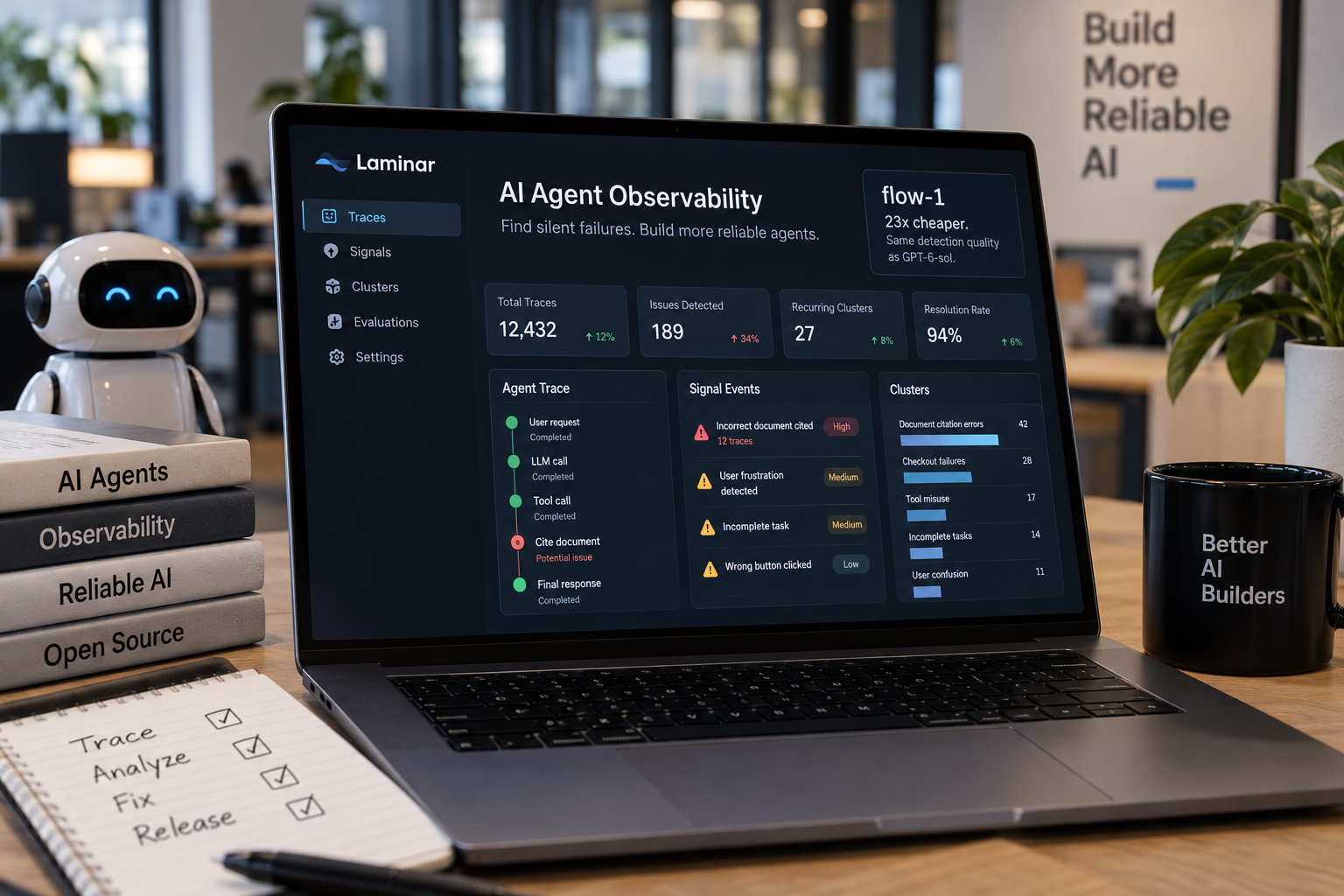
What does Laminar's flow-1 model do?
Laminar, a company from Y Combinator's S24 batch, has released flow-1, a model it built to catch failures in AI agents that often go unnoticed. The company says the model matches GPT-6-sol in detection quality on its own benchmark while running 23 times cheaper, a gap that it argues makes it affordable to check every production trace rather than a sample.
Why are silent AI agent failures hard to catch?
The problem Laminar is targeting is a quiet one. AI agents now run for many steps, and they can fail without raising any alarm. An agent might click the wrong button or cite the wrong document while every individual call completes successfully. Those are the errors that matter most, and they are the hardest to find. Looking only at an agent's final output won't reveal them. Finding them means understanding what the agent was trying to do and inspecting its large language model calls and tool results along the way.
Laminar's founders, Robert and Din, argue that simply collecting traces doesn't solve the issue. Many agent observability platforms, they say, are still data collectors at heart, and users can end up paying to store traces that nobody has the time to read. Using another large language model to review traces is the obvious answer, but capable models are expensive at scale. Cheaper ones, the company says, often miss errors or flag things that don't matter.
To address that tradeoff, the team fine-tuned a small open-source model and then trained it further with reinforcement learning. The training used thousands of synthetic investigations of realistic agent workflows in areas including software, legal work and customer support. The result, Laminar says, is a model that is both good at analyzing agent traces and inexpensive to run.
How does flow-1 analyze agent traces?
flow-1 operates inside a harness the company calls Signals. The setup treats an agent trace like a code repository, with each span, such as a model call or a tool call, serving as a file. The model starts with a compressed text version of a full trace and a user prompt. It then searches across the spans and reads the relevant ones in full, much as a coding agent would work through a codebase.
Signals is not limited to hunting for errors. Users can give it general prompts, such as asking it to identify user frustration or to check whether a browser agent completed a checkout. Findings come back as JSON in a schema that users define themselves. Laminar calls these results signal events.
Analyzing every trace produces a lot of signal events, too many to read one by one. Laminar groups similar events into clusters automatically, so teams can see which problems recur and how often they occur. From there, users can drill down into individual events and the traces behind them. Traces from a cluster can also be used to build an evaluation dataset for that type of failure. Developers can then use a coding agent to iterate on fixes against those evaluations and confirm that a change works across the cases before it reaches production.
The company describes the full cycle as trace, analyze, catch errors and form clusters, fix, then release. Laminar's other features are built around the same loop. Its blog describes 20x trace compression, a custom SQL query engine and automatic task extraction, all developed from the team's study of how agents actually behave.
Laminar is licensed under Apache 2.0 and can be self-hosted through its public GitHub repository. The company says it earns revenue from its managed cloud. In its launch post on Hacker News, the founders asked readers how they track agent performance today, and how much they rely on user feedback compared with their own monitoring. They also asked how teams confirm that a fix for one failure doesn't introduce another.
Questo articolo è stato scritto con l'assistenza dell'IA.
News Factory APP - notizie agentiche per potenziare il tuo SEO e AEO.