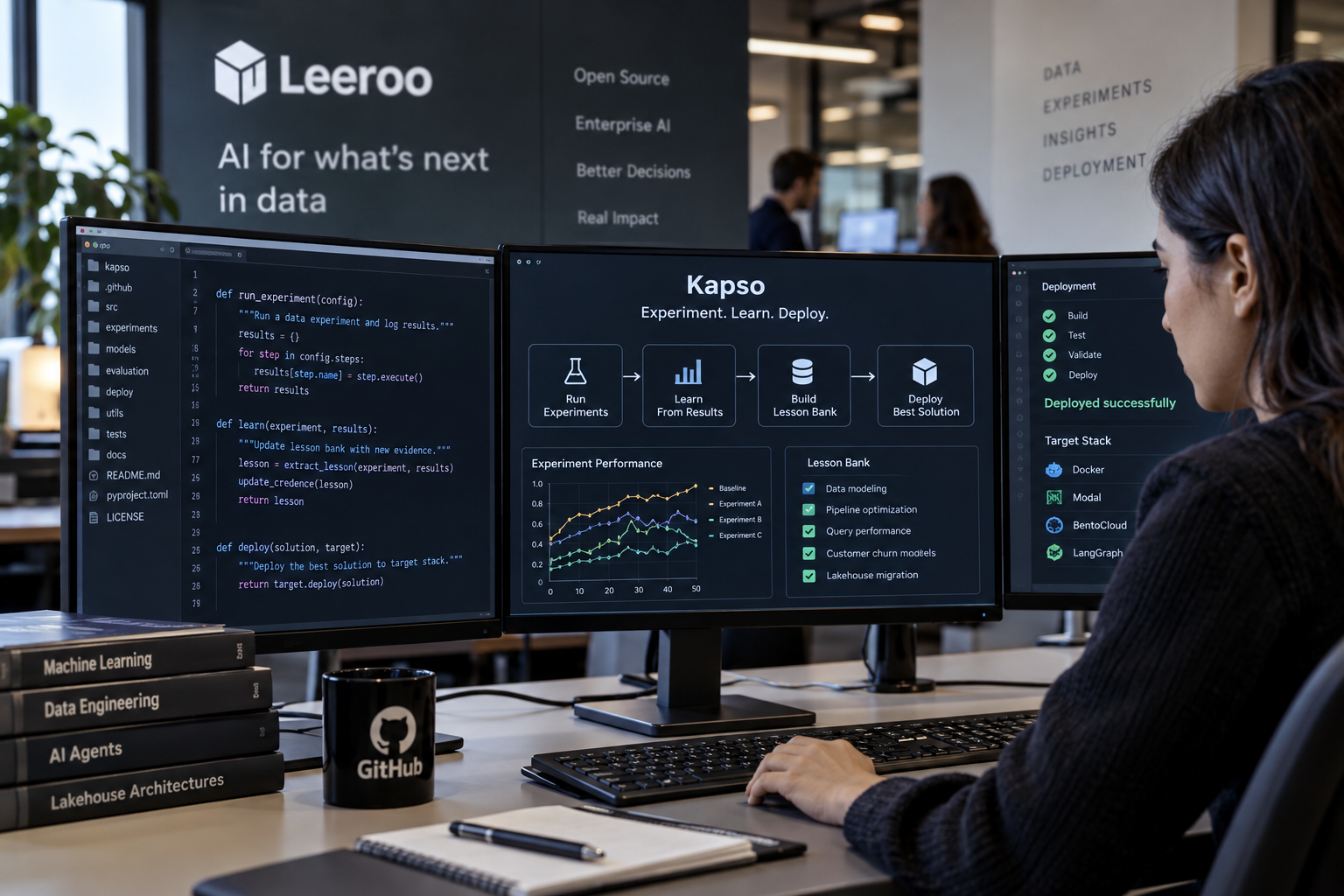
Leeroo has open-sourced Kapso, an engine that runs experiments against a company's data, deploys the strongest solution it finds and keeps a record of what it learned along the way. The company, which says it is focused on AI systems for enterprise data, announced the release in a post on Hacker News.
The idea rests on a simple observation from the company's founders, Alireza and Majid. Data work is iterative. Analysts investigate, form hypotheses, test them and adjust. Leeroo argues that this bottom-up process is the only way to deliver results quickly in large, disorganized enterprise environments. Waiting for consultants to gather context in meetings, or for a team to define a full business ontology before touching the data, can take quarters or even years, the founders wrote.
They point to a recent project as an example. A company was moving off an aging data estate onto a lakehouse, a setup spanning more than 30 source-system families, thousands of tables and transformations, and hundreds of business intelligence reports. Nobody involved, human or AI agent, understood how the pieces connected. The team learned the system by reading the company's repositories, dbt models, documentation and the data itself, then proposing hypotheses, running experiments and checking the results until they understood how each system behaved and under what conditions.
Leeroo says the same loop applies to almost any data or software job, whether the goal is optimizing a warehouse, building a lakehouse pipeline or predicting customer churn. Know-how builds over time, the company argues, and it is most useful when it is tested in a specific environment. Retrieval-augmented generation over documentation, by contrast, has little value until the consequences of a change have been observed. Kapso is designed to do that testing in a sandbox, much as a human engineer would.
How the lesson bank works
How does Kapso learn from experiments?
Users give Kapso an objective and success criteria. The system then works toward an optimal solution that can be deployed on the user's stack. Its central component is a bank of lessons, drawn from past experiments. Each lesson carries a credence score, the conditions under which it applies and the evidence behind it.
How does Kapso choose its next experiments?
For each new experiment, an ideation module proposes ideas informed by those earlier lessons. It ranks them by expected return against the budget each idea would consume, then sends the top candidates to an implementor. Because the bank keeps learning from experiments in that particular environment, Leeroo says its proposals are better matched to the setting than generic hypotheses from a large language model.
Results are checked by a separate verifier module that the experiments themselves cannot access, which the company says prevents the system from gaming its own evaluations. The experimentation modules can also propose changes to the metrics and criteria, and the verifier approves or rejects them. After each run, a learn() function updates the lesson scores and boundaries using that run's evidence. Users can A/B test changes to the bank by running otherwise identical builds with the old and updated versions.
The lesson banks are built on git, so they can be shared, listed and updated. The company lists commands for the command-line interface, including kapso experience share, list and update. Kapso is described as both model-agnostic and coding-agent-agnostic. A separate command, kapso.deploy, takes a solution and a target stack and runs a shorter experimentation loop to adapt it. Leeroo lists Docker, Modal, BentoCloud and LangGraph as examples of target stacks. Users can also write their own domain harness, a starting point for a specific field, using the plugin's harness command or the CLI.
Benchmark claims
How does Kapso perform on public benchmarks?
Leeroo says Kapso performed well on several public benchmarks and live competitions. On RelBench, a benchmark for predictive modeling on relational databases run by Stanford and originally developed alongside Kumo AI, which is now part of Nvidia, the company says Kapso ranked first, ahead of the best tabular foundation model. Leeroo argues that this shows keeping learning at the harness level can beat foundation models for tables, and that updating a lesson bank costs far less than retraining one.
On OpenAI's MLE-bench, the company says Kapso was first at the time of its submission and remains among the top open-source systems. In competitions, Leeroo says Kapso outperformed the best agent reported by the ALE-Bench authors at Sakana AI. It also says Kapso ran autonomously at the live International Olympiad in AI 2026, finishing above all 471 human contestants and in the top three AI systems. These are the company's own reported results, and the public leaderboards and pull requests it links are the places to check them.
Leeroo also runs a public bank of machine learning and data knowledge at Leeroopedia. The company says the site contains around 100,000 pages extracted by experimenting on papers and code repositories. It receives about 6 million requests a month, roughly 28 percent of them from AI agents.
The company is inviting growing businesses with complex data estates across multiple systems and functions, and stretched data and AI teams, to get in touch. The code is available on GitHub.
Questo articolo è stato scritto con l'assistenza dell'IA.
News Factory APP - notizie agentiche per potenziare il tuo SEO e AEO.