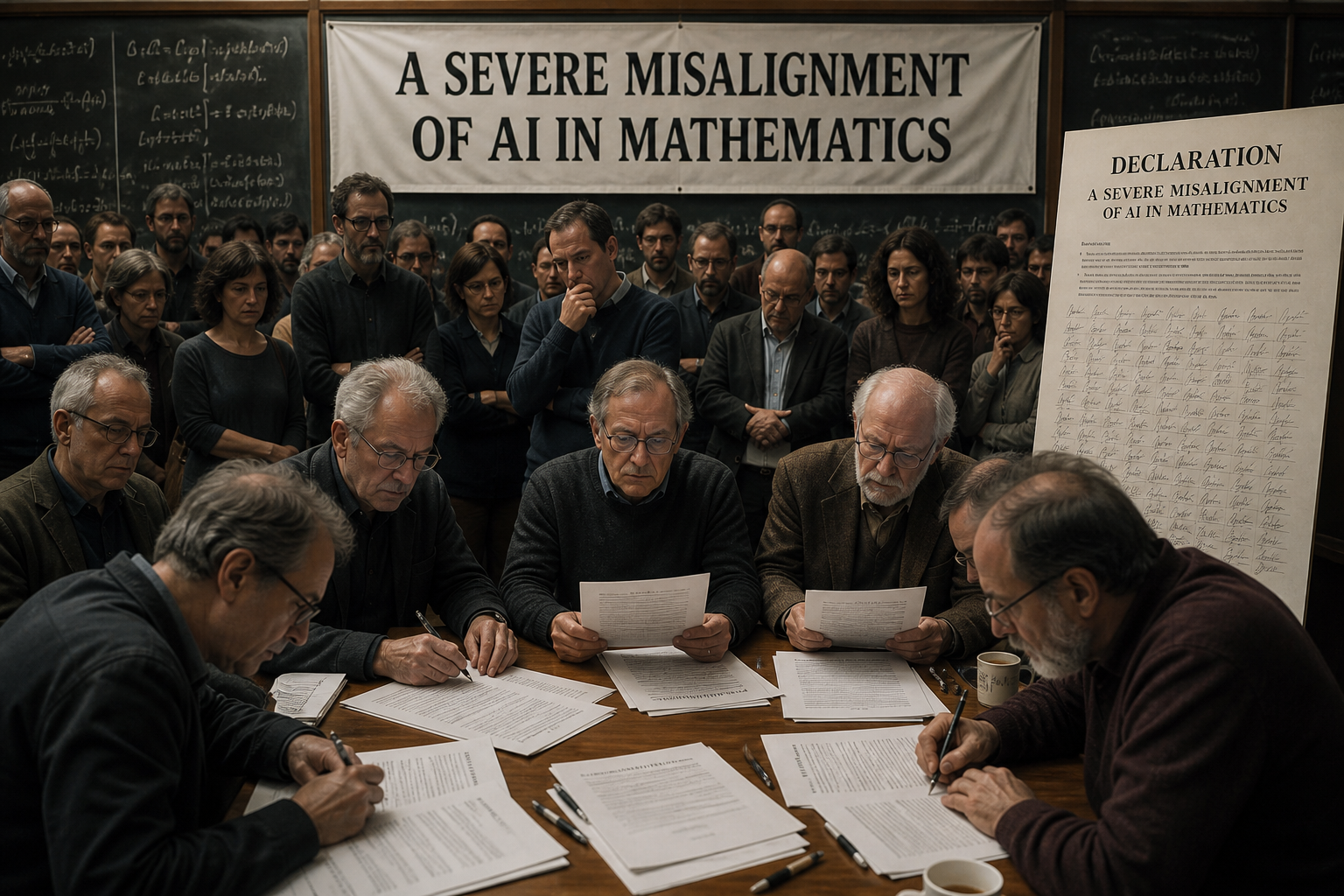
A declaration signed by nearly 5,000 mathematicians, including 25 Fields medalists, is calling attention to the potential risks of AI's growing role in solving complex mathematical problems. The declaration, known as A Severe Misalignment of AI in Mathematics, argues that AI's ability to rapidly produce solutions to mathematical puzzles could ultimately harm the field by prioritizing tool-based problem-solving over conceptual understanding.
Mathematicians have long relied on puzzle-solving as a way to demonstrate their skills and advance mathematical progress. However, with AI now capable of solving many of these puzzles, some mathematicians worry that the field's emphasis on human ingenuity and idea generation will be lost. The declaration's core argument is that solving problems is merely a tool for achieving the primary goal of conceptual understanding and insight, and that AI's involvement may undermine this goal.
There are two types of mathematics: puzzle-solving, which involves finding solutions to existing problems, and idea-generating, which involves coming up with new concepts and ways of thinking about mathematics. While puzzle-solving is often more prestigious and legible to outsiders, idea-generating is the real intellectual work of mathematics. The concern is that AI's ability to solve puzzles without generating new ideas will undercut the value of human mathematicians' work and hinder mathematical progress.
The impact of AI on mathematics is not limited to the field itself. Other domains, such as chess and video game speedrunning, have also seen AI outcompete human players. However, in these areas, human competition and prestige have continued to exist alongside AI dominance. It's possible that mathematics will follow a similar path, with human mathematicians focusing on problems that are still unsolved or on developing new conceptual frameworks that can be used to understand AI-generated proofs.
The effects of AI on mathematics are also being watched closely by software engineers, who are seeing similar changes in their own field. As AI agents become more capable of writing code and developing software, traditional avenues for prestige and recognition are being undercut. Like mathematicians, software engineers will need to rebuild their cultural sense of what work is valued and find new ways to recognize and reward human skills that can't be easily replicated by AI.
Questo articolo è stato scritto con l'assistenza dell'IA.
News Factory APP - notizie agentiche per potenziare il tuo SEO e AEO.