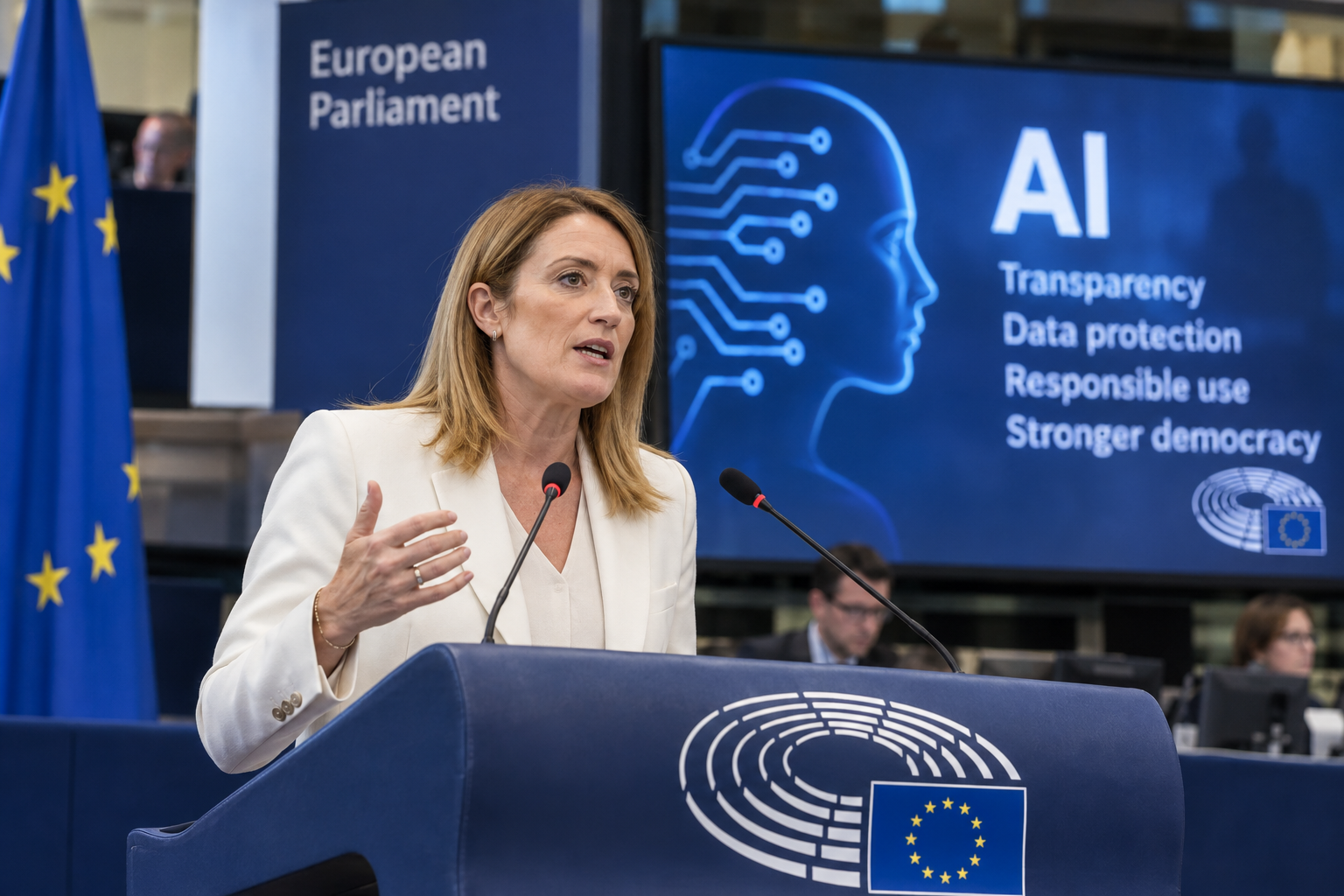
European Parliament President Roberta Metsola has warned that AI cannot replace real debate, legal judgment or the responsibility of elected members in lawmaking. She said people should be told when AI is used. Parliament's administration will soon present new guidelines built on openness, protecting sensitive files and checking all work.
European Parliament President Roberta Metsola has warned lawmakers not to rely on artificial intelligence to write laws, telling them that responsibility for every decision stays with the elected members who cast the votes.
Can AI replace debate in lawmaking?
She made the case Wednesday at an event inside the Parliament on how AI is used in its work, according to Politico Europe. Drafting an amendment with AI cannot replace a real debate with colleagues, Metsola said. Legal research done with AI, she added, cannot stand in for the judgment that hard decisions require. She also said people should be told when AI has been used, because voters need to be able to hold lawmakers accountable.
The warning comes as Parliament officials grow worried about a sharp rise in amendments written with AI. Amendments are the proposed changes lawmakers table to draft legislation, and some of the AI-written ones refer to laws that do not exist.
Alessandro Chiocchetti, the Parliament's secretary-general, offered a concrete example at the event. A member of the European Parliament received wrong legal advice from an AI tool. The Parliament's lawyers then needed two days to prove the advice was wrong.
That episode, Chiocchetti said, is why drafting and reviewing laws must remain the job of MEPs. AI can still help staff sort through thousands of amendments, and the Parliament does not intend to take that help away. The administration will soon present new guidelines to the Parliament's leadership.
The new rules will rest on three ideas. Parliament should be open about using AI. Sensitive files should never be put into a public tool. And all work should be checked before it goes out.
Do MEPs have to disclose when they use AI?
For now, the rules do not require MEPs to say when AI helped them write an amendment, a question or a speech. Staff, by contrast, must already label that kind of work under rules set in 2024. The gap is notable because the same concerns about transparency apply to both groups.
Turning the guidelines into binding requirements for MEPs could take more than an internal memo. The Parliament may need to change its own rules of procedure, and that change would go through its constitutional affairs committee.
What is the EPGenAI Hub?
Parliament is also building its own platform, the EPGenAI Hub. It runs on the institution's own systems and is meant for sensitive work. Commercial tools, including ChatGPT, Anthropic's Claude and Meta's Llama, will remain available for less sensitive tasks.
The Parliament has already restricted AI on its own devices. Earlier this year, it switched off built-in AI features on MEPs' tablets over data protection concerns, a step that signaled how seriously it treats the risks of letting AI tools near confidential material.
Questo articolo è stato scritto con l'assistenza dell'IA.
News Factory APP - notizie agentiche per potenziare il tuo SEO e AEO.