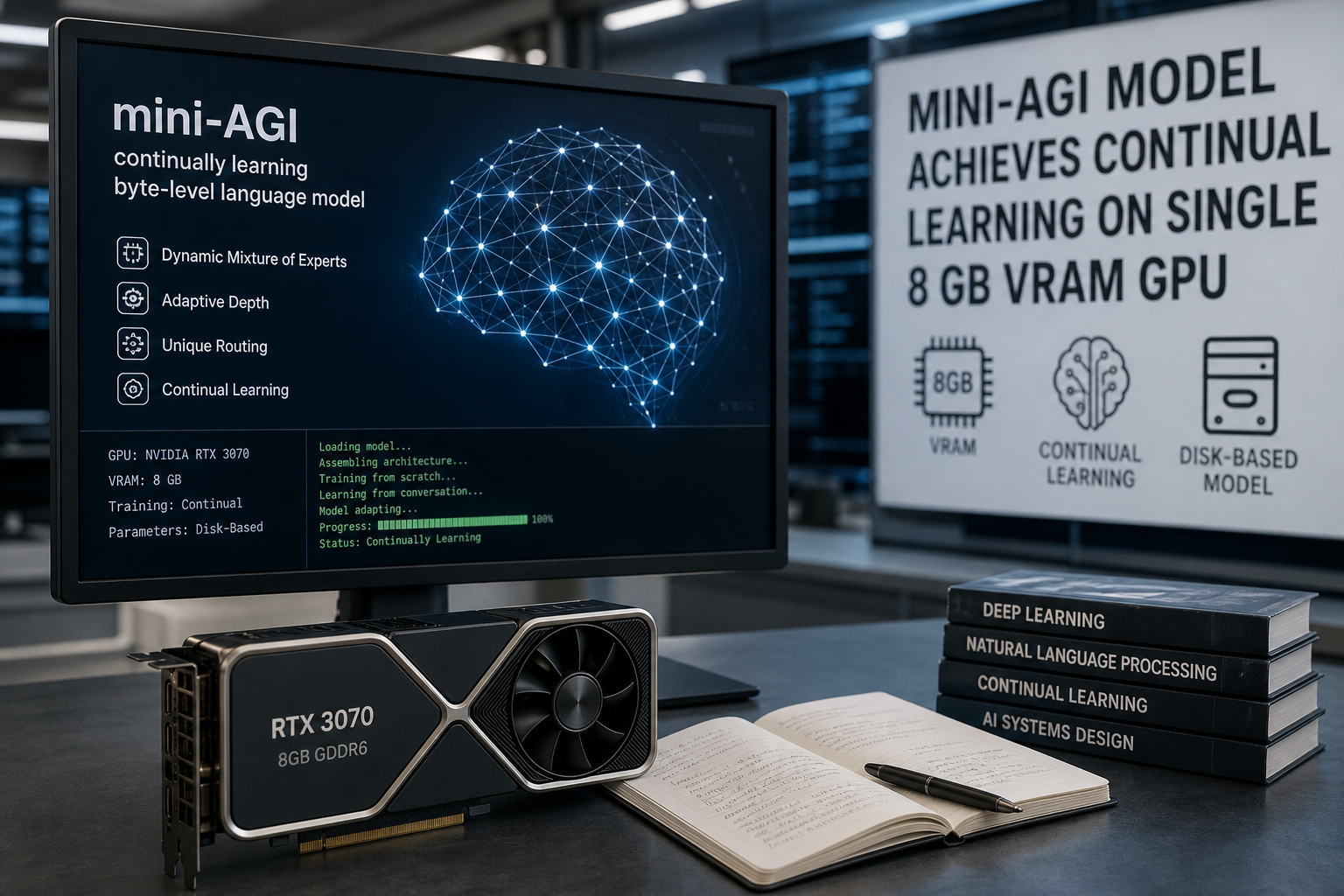
A novel approach to language modeling has resulted in the creation of mini-AGI, a continually learning byte-level language model that can be trained on a single 8 GB VRAM GPU. This model is designed to assemble its own architecture and train from scratch, enabling it to learn from every conversation it has and adapt to new information without forgetting what it previously knew.
The mini-AGI model achieves this through a combination of techniques, including a dynamic mixture of experts, adaptive depth, and a unique routing mechanism. It stores its weights as ordinary files on disk and pages them onto the card as needed, allowing the parameter count to be bounded by free disk space rather than VRAM. This approach enables the model to grow new capacity while training and prune what is no longer needed, making it possible for almost anyone to train their own version of the model on modest hardware.
One of the key challenges in training language models is catastrophic forgetting, where the model forgets what it knew before when it learns new information. The mini-AGI model addresses this issue by using a trunk learning rate that is one-tenth of the experts' rate, allowing it to retain 99.84% of its progress against chance. This is achieved through a mechanism where the model reads 524,000 characters of a single subject and nothing else, with the result showing that the model does not forget what it knew before.
The model has been tested on a range of subjects, including chess, stories, arithmetic, code, reasoning, chat, and Wikipedia, and has shown promising results. It has also been compared to other models, such as MambaByte-353M and Transformer-320M, and has demonstrated comparable performance despite being trained on significantly less data.
The mini-AGI model has the potential to revolutionize the field of natural language processing, enabling the creation of personalized models that can learn and adapt to individual users' needs. With its ability to train on modest hardware and continually learn from new data, this model could have a significant impact on a range of applications, from chatbots and virtual assistants to language translation and text generation.
The development of the mini-AGI model was assisted by the "Claude Opus 5" model, which implemented most of the code, verified and debugged it, and helped with brainstorming complex problems. The model was also trained using a range of open-source datasets, including TinyStories, OpenHermes-2.5, and the Lichess open database.
Questo articolo è stato scritto con l'assistenza dell'IA.
News Factory APP - notizie agentiche per potenziare il tuo SEO e AEO.