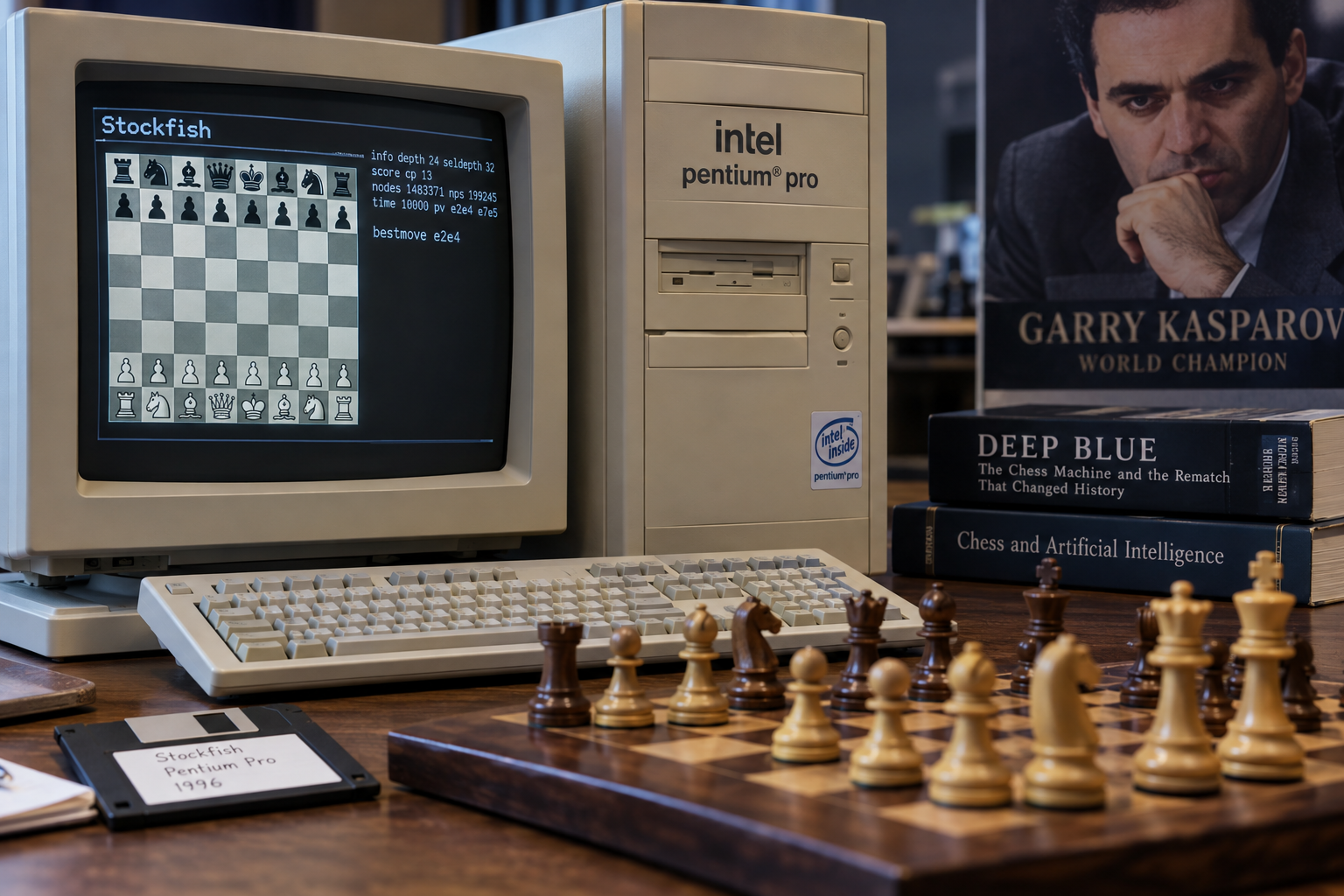
A chess engine running on a 200 MHz Intel Pentium Pro, a processor that sold for $1,325 at its launch in November 1995, could likely have beaten Garry Kasparov in 1996, according to a programmer who tested the idea. The machine, which the author bought used, is now connected to the internet and can be played online.
The question is a pointed one. In February 1996, IBM's Deep Blue became the first computer to defeat a reigning world champion in a game. Deep Blue lost that match, but it won a 3.5-2.5 rematch in 1997. IBM spent several million dollars building a special-purpose machine for the job, powered by 30 P2SC processors and 480 custom chess chips that could analyze more than 200 million positions per second.
Could a modern chess engine have beaten Kasparov on a 1996 Pentium Pro?
The author wanted to know whether that effort was necessary. His answer is no. Running on the Pentium Pro with 64MB of RAM, his custom port of Stockfish is estimated at an Elo rating of 3300, plus or minus 87, at classical time controls. Kasparov's rating was just under 2800.
Elo is a relative scale, so the numbers need some unpacking. A 200-point gap means the stronger player should win about three of every four games. A 400-point gap corresponds to an expected score of 90 percent. The best chess engines that could run on commodity 1996 hardware were rated roughly 2300. Deep Blue was rated 2700. Modern Stockfish is closer to 3700.
How much of chess engine progress comes from better software?
That raises a second question: how much of today's advantage comes from faster computers, and how much comes from better software? The author estimates that 720 of the 1,335 Elo points gained since 1996 come from better programming. The rest is hardware.
To test this, he ran two experiments. In the first, he used Crafty, a competitive engine from 1996 whose source code is now public. The 1996 build of Crafty 11.13 rated 1999 on the Pentium Pro at one second per move and 2383 at 10 seconds per move. When he added modern techniques, including better search algorithms, improved quiescence methods and neural-network evaluation known as NNUE, the same engine reached 2718 at one second per move and 2974 at 10 seconds per move on the Pentium Pro.
In the second experiment, he tried running Stockfish itself on the old hardware. That meant rewriting the code to use 32-bit arithmetic, since the Pentium Pro is a 32-bit machine, and cutting memory use to fit within 64MB. The naive port rated 2496 at one second per move. After a series of adjustments tuned to the Pentium Pro, the rating rose to 2846 at one second per move, 3109 at 10 seconds and 3180 at 30 seconds.
When the author pitted the modern-tuned Stockfish on the Pentium Pro against the 1996 Crafty running on modern hardware, the old machine won 78 games, drew 17 and lost 5 in a 100-game match.
How was the 1996 Pentium Pro chess setup built?
The setup itself is modest. The Pentium Pro sits on an Intel VS440FX motherboard. The system boots from a 1.44MB floppy disk and connects to the internet through a Realtek RTL8139C network card. The author wrote a small custom program to boot the processor into 32-bit protected mode, start the network card and wait for instructions. The chess program runs a basic web server that accepts a board position, written in FEN notation, along with a maximum run time, and returns the engine's move when the timer expires. The author says he used language models to write most of the code.
The author is careful about the limits of his numbers. Because he could not run enough games at classical time controls on a single machine, he extrapolated the classical rating from shorter tests. He estimates a classical game would give about six minutes per move, which he says points to an Elo of about 3350. Allowing for diminishing returns, he uses 3300 as a safe figure. He also notes that ratings on the Computer Chess Rating Lists do not map perfectly onto FIDE ratings, the scale used for human players. He argues that the gap between the engine and Kasparov is large enough to absorb any such difference. He estimates the engine would score roughly 9 out of 10 against Kasparov, and he has offered to take on a 2700-rated grandmaster.
The author says the project was partly for fun, but he also wanted to learn something about how fast AI research moves. Chess programmers in the late 1990s already had advanced engines, and it was reasonable to assume few ideas remained. In hindsight, he says, that assumption was wrong. He suggests the same may be true for language models and whether software gains will outpace hardware gains in the coming years. He acknowledges that a single experiment cannot settle that question.
Questo articolo è stato scritto con l'assistenza dell'IA.
News Factory APP - notizie agentiche per potenziare il tuo SEO e AEO.