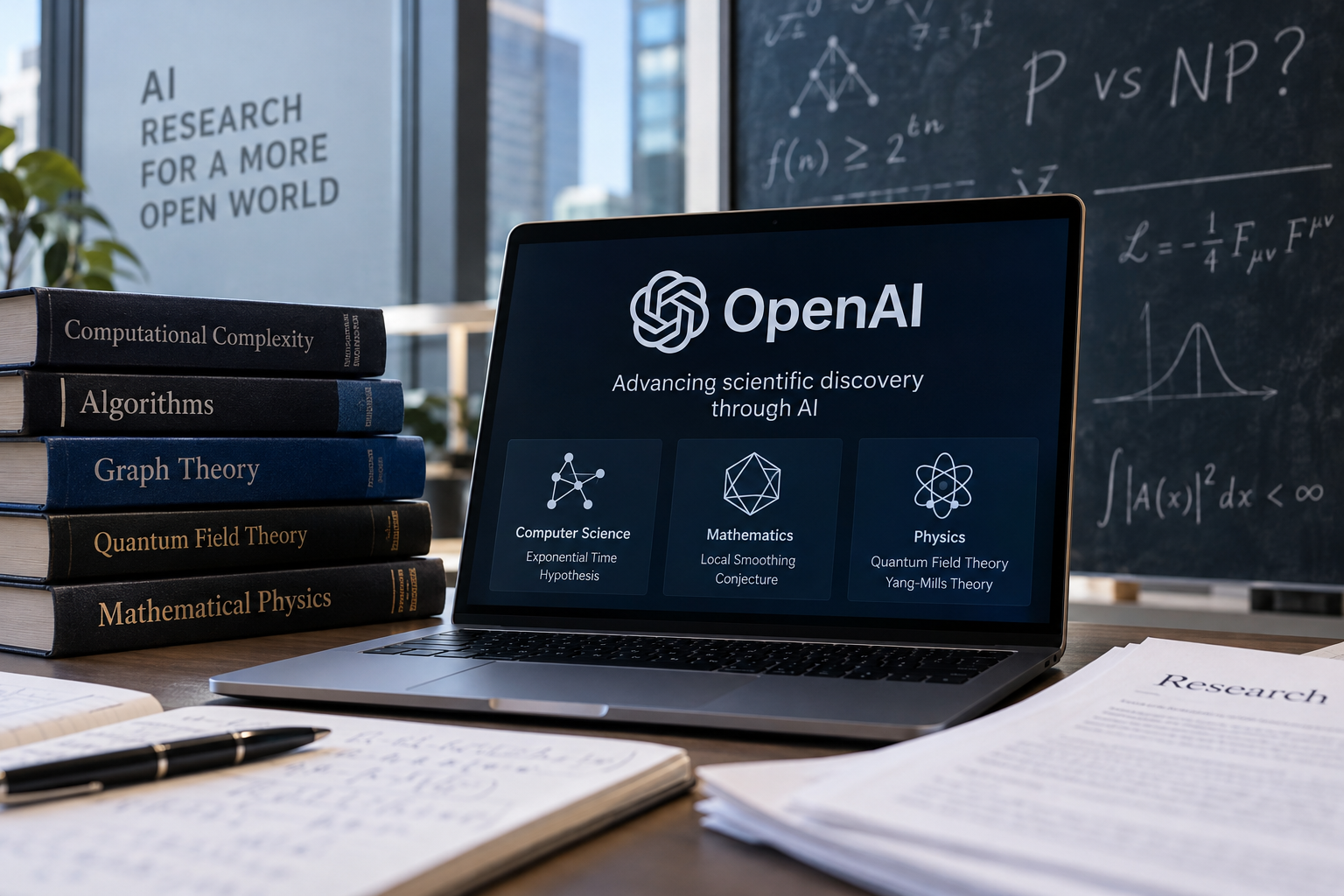
OpenAI said Monday that an internal model has disproved the Exponential Time Hypothesis, a conjecture that hundreds of computer science papers depend on. The company also announced two more results the same day, one in mathematics and one in physics, in a release that tests new ways of sharing AI-generated research with the scientific community.
What is the Exponential Time Hypothesis?
The Exponential Time Hypothesis, or ETH, has long been considered likely true. It concerns how hard it is to solve Boolean satisfiability, a problem closely tied to the P versus NP question. Researchers have used it to show that problems in graph theory, computational biology, databases and other fields are difficult to solve quickly. In a blog post, OpenAI said the hypothesis has been “widely believed to be true.” If the claim holds, it could open the door to faster algorithms across those fields.
According to OpenAI, its model found the disproof on October 16. The company checked the proof the following day in Lean, a programming language that verifies mathematical proofs by machine. It has published the model’s write-up and the Lean proof on GitHub.
Who is checking OpenAI's disproof?
The hypothesis was first proposed by Russell Impagliazzo and Ramamohan Paturi of UC San Diego, together with Francis Zane. Impagliazzo, Paturi and Ryan Williams of MIT now lead a group that will check and explain the result. Williams announced the effort on X, saying he and his colleagues had been asked to help organize “an open and independent examination of this claim.”
The three researchers were quick to say their involvement is not an endorsement. In an open letter to their field, they wrote, “Our involvement should not be taken as certification of the claim. A result of this significance requires careful, independent scrutiny.”
Williams said the group signed no non-disclosure agreements and will not be paid. The group asked OpenAI to release all of its raw data on the ETH result and to fund a conference for the research community. Williams and OpenAI both say the company agreed to both requests.
Math and physics results
In mathematics, OpenAI says its models proved the local smoothing conjecture in every dimension. Christopher Sogge proposed the conjecture in 1991. If the proof stands, it would also settle the Kakeya conjecture and Stein’s restriction conjecture in all dimensions. Mathematicians had proved local smoothing in two dimensions in 2019, and they proved the Kakeya conjecture in three dimensions in 2025. As with earlier releases, OpenAI published the model’s write-up and a Lean proof for the new result.
The physics work is more closely held. OpenAI says its models produced a rigorous proof that certain quantum field theories exist in four dimensions. That group includes quantum chromodynamics, the theory that describes the strong force binding quarks and gluons. The work also includes a proof that pure Yang-Mills theory exists, a question tied to one of the Clay Mathematics Institute’s Millennium Prize problems. OpenAI said in September that it would not claim the prize for its Navier-Stokes proof.
Nobel laureate David Gross will lead the physics group. He is joined by Michael Douglas, Arthur Jaffe, Igor Klebanov and Nikita Nekrasov. That group has decided not to release the AI-produced material for now. Instead, it will write up the work itself.
Who gets the credit
Who gets credit for AI-generated research?
OpenAI says it does not seek academic credit for these discoveries. It says the researchers who write the explanations in each group should receive the recognition. The company has also given $5 million to the Simons Foundation to fund workshops and conferences on AI-produced results.
The three computer scientists raised a broader concern in their letter. They asked how credit should work when AI finds results first. They warned that recognition could go to whoever publishes first or controls the most powerful tools, while the slower work of checking and explaining a result gets less attention. Mathematicians raised similar concerns in the Leiden declaration in June.
“If the claim is correct, it will change an important part of theoretical computer science,” the three researchers wrote.
Questo articolo è stato scritto con l'assistenza dell'IA.
News Factory APP - notizie agentiche per potenziare il tuo SEO e AEO.