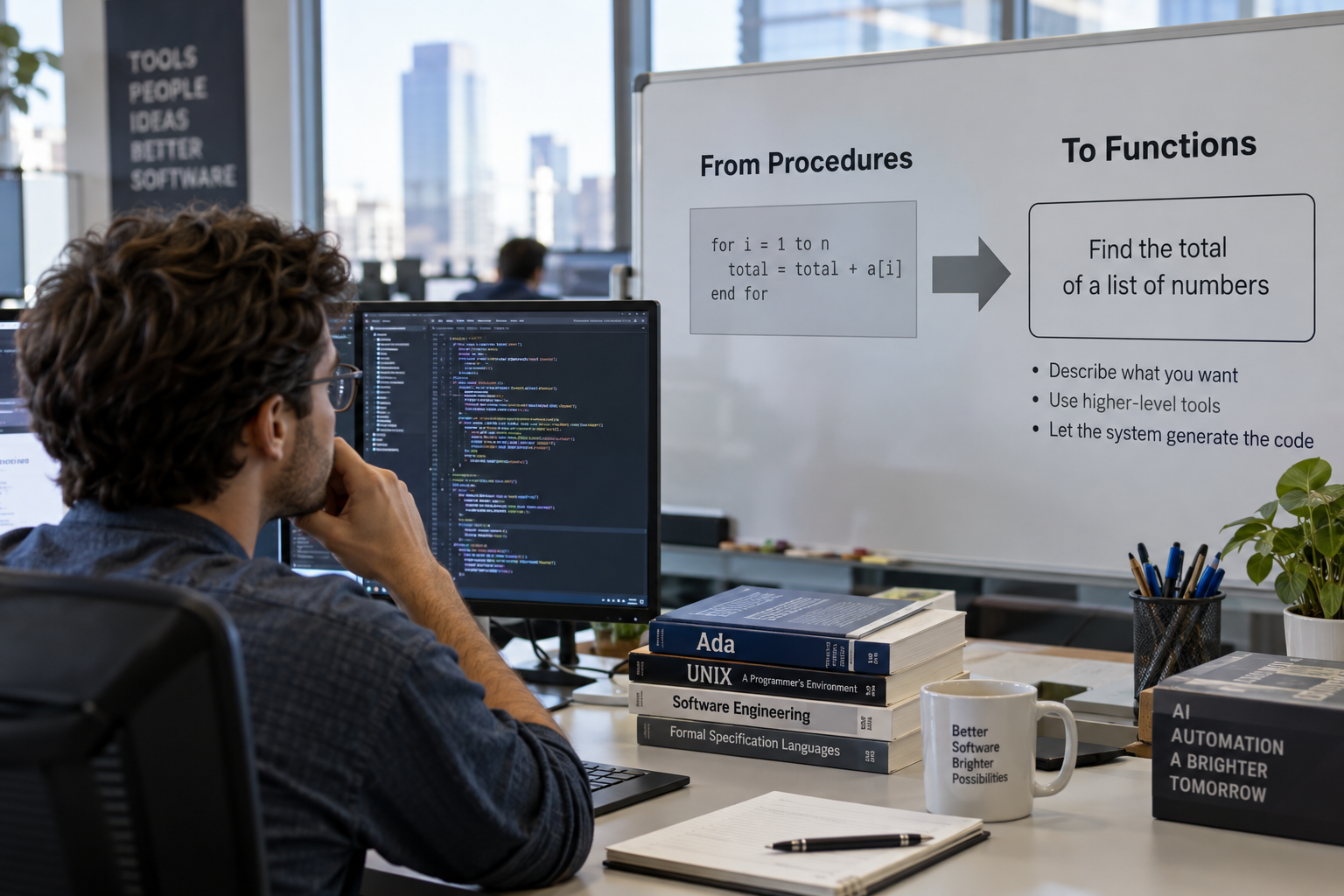
The way people write software is about to change, according to a paper by A.I. Wasserman and S. Gutz titled "The future of programming." The authors contend that the work of programming is shifting now, and that the pace of that shift will pick up as software development practices improve and development tools and environments become more sophisticated.
The paper lays out its predictions in three stages. The authors see the nearest gains coming in programmer productivity, driven by improved tools and integrated development environments. That is the short-term picture.
Further out, the authors expect programmers to draw on libraries of software components. They also expect wider use of packages that generate programs automatically for certain kinds of common systems. The paper places this in the medium term.
The longest-range prediction is the most ambitious. The authors argue that programmers will eventually be able to describe what they want in a nonprocedural way. That could mean working through a set of rules or formal specification languages instead of spelling out each step of the procedure. In that scenario, the programmer's role changes. Wasserman and Gutz write that the job of the application programmer will become increasingly analysis-oriented.
That change, the authors say, would let software developers tackle a large number of application areas that could not previously be addressed effectively. The abstract does not say which areas they have in mind, and it does not put a timeline on the long-term changes.
The paper's bibliography offers a sense of the research the authors drew on. It lists 50 references, many from the late 1970s and early 1980s. Among them are a U.S. Department of Defense report on requirements for Ada programming support environments, a reference manual for the Ada programming language, and studies of the Unix programming environment and INTERLISP. Other entries cover the Pascal programming language, the Euclid programming language, the CLU reference manual, and query-by-example systems. Several works address software engineering as a discipline, including a 1978 article by Wasserman and L.A. Belady titled "Software engineering: The turning point." Wasserman is also cited for his own work on information system design methodology and on user software engineering.
The references point to a field that was then focused on how programs are built, tested and managed, and on the environments programmers use to do that work. The paper's predictions build on that body of work, moving from better tools toward automatic generation and, finally, toward describing software in terms of what it should do rather than how to do it.
Questo articolo è stato scritto con l'assistenza dell'IA.
News Factory APP - notizie agentiche per potenziare il tuo SEO e AEO.