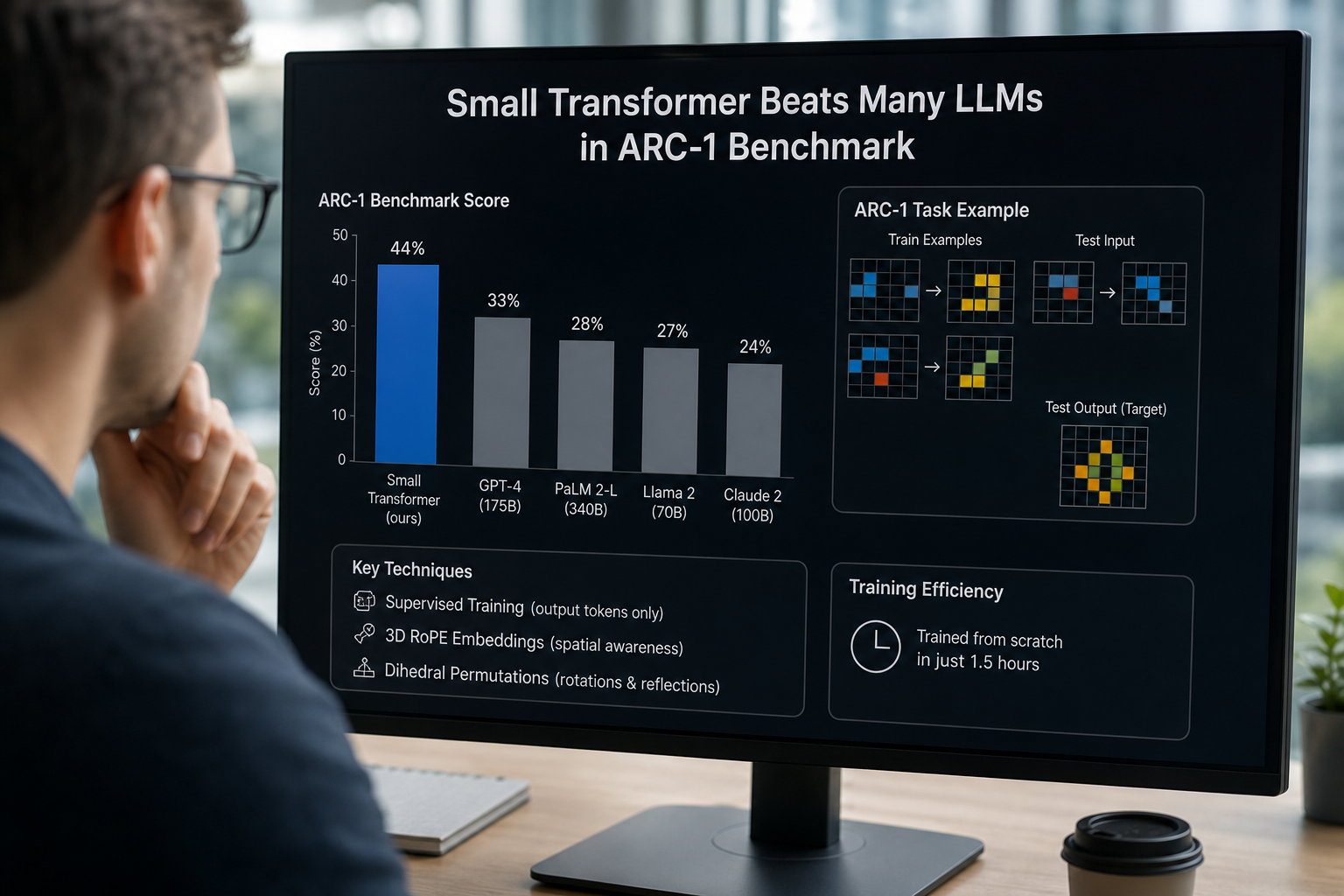
A small transformer model trained from scratch in 1.5 hours has achieved a score of 44% on the ARC-1 benchmark, outperforming many larger language models. The model uses a combination of techniques including supervised training, 3D RoPE embeddings, and dihedral permutations to achieve state-of-the-art results.
The ARC-1 benchmark is a metalearning benchmark that tests a model's ability to learn and reason about abstract concepts. It consists of a set of train puzzles and a set of eval puzzles, each with example pairs and test pairs. The model is trained on the train puzzles and evaluated on the eval puzzles.
The small transformer model was trained using a supervised approach, where the model is trained on the output tokens only. This approach has been shown to be more effective than unsupervised training, where the model is trained on both input and output tokens.
The model also uses 3D RoPE embeddings, which are a type of positional embedding that takes into account the spatial relationships between tokens. This allows the model to better understand the structure of the input data and make more accurate predictions.
In addition to the 3D RoPE embeddings, the model also uses dihedral permutations, which are a type of augmentation that involves rotating and reflecting the input data. This helps to increase the diversity of the training data and improve the model's ability to generalize to new situations.
The small transformer model has been shown to be highly effective, achieving a score of 44% on the ARC-1 benchmark. This is impressive, given that the model was trained from scratch in just 1.5 hours. The model's performance is also comparable to that of larger language models, which have been trained on much larger datasets and have many more parameters.
The Importance of Sample Efficiency
The small transformer model's performance on the ARC-1 benchmark highlights the importance of sample efficiency in machine learning. Sample efficiency refers to a model's ability to learn from a small amount of data, rather than requiring large amounts of data to achieve good performance.
Sample efficiency is critical in many real-world applications, where data may be scarce or expensive to collect. By developing models that are highly sample efficient, researchers can create more effective and efficient machine learning systems that can learn from limited data.
The small transformer model's performance on the ARC-1 benchmark demonstrates that it is possible to achieve state-of-the-art results with a small amount of data. This has important implications for the development of more efficient and effective machine learning systems.
Questo articolo è stato scritto con l'assistenza dell'IA.
News Factory APP - notizie agentiche per potenziare il tuo SEO e AEO.