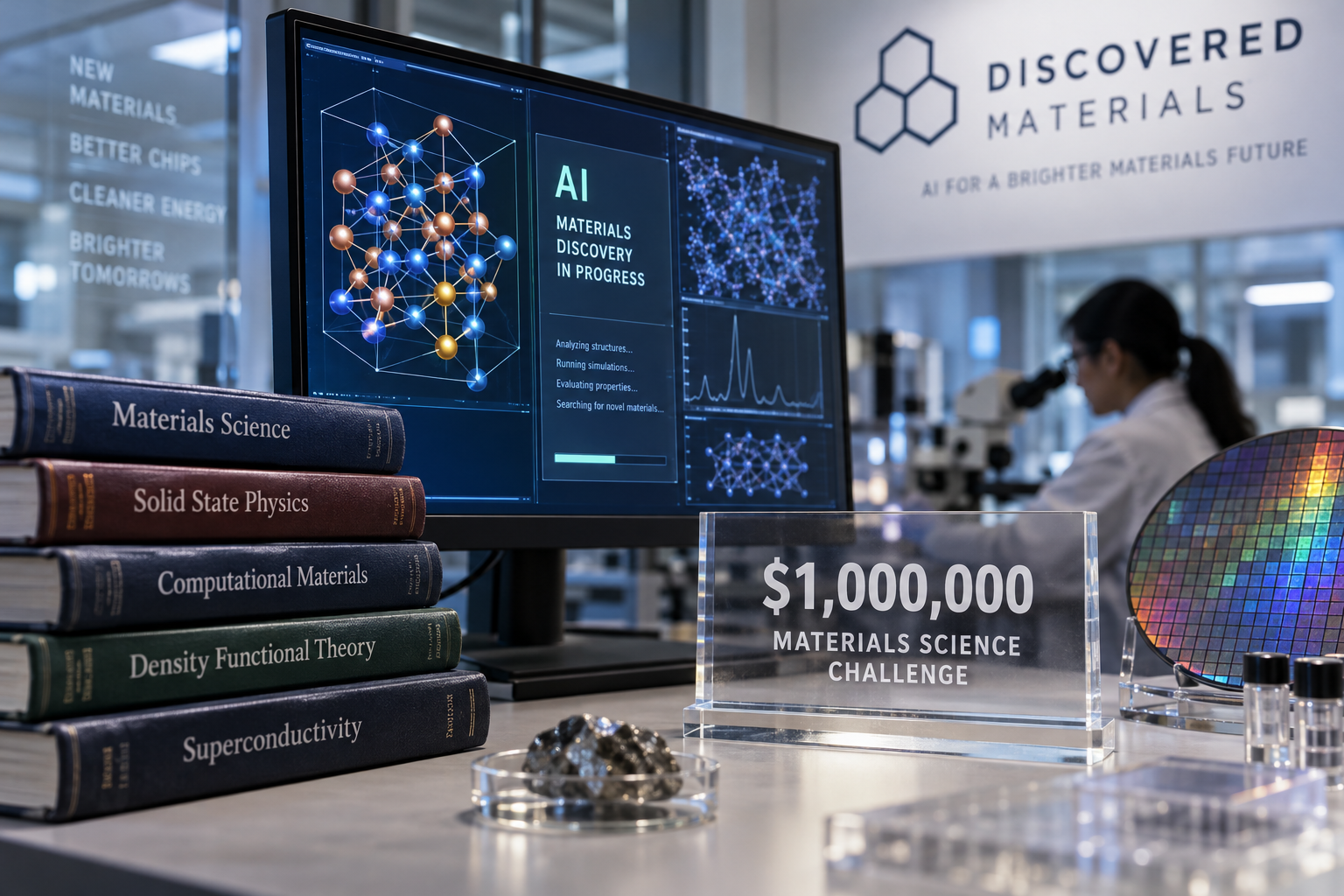
Discovered Materials, a months-old San Francisco startup that uses AI models to find new substances for advanced chips, has put up $1 million in prizes for anyone who can solve five unsolved problems in materials science. The company wants AI systems to take a shot at them, and it says the problems are meant to serve as a yardstick for progress.
Why is materials science harder for AI to benchmark than math?
Frontier AI models have cracked a string of difficult math problems and made headway in the life sciences. Materials science is harder to pin down. There is no single yes-or-no answer to check against, and the physics is messy.
“It’s more difficult to specify problems clearly in materials science because it’s not like math, where you have a very specific definition and can get to a yes or no,” said Advaith Sridhar, a co-founder of Discovered Materials, which was part of Y Combinator’s spring 2026 batch. “We came to this discussion [wondering], what are the grand challenges in this field? How do we know AI is making progress?”
What problems is Discovered Materials offering $1 million to solve?
Materials science has no equivalent of the Millennium Prize Problems, so the company recruited an advisory group of academics at leading global universities to spell out the open questions. The resulting list includes a theory to explain cuprate superconductivity, the phenomenon in which certain materials carry electricity with zero resistance at ultra-low temperatures. It also includes a numerical method for predicting the structures of interfaces between silicon and silicon dioxide, a pairing found in almost all semiconductors. Another challenge asks for a numerical method that maps grain structure to thermal properties, which could lead to better heat-dissipating materials. A fourth asks for a theory explaining why shining light on materials can change their behavior, particularly around superconductivity. The last asks for a numerical method that improves density functional theory, a key technique for modeling the structures of atoms and molecules.
Felipe Jornada, a Stanford professor who helped develop the challenges, said the gaps in understanding are wide. “Across materials science, there are phenomena we observe but cannot explain,” Jornada said in a statement. “Explaining these phenomena would improve our understanding of physics, and the answers would directly shape how we build electronics, store energy, and manufacture the materials of the future.”
Could frontier AI labs solve these materials science problems?
Before announcing the prizes, Discovered Materials tested the problems on frontier lab models. It gave AI agents internet access and other resources and let them work autonomously for days. The models spent several days on each problem without making much headway. The company did not say which models were used. Still, it is not hard to imagine OpenAI or Anthropic taking a run at the problems with far more computing power or a newer model.
Sridhar said the company doesn’t much care who cracks them. “It’s not particularly a concern to us whether we find it, or someone else finds it, or a professor finds it, or the frontier labs find it,” he said. “The reason we’re putting out these challenges is because we want them to serve as the goalposts. If you go and solve these challenges, we are deepening our understanding of materials and how things around us behave.”
Tracking attempts at the problems, he added, will show “whether the models are climbing in this domain.”
The challenge also points to a shift in how science gets done. AI is increasingly turning up insights and techniques that human researchers did not anticipate, which makes the choice of questions more important. Sridhar described a different order of operations. “This is a new way of thinking about science, where we come up with the verification and the challenges first, and then we let somebody come up with the ideas that explain the problem,” he said. “Knowing what are the right questions to ask is not trivial and very difficult in this domain, so this is where the professors have really helped us shape what are the right questions we should be asking.”
Discovered Materials’ main focus is developing new materials for semiconductors. The startup partners with chip giants on research projects and also funds its own scientific work. When it announced its seed round in August, Sridhar told TechCrunch he hoped the company would produce a useful material within a year. He now sounds more optimistic. “Those timelines have accelerated a little bit,” he said. “I’m more confident now that we will be able to find these industrially useful materials in a timeline shorter than a year.”
Questo articolo è stato scritto con l'assistenza dell'IA.
News Factory APP - notizie agentiche per potenziare il tuo SEO e AEO.