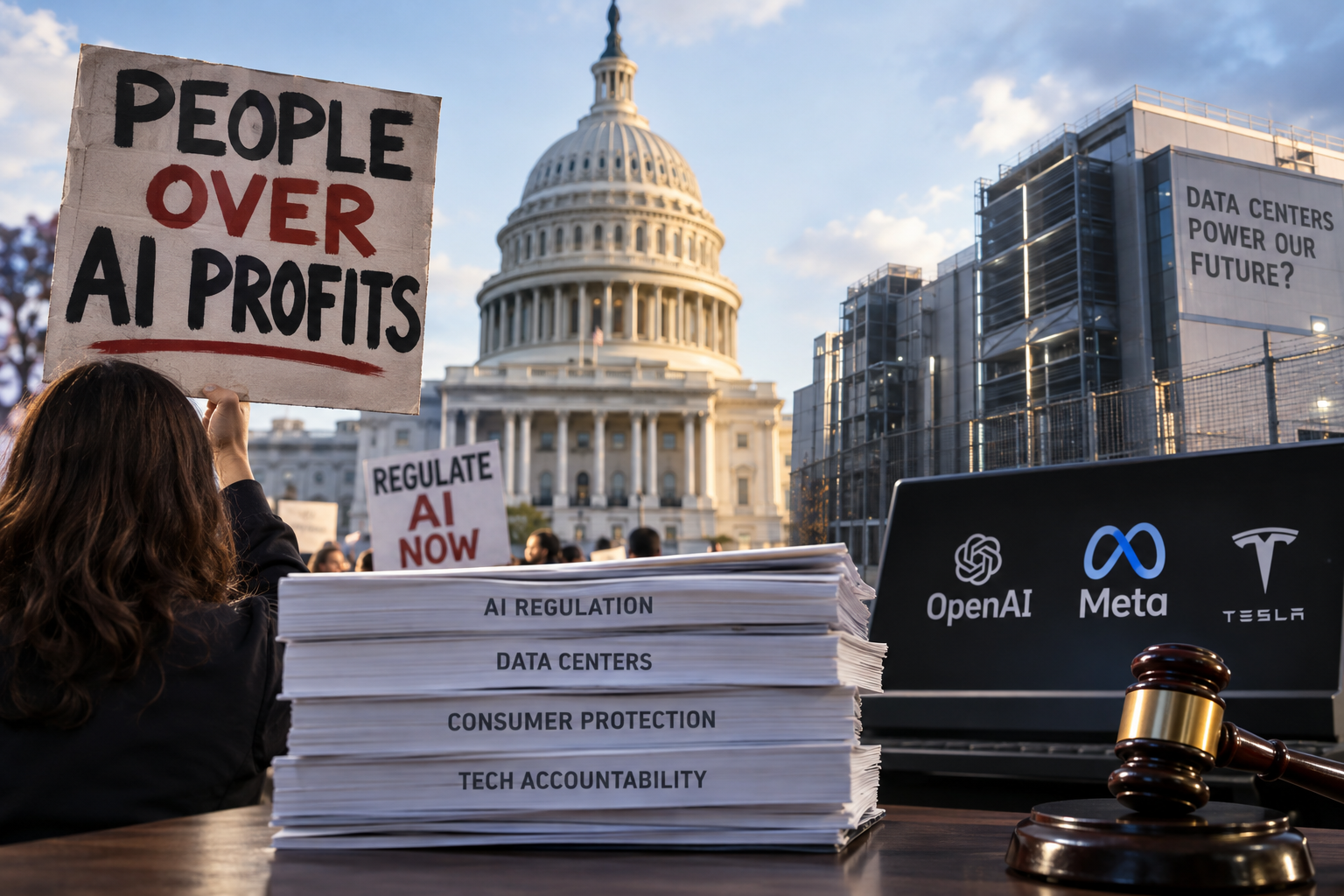
Democrats took control of the House and Senate this week, and a wave of voter anger over artificial intelligence rode alongside them. Candidates in traditionally red and swing states campaigned on holding AI companies accountable, and the industry is now left weighing new regulation, slower construction of data centers and closer scrutiny from Congress.
The Democratic gains included history in the governor’s races. Georgia elected its first Black woman governor, New Mexico elected the first Native American woman to hold the office in that state, and a Maine senator who had served for 30 years ceded the seat to a Democrat. In many of those campaigns, the same message kept coming up.
Most major AI company chief executives have been quiet in public. OpenAI and Anthropic did not respond to requests for comment from The Verge. Elon Musk, who had spent close to $450 million backing Republican campaigns, posted on X urging voters to vote “red” for the midterms. That post disappeared once results started coming in. OpenAI CEO Sam Altman did post that “people should always be in control of the future,” but he spent other parts of the evening talking about RAM.
Privately, the picture looks different. According to The Wall Street Journal, executives have discussed serious compute capacity constraints after Tuesday’s results, particularly at OpenAI. Dina Powell McCormick, president of Meta’s platforms, says many in the industry are considering moving data center construction abroad. Some executives are reportedly nervous about the results, though they may also be able to point to them as a reason the companies have not delivered as much revenue to investors. Several incoming lawmakers have promised to bring CEOs in to testify. On X, former product lead Nikita Bier warned that “This is going to be like the Nuremberg Trials but for AI researchers.”
Wes McEnany, a former deputy labor policy director for the Senate Committee on Health, Education, Labor, & Pensions who now works with the nonprofit Future of Life Institute, called the results a “total repudiation” of the AI field. He said AI touches “every aspect of people’s lives,” from job applications and social media to electricity bills for people who live near a data center. He said voters are tired of not having “any agency in that conversation.”
Why did voters turn against data centers in the midterms?
The clearest sign of that frustration may be the data center fights. Of 44 local data center moratoria on Tuesday’s ballots, 43 passed. In Texas, a state that has seen the fastest data center growth and is a key battleground, governor-elect Gina Hinojosa has said she plans to “issue a moratorium — a ban — on all data center approvals until laws can be passed by the legislature to protect Texans.” Similar promises have come from a handful of other states.
“Data centers were clearly on the ballot,” said Guru Sethupathy, general manager of AI governance at Optro.
Residents have pushed back across a wide range of states in recent months, with protests and bipartisan organizing over noise, rising electricity rates and other concerns. When NBC News polled voters on Tuesday, 76 percent said they opposed data centers in their communities.
“The data center backlash is one of the most bipartisan political issues I’ve ever seen,” said Shaunna Thomas, co-founder and director of the Guardrails Alliance, a super PAC pushing for AI regulation.
Kyle Jacobs-Morse, deputy executive director at The Tech Oversight Project, a nonprofit tech industry watchdog, said data centers have become a way for voters to ask bigger questions. “Data centers are an entry point to looking at this broader corporate accountability lens of, ‘My bill is going up, why?’” he said. He added that Democratic campaigns in the Texas, Georgia and Ohio governor’s races focused on local problems tied to data centers, including what he called “spillover costs” for residents, communities and state governments.
Not everyone reads the results as a referendum on the industry itself. Katie Barr, CEO of Glen Echo Group and a partner at Orchestra, said she would not “over-read” the outcome as an overwhelming rejection of technology. Instead, she said, voters were sending a message about “affordability, jobs, safety, and whether people have a say in what’s happening in their communities and their lives.”
Analysts at Yorkville Ives & Co. wrote in a note that investors should prepare for “major hurdles for AI and tech legislation” and a slowdown in the planned construction of up to 1,000 data centers across the country. They also said there could be a “slight positive” if the backlash helps avoid an AI bubble and slows the flood of capital into the sector.
What happens to AI safety regulation after the midterms?
AI safety is likely to be next. Sen. Mark Warner (D-Va.) was reelected after campaigning on AI safety policy. In a victory speech Tuesday, Sen. Jon Ossoff (D-Ga.) said, “The titans of Silicon Valley dig bunkers for themselves and warn that the artificial intelligence they’re creating risks human extinction.” A bill to “ban superintelligence,” introduced in September by Sen. Bernie Sanders (I-Vt.) and Rep. Greg Casar (D-Texas), is already in play.
President Trump has called the idea of an AI safety crisis a “hoax.” He wrote on social media that “the only control or ‘guardrails’ that AI needs is a STRONG AND SMART (High IQ!) PRESIDENT.” Republicans in Congress now have to decide whether to go along with Democrats on safety measures or push back. Adam Kovacevich, founder and CEO of Chamber of Progress, a pro-tech industry advocacy group, expects AI safety legislation to keep moving in blue states regardless.
Kovacevich also raised a question that Democrats will have to answer. “There’s a lot of open questions about where democrats go next on tech policy,” he said. “Do we revert to the Biden era war on tech, the Obama era tech honeymoon, or something in between?”
Thomas said she considers the idea of wiping out state AI laws “completely dead.” McEnany said any member who votes to do so “is going to be looking for a job in the next [election].” Both points reflect how much the political terrain has shifted in a single election cycle.
Questo articolo è stato scritto con l'assistenza dell'IA.
News Factory APP - notizie agentiche per potenziare il tuo SEO e AEO.