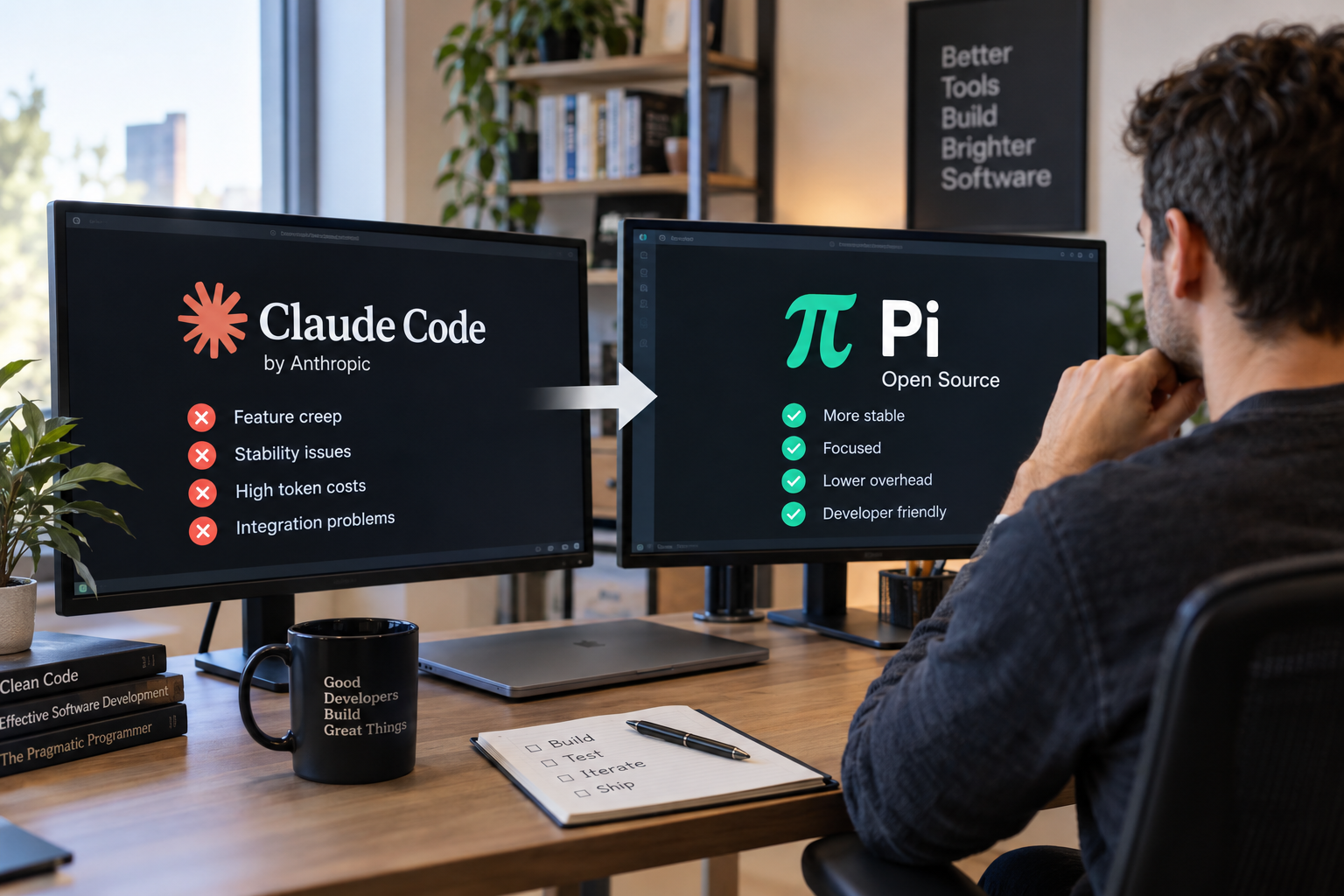
A longtime user of Anthropic's Claude Code has dropped the tool as his main coding harness and moved his development work to Pi, an open source alternative. In a blog post on his site, caleb.software, the developer described a series of small frustrations that eventually added up to a decision to leave.
Why did a longtime Claude Code user leave the tool?
He had used Claude Code since it arrived in the Claude Pro subscription plan more than a year ago, and he still remembers how impressed he was when it turned a single prompt into working Python for a weekend project. That enthusiasm faded. He said the tool's problems piled up until switching made sense.
Timing was not on Anthropic's side. A day after he made up his mind, the company announced that Claude Code would begin supporting AGENTS.md files. He said the change came too late to keep him. “Unfortunately, for me it was too little, too late,” he wrote.
The AGENTS.md issue, he said, captured the broader problem. Many of his projects already used CLAUDE.md files, and he had to copy or symlink between the two formats to keep things working. He described that as an unnecessary burden on users.
What problems did the developer have with the VS Code integration?
He also pointed to trouble with the IDE integration. He still reviews most of the code the tool generates before committing it, and he relied on Claude Code's connection to VS Code, which lets a user highlight text in a file and send it to the model as context. The problem is that only one session can stay connected to the IDE at a time. If he opened a second tab to run another task, the new session could not receive text selections from the editor. He said the issue had been reported as far back as December 2025, and was closed as a duplicate of an unrelated bug.
The official Claude Code GUI extension for VS Code supports multiple tabs, but he said it brings its own problems. Half of the built-in slash commands do not work in the GUI, and it lacks support for a custom status line. Output from subagents is layered into the main chat in chronological order, which he called hard to follow when several are running at once.
He argued that Anthropic has pushed new features into the product at a rapid clip without enough attention to quality or stability. He listed dynamic workflows, agent teams and ultrareviews as examples. In his view, those features help enterprise customers consume more tokens, but they do little for him.
Frequent updates were another sore point. He said Claude Code had 244 releases this year, and more than three-quarters of them changed the system prompt or tool descriptions. He noted that such changes can substantially alter how a model performs, especially when new instructions conflict with user prompts or repository conventions.
He also questioned the tool's overhead. Even after cutting roughly 80 percent of the system prompt, he said, Claude Code still carried far more overhead than Pi. The default Bash tool description runs to almost 3,000 tokens, much of it about using git and opening pull requests on GitHub. He argued that current models already know how to do those tasks without detailed instructions. He estimated that, at one million daily active users and 100 million requests per day, trimming 1,000 tokens could save millions of dollars a year in inference costs.
His larger complaint was about direction. He described Claude Code as a product without a clear vision, with features added quickly to suit individual workflows and little regard for how those additions affect other users. He said it appears there is no senior person whose job is to say no to requests, which he considers essential in product engineering.
He was not entirely harsh. He called Anthropic's work “a really cool piece of software” and acknowledged that coding harnesses are a new category, where being an early innovator is difficult. Later tools, he said, benefit from seeing what works and what can be cut.
What is Pi, and why did the developer choose it?
Pi, by contrast, has earned his praise for its stability, minimalist design and deep customizability. He said the first few days required some work, but the setup has run smoothly since. He wrote an extension to bring multi-tab support to Pi in about 20 minutes, and he plans to share several extensions he has built once he cleans them up. He encouraged other developers who share his frustrations to try an open source harness.
Dieser Artikel wurde mit Unterstützung von KI verfasst.
News Factory APP - agentische News für besseres SEO & AEO.