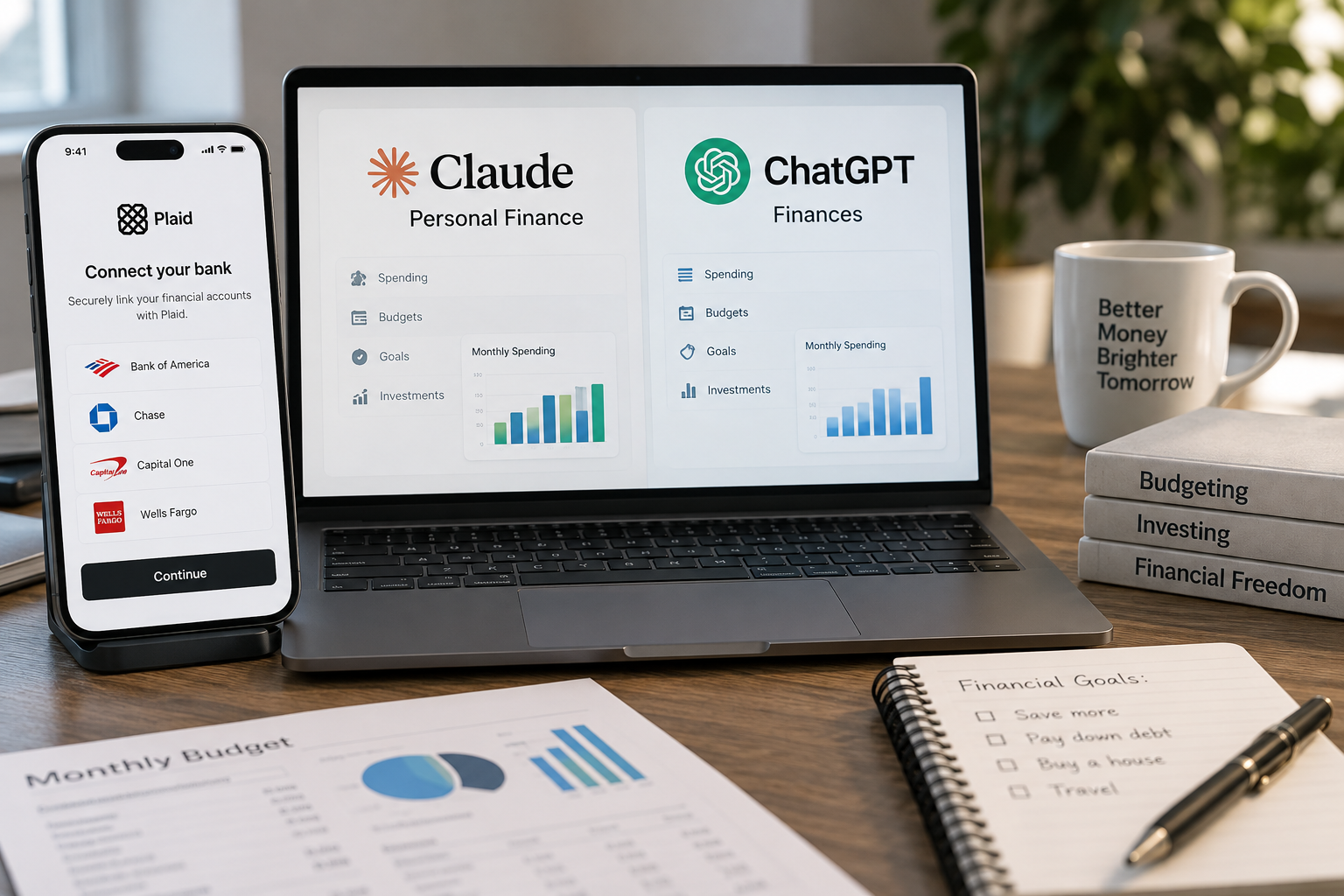
Claude Personal Finance and ChatGPT Finances both let users link bank accounts through Plaid for read-only analysis, including spending dashboards and general goal planning. They differ mainly on privacy: Anthropic says Claude Personal Finance conversations are not used for model training, while ChatGPT follows the user's training setting, which is on by default. Claude's feature has no ads.
Anthropic and OpenAI are both pitching AI chatbots as a way to get a clearer picture of your money. Anthropic's new Personal Finance feature for Claude is a direct rival to Finances, the tool OpenAI added to ChatGPT in May. Both are designed to help users understand their finances, not to act as financial advisers. The differences between them are small, but they could matter to anyone deciding where to share their bank data.
What the two tools share
The core functions overlap heavily. Both chatbots can answer general questions about financial goals, such as buying a house, planning an expensive family vacation or building a savings plan. Both can also generate dashboards that show users their monthly expenses, investments and spending habits in visual form.
How do Claude and ChatGPT handle bank account data?
To use either feature, users must link a bank account. Both companies partnered with Plaid to make those connections possible, and the link works with major financial institutions, including Bank of America, Capital One and Chase. Once connected, Claude and ChatGPT have read-only access to financial accounts. They can view the information but cannot make changes to it.
The amount of data each tool can see is spelled out in some detail. Anthropic said Claude's Personal Finance feature can see a user's bank name, account name, account type, the last four digits of the account number, balances, credit limits and up to two years of transactions. OpenAI said its Finances tool can see balances, transactions, investments and liabilities.
Where they split on privacy
Do Claude and ChatGPT use financial chats for model training?
The sharpest contrast comes down to how each company handles user data by default. Anthropic states that “when you chat with Claude in the Personal Finance hub, those conversations aren't used to train our models.” If a user unlinks a bank account, Claude will no longer see any data that was previously provided to the Personal Finance feature.
OpenAI takes a different approach. The company said “your conversations with connected financial accounts follow the same model training settings you choose across ChatGPT.” That means users who do not want their data used for training have to act on their own. They must go to Data controls in ChatGPT's settings and turn off the option called Improve the model for everyone, which is on by default.
Disconnecting accounts also works differently in practice. OpenAI said that after a user disconnects bank accounts, “your synced account data will be deleted from OpenAI's systems within 30 days.”
Does Claude Personal Finance include ads?
Advertising is another point of separation. Anthropic said its Personal Finance feature “has no ads or sponsored recommendations, and it doesn't offer credit cards, loans or savings accounts of its own.” OpenAI does not explicitly mention ads in connection with ChatGPT Finances. However, the company has been testing ads for its cheaper tiers since January.
Both companies also say they plan to expand their tools. OpenAI is working with Intuit to add features such as help with credit card applications and tax questions to ChatGPT's Finances. Anthropic, for its part, is asking banks, wealth managers and financial services companies for feedback to improve Claude's Personal Finance feature.
Dieser Artikel wurde mit Unterstützung von KI verfasst.
News Factory APP - agentische News für besseres SEO & AEO.