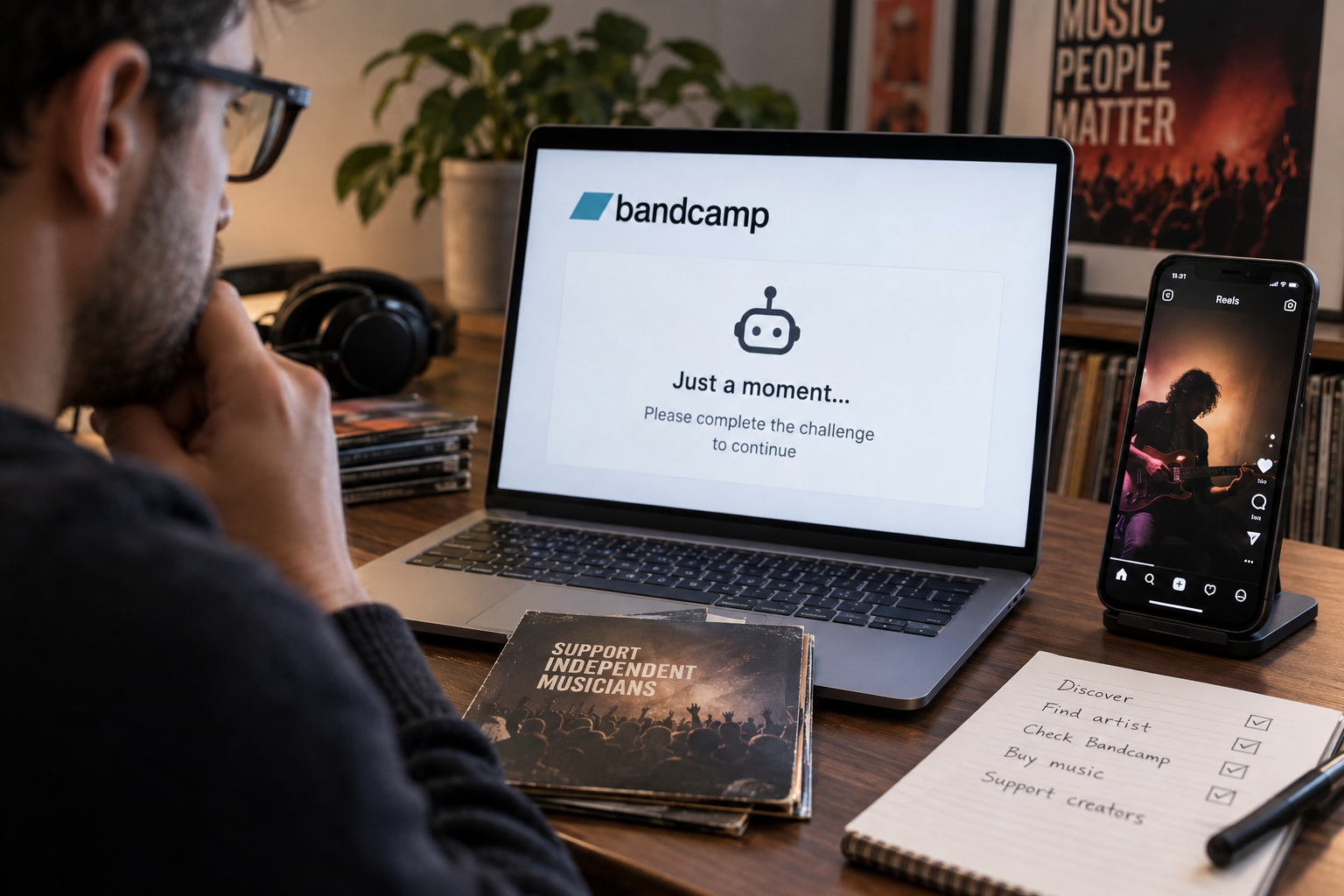
A blogger says his personal AI agent, built with Anthropic's Claude Code to buy music from independent artists, stopped working after Bandcamp added a challenge to its search API page. He says Claude refused to help him get around the barrier, and the episode has renewed debate over how much control AI companies keep over their tools.
A blogger who built a personal AI agent to buy music from independent artists says the tool broke after Bandcamp added a challenge to its search API page, and that the AI model behind it refused to help him get around the barrier. The episode, which he laid out in a long post, has become a pointed example of how much control AI companies keep over what their tools will do for the people using them.
The blogger said he used Claude Code, Anthropic’s coding tool, to build a “skill” that streamlines a habit he has in the evenings. He scrolls through Instagram reels, often while drinking, and when a song catches his ear, he wants to find the artist and buy the music. Most musicians, he said, now point fans to Spotify or TikTok, not to a store where a listener can pay for downloadable files.
His agent was designed to handle that job. It opens the reel, tries to identify the artist and song, checks whether the artist has a Bandcamp page and, if one exists, hands him the URL so he can complete the purchase. For a while, it worked.
Then it stopped. Bandcamp had added a challenge to its search API page, and the agent could no longer complete the lookup. The blogger said the workaround he had been using was never published, so he was not surprised to lose it. What caught his attention was the model’s response when he asked it to get past the challenge.
Why did Claude refuse to help with a Bandcamp workaround?
According to the post, Claude said it would not help him work around the challenge. The blogger quoted the exchange only in summary, but he framed the refusal as a preemptive one, saying the model told him it wouldn’t help before he had asked for anything beyond the lookup itself. He stressed in a note at the end of the post that he was not trying to break into Bandcamp. He said he was reacting to the model’s refusal.
The irony, in his telling, comes from another part of the same tool. The agent includes a branch that searches for the same song on YouTube and will download it to his computer if he asks. That route, he noted, sends no money to the musician or anyone else.
“So let me get this straight,” he wrote. The agent “will not attempt to work around the challenge at Bandcamp so that I can more easily connect with bands to complete a sale, but it will download the YouTube song.”
Can AI companies restrict what their tools will do?
He argues the episode points to a deeper problem. Frontier AI models, he says, work for their makers as much as they work for the people using them. He reads the Bandcamp refusal as an example of Anthropic restricting what its model will do to prevent misuse, and he says he believes the company is entitled to make that call. But he worries about where the restrictions end.
He points to two concerns. The first is commercial. He wonders whether AI answers about products, such as which robot vacuum to buy, could eventually be shaped by companies that pay for placement, rather than by what the model finds in sources such as Reddit threads or product reviews. The second is political. If a company can tell its model not to work around a technical barrier, he argues, it could also tell the model to follow government demands, including ones that limit help with downloading copyrighted music. He acknowledges that the models currently do some of that, and he says it would be easy to tighten those limits further.
Why does the blogger want to run his own AI model?
His answer is to run his own model. He said he wants a local model that operates in his home lab and works in his interest. He also said he plans to learn more about what “open models” means, noting that he initially thought of them as the free-software version of large language models but now believes the comparison does not hold. The most important factor, he said, appears to be how a model was trained. He cited Chinese models as an example, saying they are likely to refuse questions about Taiwan.
The blogger describes himself as firmly in the camp that sees AI as a tool, not a threat to humanity. He said he does not like artificial restrictions on his tools and will do what he reasonably can to remove them.
The post offers a single user’s experience, not a formal test of how these systems respond to requests. Neither Bandcamp nor Anthropic responded to the post in it, and the blogger’s account of the model’s reasoning comes from his own summary. Still, it captures a tension that many people using AI agents may eventually face: a tool built to act on a user’s behalf can end up following rules set by the company that made it.
Este artículo fue escrito con la asistencia de IA.
News Factory APP - noticias agénticas para impulsar tu SEO y AEO.