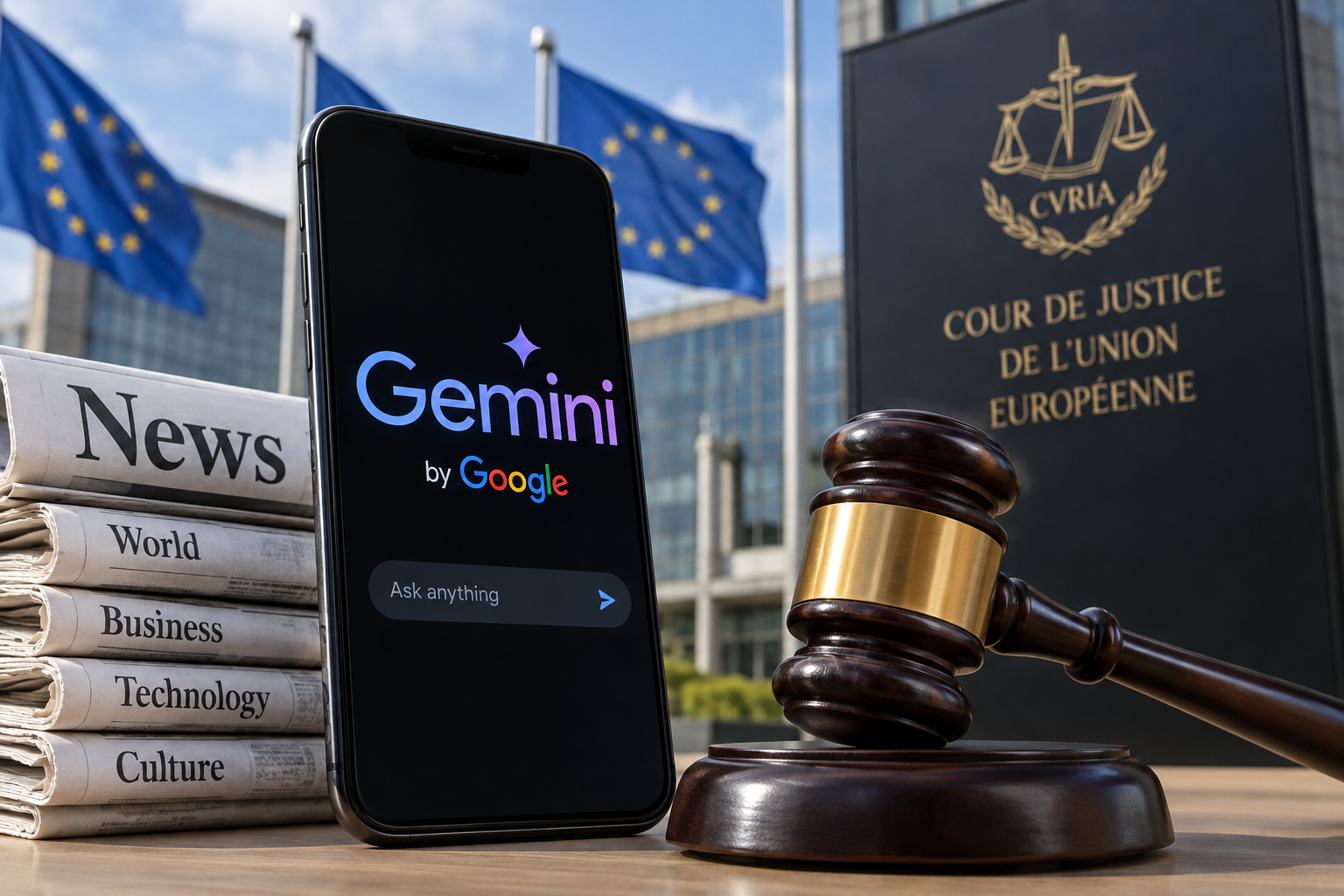
An adviser to the EU's highest court said Tuesday that Google's Gemini chatbot may violate EU copyright rules when it uses press articles to generate answers for users. Training AI models on copyrighted material is permitted, but reproducing publishers' work in chatbot responses is not necessarily so.
An adviser to the European Union’s highest court said Tuesday that Google’s Gemini chatbot may violate EU copyright rules when it uses press articles to generate answers for users.
Is training AI models on copyrighted material allowed in the EU?
The opinion, from Advocate General Maciej Szpunar, separates two activities. Training AI models on copyrighted material is permitted. Reproducing publishers’ work in the responses a chatbot gives users is a different matter.
Does Google's Gemini infringe press copyright?
Feeding copyrighted material into model training is “freely permitted under the text and data mining exception,” Szpunar wrote. The position changes when a chatbot retrieves a publisher’s article, uses it to construct an answer and presents that answer to a user. In those cases, he said, “the press publisher’s right may be infringed in certain circumstances.”
The opinion concerns case C-250/25, which the court’s proceedings describe as the first before it to examine generative AI and copyright. Hungarian news publisher Like Company sued Google Ireland after Gemini generated summaries of its articles in response to user queries. The publisher argues the chatbot reproduced its content without permission, going well beyond the use of short extracts. A Budapest court referred the questions to the EU court in April 2025.
Google has pushed back on several fronts. The company argues that Gemini does not memorize articles and that any potentially infringing outputs would fall under exceptions for temporary copies and text and data mining. It has also challenged the application of Hungarian law, arguing that Gemini was not trained in Hungary.
Szpunar also clarified that copyright does not protect the facts reported in news articles. It protects only the way those facts are expressed. That line is central to the case, because it determines how closely a chatbot’s summary can track the original wording without crossing into reproduction.
Advocate General opinions are not binding on the court, although judges follow them in most cases. A final ruling is expected in the coming months. It could clarify how AI chatbots across the EU must respect the press publishers’ right, a protection introduced under the bloc’s 2019 copyright reform.
Publishers and AI companies are already fighting over the use of copyrighted material in courtrooms on both sides of the Atlantic. The disputes range from licensing disagreements to lawsuits over web scraping. The Luxembourg case moves the focus away from the data used to train chatbots and toward what those chatbots produce for users.
Este artículo fue escrito con la asistencia de IA.
News Factory APP - noticias agénticas para impulsar tu SEO y AEO.